Executive Summary
Number plate insurance, more accurately called private plate or cherished plate insurance, protects the financial value of your registration right, not the physical plates on your vehicle. If you own a valuable private number plate purchased from the DVLA or a dealer, standard car insurance typically does not cover the loss of your registration rights if the plate is stolen, transferred fraudulently, or affected by administrative errors.
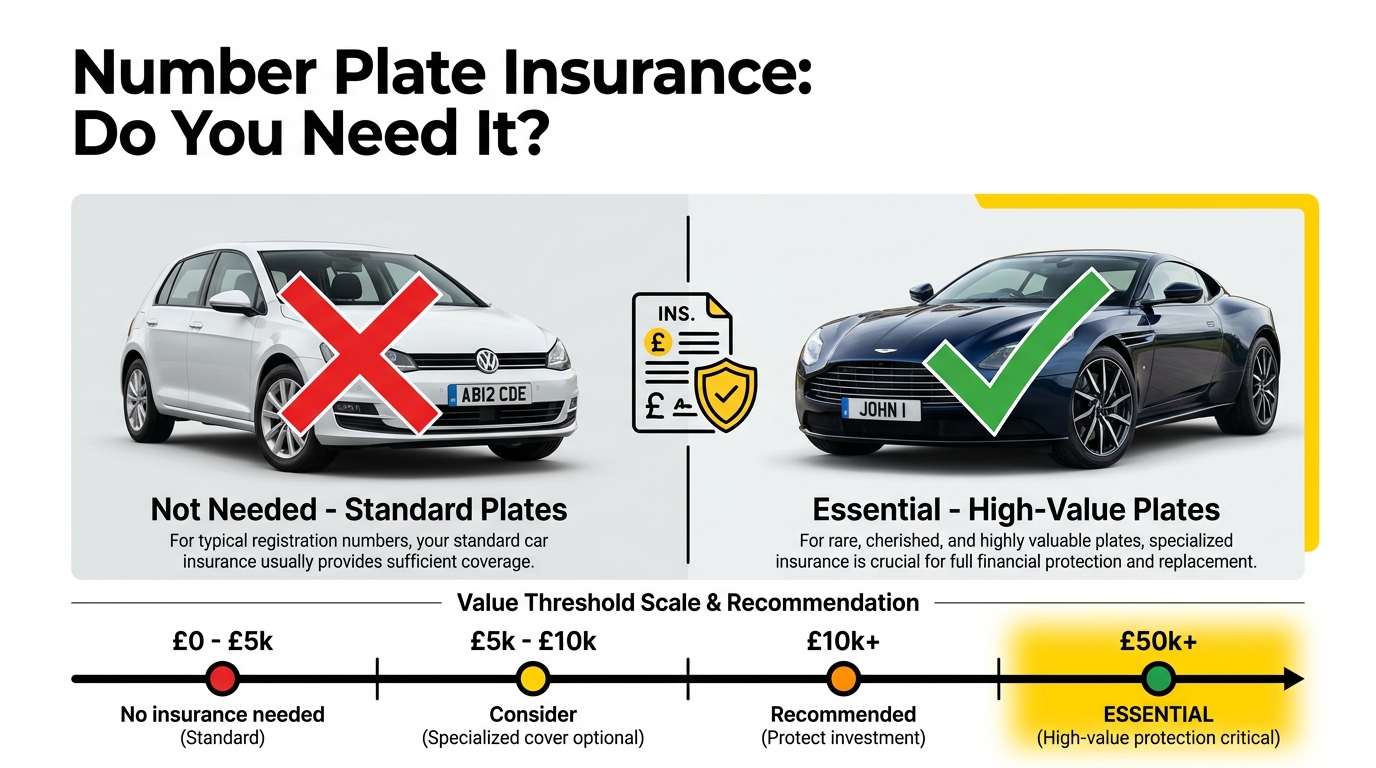
For high-value plates worth thousands or tens of thousands of pounds, specialist number plate insurance provides essential protection that standard comprehensive policies exclude. This coverage safeguards your investment during DVLA transfer processes, retention periods, and against cloning or fraudulent use. For standard registrations or low-value private plates, however, the additional premium may not justify the cost.
As a DVLA-registered manufacturer (RNPS ID: 73132), we regularly handle physical plate replacements for stolen plates, but protecting the registration right itself requires separate insurance coverage. This guide explains when number plate insurance is necessary, what it covers, how it differs from standard car insurance, and whether your valuable registration deserves specialist protection.
Understanding Number Plate Insurance: What It Actually Covers
The Critical Distinction: Physical Plates vs Registration Rights
When discussing “number plate insurance,” it is essential to understand two completely different types of coverage.
1. Physical Plate Coverage
This covers the actual metal or acrylic plates attached to your vehicle. If someone steals your physical plates, comprehensive car insurance may cover the replacement costs (subject to your excess). This is relatively straightforward, as the plates are vehicle accessories worth £25 to £100. For a full breakdown of what to do in that situation, see our guide on what happens if your number plate is stolen.
2. Registration Right Protection
This protects the legal right to use a specific registration number, which can be worth thousands or even millions of pounds. Private plates (also called cherished plates or personalised registrations) are assets that can be:
- Bought and sold independently of vehicles
- Retained on V778 certificates when not assigned
- Transferred between vehicles
- Passed to family members or beneficiaries
The registration right itself is the valuable asset, not the physical plates.
What Standard Car Insurance Covers (and Does Not Cover)
Typically Covered:
- Physical damage to plates in accidents
- Theft of physical plates (comprehensive policies only, subject to excess)
- Vandalism damage to plates
Typically NOT Covered:
- Loss of registration rights through administrative error
- Fraudulent transfer of your private plate
- Costs associated with recovering stolen registration rights
- Depreciation in plate value
- Legal fees to prove ownership of the registration
- Loss of use during DVLA processing delays
This gap in coverage is where specialist number plate insurance becomes valuable for high-value registrations.
What Specialist Number Plate Insurance Covers
Specialist private plate insurance policies typically include the following.
Registration Right Protection:
- Coverage for the market value of your registration
- Protection against fraudulent transfers
- Coverage if the DVLA makes an administrative error
- Legal expenses to recover registration rights
- Compensation if your plate is cloned and used in crimes
Transfer and Retention Coverage:
- Protection during V750/V778 transfer processes
- Coverage while plates are on retention
- Administrative cost reimbursement
- Expedited processing fees if delays occur
Additional Benefits:
- Agreed value coverage (you and the insurer agree on the plate’s worth)
- New-for-old replacement if the registration is lost
- Legal assistance for ownership disputes
- Coverage for multiple plates under one policy
Who Actually Needs Number Plate Insurance?
High-Value Plate Owners
If your private plate meets any of these criteria, specialist insurance is worth serious consideration.
Value Thresholds:
- Plates worth over £5,000 (minimum threshold for consideration)
- Plates worth over £10,000 (strongly recommended)
- Plates worth over £50,000 (essential protection)
- Plates worth over £100,000 (absolutely critical)
If you’re weighing up a purchase, our guide on how to buy personalised number plates in the UK explains how plates are valued.
Examples of High-Value Registrations:
- Single or double character plates (e.g., “A 1”, “F 1”)
- Popular names (e.g., “JOHN”, “SARAH”, “JAMES”)
- Desirable words (e.g., “LOVE”, “COOL”, “FAST”)
- Low-number combinations (e.g., “100”, “500”)
- Dateless registrations with broad appeal
Situations Requiring Enhanced Protection
Frequent Transfers:
If you regularly move your private plate between vehicles, each transfer creates administrative risk. DVLA processing errors, while rare, can result in temporary or permanent loss of registration rights.
Retention Periods:
When plates are on V778 retention certificates (not assigned to a vehicle), they remain valuable assets but lack the protection of being linked to an insured vehicle. Specialist policies cover retained plates.
Business or Commercial Use:
If you use your private plate for business purposes, branding, or company vehicles, the commercial value may exceed the personal use value, warranting higher coverage levels.
Inheritance or Family Assets:
Plates passed down through families or intended as inheritance should be protected against loss, ensuring they can be transferred to beneficiaries without complications.
When Number Plate Insurance Is NOT Necessary
Standard Registrations:
If your vehicle has its original, age-appropriate registration with no special value, insurance is unnecessary. The registration has no independent market value.
Low-Value Private Plates:
Plates purchased for £250 to £500 with limited resale appeal typically do not justify annual insurance premiums of £50 to £150.
Short-Term Ownership:
If you plan to sell or transfer the plate within months, the insurance premium may exceed the risk exposure period.
Already Covered:
Some high-end classic car insurance policies or collector vehicle policies include private plate coverage as standard, so verify this before purchasing duplicate coverage.
How Private Plate Insurance Works
Valuation Methods
Agreed Value Policies:
You and the insurer agree on the plate’s worth when purchasing the policy. This provides certainty but requires an accurate valuation upfront.
Market Value Policies:
Coverage reflects the current market value at the time of loss. This can fluctuate with private plate market trends and may result in lower payouts if values decline.
New-for-Old Replacement:
Some policies offer to replace your lost registration with an equivalent-value plate rather than cash compensation.
The Claims Process
If your registration right is lost, stolen, or compromised:
- Immediate Notification: Contact your insurer within 24 to 48 hours of discovering the issue
- DVLA Reporting: File the appropriate forms with the DVLA (V62 for lost certificates, fraud reports if applicable)
- Police Report: If fraud or theft is suspected, obtain a crime reference number
- Documentation: Provide V750/V778 certificates, purchase receipts, and valuation evidence
- Assessment: The insurer investigates and assesses the claim’s validity
- Settlement: Agreed value payment or replacement registration provision
Typical timeline: 4 to 12 weeks, depending on DVLA processing and investigation complexity.
Premium Costs and Factors
Typical Annual Premiums:
- Plates valued £5,000 to £10,000: £50 to £100
- Plates valued £10,000 to £25,000: £100 to £250
- Plates valued £25,000 to £50,000: £250 to £500
- Plates valued £50,000+: £500 to £2,000+
Factors Affecting Premiums:
- Agreed plate value
- Transfer frequency
- Retention status (on a vehicle vs on a certificate)
- Security measures (locked storage of documents)
- Claims history
- Policy excess level
Protecting Your Investment: Beyond Insurance
DVLA Retention and Transfer Security
V778 Retention Documents:
When plates are not assigned to a vehicle, they exist on V778 retention certificates. These documents are critical, so treat them like valuable assets:
- Store originals in a fireproof safe or bank safety deposit box
- Keep digital copies in secure cloud storage
- Never carry the original V778 unless you are actively transferring
- Use recorded delivery for any DVLA correspondence
If you’re unclear on how these documents differ, our guide comparing the V5C, V750, and V778 explains what each one does and when you’ll need it.
V750 Certificates of Entitlement:
For newly purchased plates not yet assigned, V750 certificates require similar protection. These expire after specific periods and must be renewed or extended.
Preventing Fraudulent Transfers
DVLA Security Measures:
The DVLA has implemented safeguards, but you should also:
- Register for DVLA online services to monitor your registration status
- Set up alerts for any transfer attempts
- Verify that your contact details are current with the DVLA
- Use strong passwords for DVLA online accounts
- Never share V5C, V750, or V778 details via email
Red Flags to Monitor:
- Unexpected DVLA correspondence about transfers
- A V5C logbook arriving with a different registration
- Online account access attempts you did not initiate
- Requests for your registration documents from unknown parties
Physical Security for Valuable Plates
While insurance covers registration rights, preventing physical plate theft remains important.
Anti-Theft Measures:
- Use one-way security screws (our number plate fitting guide explains how)
- Install locking number plate holders
- Apply tamper-evident seals
- Park in well-lit, CCTV-covered areas
- Consider GPS trackers for high-value vehicles with desirable plates
Documentation:
- Photograph plates with date stamps
- Record plate numbers and vehicle assignments
- Keep purchase receipts and valuation certificates
- Maintain a transfer history log
Alternatives to Specialist Number Plate Insurance
Enhanced Comprehensive Car Insurance
Some insurers offer add-ons or enhanced policies that include private plate coverage.
Advantages:
- A single policy for both vehicle and plate
- Potentially lower cost than separate policies
- A simplified claims process
Disadvantages:
- Coverage limits may be lower than specialist policies
- May not cover retention periods
- Less flexibility in agreed values
Action: Request quotes from your current insurer before purchasing standalone plate insurance.
Self-Insurance for Moderate-Value Plates
For plates worth £2,000 to £10,000, consider the following.
Cost-Benefit Analysis:
- Annual premium: £50 to £150
- Over 10 years: £500 to £1,500 in premiums
- Probability of loss: Low (DVLA errors are rare)
- Risk tolerance: Can you absorb a £5,000 loss?
Middle Ground Approach:
- Implement strict document security
- Monitor your DVLA account regularly
- Accept the risk for plates under £5,000
- Insure only plates above the £10,000 threshold
Classic Car and Collector Vehicle Policies
If your private plate is on a classic or collector vehicle, some specialist insurers may already cover it.
Specialist Classic Car Insurers:
Many understand the value of matching number plates and period-correct registrations. Examples include:
- Hagerty
- Adrian Flux
- Lancaster Insurance
- Footman James
Typical Coverage:
- Agreed value for the vehicle including the plate
- Coverage for retention transfers
- An understanding of registration importance
- Sometimes includes spare parts and memorabilia
For more on choosing the right registration in the first place, our guide on how to buy personalised number plates in the UK is a useful starting point.
Practical Takeaways
Do You Need Number Plate Insurance?
YES, purchase specialist insurance if:
✅ Your plate is worth over £10,000
✅ You frequently transfer it between vehicles
✅ The plate is on long-term retention (V778)
✅ It is a family heirloom or intended inheritance
✅ You use it for business or commercial purposes
✅ You cannot afford to replace it if lost
NO, insurance is likely unnecessary if:
❌ The plate value is under £5,000
❌ It is your vehicle’s original registration
❌ You purchased it for under £500 with limited resale appeal
❌ Your classic car policy already covers it
❌ You plan to sell within 12 months
Essential Protection Steps (With or Without Insurance)
Immediate Actions:
- Verify your current DVLA registration status online
- Locate and secure your V750/V778 documents
- Photograph all certificates and store them digitally
- Set up DVLA online account monitoring
- Check your car insurance policy for existing coverage
Ongoing Maintenance:
- Review the plate value annually (market fluctuations)
- Update insurance coverage if the value increases
- Renew retention certificates before they expire
- Monitor for fraud attempts
- Keep your contact details current with the DVLA
How Plate-Maker Supports Plate Owners
As a DVLA-registered manufacturer (RNPS ID: 73132), we support private plate owners through our physical plate services.
Physical Plate Services:
- BS AU 145e compliant replacement plates
- Same-day collection for urgent replacements
- Premium styles (3D gel, 4D laser, and 5D) for valuable vehicles
- Document verification to prevent cloning
What We Don’t Do:
- We do not sell or trade registration rights
- We do not provide insurance products
- We do not handle DVLA transfers
For registration transfers, always use official DVLA channels or authorised dealers. For physical plates, visit our Ilford workshop with your V5C or V778 to create compliant plates matching your valuable registration. See our same-day collection service in Ilford for urgent replacement needs.
Next Steps
- Assess your plate’s value: Research current market prices for similar registrations
- Review existing coverage: Check your car insurance and classic car policies
- Get quotes: Contact specialist insurers if your plate is worth £10,000+
- Secure documents: Implement V750/V778 storage protocols
- Order quality plates: Ensure your physical plates reflect your registration’s value
For high-value plates, the physical presentation matters. Our premium 4D laser-cut number plates provide the quality finish that matches your registration’s worth, while maintaining full BS AU 145e compliance.
Frequently Asked Questions
What is the difference between number plate insurance and car insurance?
Number plate insurance protects the financial value of your registration right, the legal entitlement to use a specific number, which can be worth thousands of pounds. Standard car insurance covers physical damage to plates as vehicle accessories but excludes loss of registration rights, fraudulent transfers, or DVLA administrative errors. High-value private plates need both types of coverage for complete protection.
How much does private plate insurance cost?
Specialist number plate insurance typically costs 1 to 2% of the plate’s insured value annually. Plates worth £5,000 to £10,000 cost £50 to £100 per year to insure, while plates valued £10,000 to £50,000 range from £100 to £500 annually. Premiums depend on the agreed value, transfer frequency, retention status, and security measures. Some classic car policies include plate coverage at no additional cost.
Do I need insurance for my private number plate?
Insurance is recommended if your private plate is worth over £10,000, frequently transferred between vehicles, held on V778 retention, or serving as a family asset. Standard registrations or plates worth under £5,000 typically do not justify the premiums. Check your existing car insurance first, as some comprehensive or classic car policies include limited plate coverage.
What happens if my private plate is stolen or transferred fraudulently?
Report suspected fraud to police immediately and obtain a crime reference number. Contact the DVLA on 0300 790 6802 to freeze transfers and investigate. If you have specialist plate insurance, notify your insurer within 24 to 48 hours. Recovery can take 4 to 12 weeks and may require legal documentation proving ownership. Without insurance, you bear all costs and may lose the registration permanently if the DVLA cannot reverse the transfer.
Can I insure a number plate on retention (V778 certificate)?
Yes, specialist insurers cover plates on V778 retention certificates, which is actually when coverage is most critical, since the plate is not attached to an insured vehicle. Retention periods can last up to 10 years (renewable), during which the registration remains a valuable asset requiring protection. Make sure your policy explicitly covers retention status and specify the V778 certificate number when purchasing coverage.
Does comprehensive car insurance cover stolen number plates?
Comprehensive car insurance typically covers physical plate theft, the actual metal or acrylic plates, subject to your policy excess. However, it does not cover the registration right itself if someone fraudulently transfers your private plate or if the DVLA makes an administrative error. For valuable registrations, you need separate specialist number plate insurance to protect the asset value beyond the physical plates’ replacement cost.
Conclusion
Number plate insurance is not necessary for every driver, but for owners of valuable private registrations, it provides essential protection that standard car insurance excludes. The key is understanding what you are insuring: not the £50 physical plates on your vehicle, but potentially the £50,000 registration right that could be lost through fraud, error, or administrative failure.
If your private plate is worth over £10,000, frequently transferred, or held as a family asset, specialist insurance is a prudent investment costing 1 to 2% of its value annually. For standard registrations or low-value plates, focus instead on document security, DVLA monitoring, and quality physical plates that reflect your vehicle’s presentation.
At Private Number Plate Maker Ltd, we manufacture BS AU 145e compliant plates for registrations of all values. Whether you have a cherished plate worth six figures or a standard registration, we ensure your physical plates meet legal requirements and present your vehicle professionally. Visit our Ilford workshop with your V5C or V778 documents for same-day service.
You can design your replacement plates online to match your registration’s value, or contact our team at 020-3576-6603 for advice on premium plate styles for high-value vehicles.
Leave a Reply