Category: Uncategorized

  • How ANPR Cameras Really Work: From Pixel to Prosecution

    How ANPR Cameras Really Work: From Pixel to Prosecution

    Executive Summary

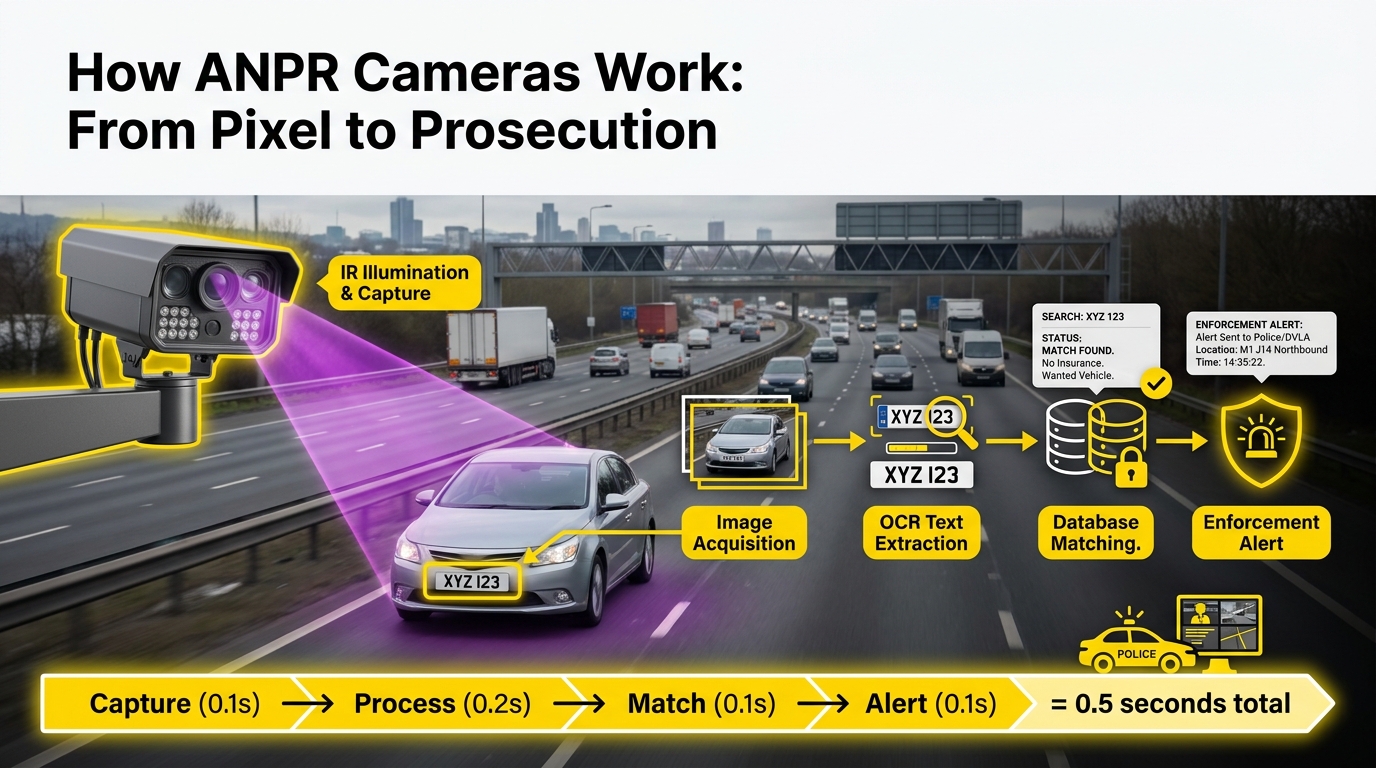
    ANPR (Automatic Number Plate Recognition) cameras use infrared illumination, optical character recognition (OCR), and database matching to automatically read vehicle registration numbers at speeds of over 100 mph, processing thousands of vehicles daily with 90 to 95% accuracy. The technology captures multiple images per second, isolates the number plate region, converts characters to digital text, and instantly checks against databases containing millions of records, all within 300 to 500 milliseconds.

    For UK drivers, ANPR readability depends entirely on having BS AU 145e:2018 compliant number plates with correct reflectivity, the proper Charles Wright font, and accurate character spacing. Non-compliant plates, including those with incorrect fonts, poor reflectivity, or illegal modifications, fail ANPR detection. This results in missed enforcement, potential police stops, and fines of up to £1,000 under the Road Vehicles (Display of Registration Marks) Regulations 2001.

    As a DVLA-registered manufacturer (RNPS ID: 73132), we produce every plate using BS AU 145e certified materials specifically tested for ANPR compatibility, including near-infrared (NIR) reflectivity that allows cameras to read plates in total darkness, rain, and at high speeds. This guide explains the complete ANPR process from image capture to enforcement, why plate compliance matters, and how to ensure your vehicle remains readable by the UK’s 10,000+ ANPR cameras.

    What is ANPR? Understanding the Technology

    Plain English Overview

    ANPR (Automatic Number Plate Recognition), also called ALPR (Automatic License Plate Recognition) in some countries, is a surveillance technology that automatically reads vehicle registration numbers without human intervention. The system combines specialised cameras, infrared lighting, and computer software to:

    • Detect vehicles entering the camera’s field of view
    • Capture high-speed images of the number plate
    • Extract the registration number as text
    • Check against databases (stolen vehicles, untaxed, no MOT, etc.)
    • Alert authorities or record the sighting

    The entire process takes less than half a second, faster than a human blink.

    Scale of ANPR in the UK

    The UK operates one of the world’s largest ANPR networks:

    • 10,000+ fixed and mobile ANPR cameras across the UK (National ANPR Service)
    • 100+ million reads per day on average
    • The National ANPR Data Centre processes all readings
    • Integration with police forces, DVLA, DVSA, and local authorities
    • 24/7 operation regardless of weather or lighting conditions

    For a full breakdown of the penalties involved, see our guide on number plate fines in the UK.

    Historical Development

    ANPR technology evolved through several generations:

    • 1970s to 1980s: Early development by the UK Police Scientific Development Branch
    • 1990s: First operational deployments for stolen vehicle detection
    • 2000s: Integration with road tax and MOT databases
    • 2010s: Near-infrared (NIR) compatibility requirements introduced
    • 2018: BS AU 145e:2018 standard mandated enhanced ANPR readability
    • 2020s: AI-powered recognition with 95%+ accuracy rates

    The Technology: How ANPR Actually Works

    Step 1: Image Capture

    Camera Specifications:

    ANPR cameras differ significantly from standard CCTV:

    • Shutter speed: 1/1000 to 1/10000 second (freezes motion at over 100 mph)
    • Frame rate: 25 to 60 frames per second
    • Resolution: 1 to 5 megapixels (optimised for the plate region, not the overall image)
    • Dynamic range: High dynamic range (HDR) to handle varying lighting
    • Wavelength sensitivity: Visible light (400 to 700nm) plus near-infrared (700 to 1000nm)

    Positioning:

    Cameras are strategically placed to optimise capture:

    • Fixed gantries: Motorways, major roads (permanent installation)
    • Mobile units: Police vehicles, temporary enforcement zones
    • Entry/exit points: Car parks, congestion charge zones, toll booths
    • Angle: Typically 0 to 30 degrees from perpendicular to the plate
    • Height: 2 to 5 metres above the road surface

    Step 2: Infrared Illumination

    Why Infrared Matters:

    ANPR cameras use near-infrared (NIR) light for several critical reasons.

    1. Consistent Illumination:

    • Works in total darkness without visible light pollution
    • Unaffected by headlights, streetlights, or weather conditions
    • Provides uniform lighting across the plate surface

    2. Reflective Plate Response:

    • BS AU 145e plates use retroreflective sheeting designed for NIR wavelengths
    • White/yellow backgrounds reflect NIR light strongly (they appear bright)
    • Black characters absorb NIR light (they appear dark)
    • Creates maximum contrast for character recognition

    3. Wavelength Specificity:

    • Typical ANPR systems use a 730 to 950nm wavelength
    • This range optimises plate reflectivity while minimising environmental interference
    • Invisible to the human eye (no distracting flashes)

    Technical Specification:

    • Infrared LEDs emit light at specific wavelengths (commonly 850nm or 940nm)
    • Pulsed illumination synchronised with the camera shutter
    • Intensity: 10 to 100 watts depending on range requirements
    • Beam pattern focused on the plate region only

    Step 3: Plate Detection and Isolation

    Finding the Plate:

    Before reading characters, the system must locate the plate within the image.

    Algorithm Process:

    Edge Detection:

    • Software identifies rectangular shapes matching plate dimensions
    • UK plates: 520mm x 111mm (front/rear standard size)
    • Aspect ratio analysis filters out non-plate objects

    Contrast Analysis:

    • Searches for high-contrast regions (dark characters on a light background)
    • The reflective background creates a distinctive brightness signature
    • Eliminates false positives (grilles, badges, stickers)

    Geometric Verification:

    • Checks for correct character spacing (11mm for cars)
    • Verifies character height (79mm for cars, 64mm for motorcycles)
    • Confirms plate position relative to the vehicle

    Region of Interest (ROI) Extraction:

    • Crops the image to the plate area only
    • Reduces the processing load for the OCR stage
    • Typical ROI: 200×80 pixels from the full image

    Processing time: 50 to 100 milliseconds.

    Step 4: Character Segmentation

    Isolating Individual Characters:

    Once the plate region is identified, each character must be separated.

    Segmentation Techniques:

    Thresholding:

    • Converts the greyscale image to pure black and white
    • Pixels above the brightness threshold = white (background)
    • Pixels below the threshold = black (characters)
    • Adaptive thresholding handles varying lighting

    Morphological Operations:

    • Removes noise (dirt, scratches, reflections)
    • Fills gaps in characters
    • Separates touching characters

    Character Boundary Detection:

    • Identifies individual character boundaries
    • Measures spacing between characters (should be 11mm)
    • Handles multi-line plates (motorcycles, imported vehicles)

    Normalization:

    • Scales all characters to a standard size
    • Corrects for perspective distortion
    • Adjusts for camera angle variations

    Challenges:

    • Dirty or obscured plates
    • Damaged characters
    • Non-standard fonts (illegal plates)
    • Extreme camera angles
    • Motion blur at high speeds

    Processing time: 30 to 50 milliseconds.

    Step 5: Optical Character Recognition (OCR)

    Converting Images to Text:

    OCR is the core technology that translates character images into alphanumeric text.

    Modern ANPR OCR Methods:

    1. Feature Extraction:

    • Analyses character shape characteristics
    • Identifies curves, lines, angles, and intersections
    • Creates a mathematical representation of each character
    • Example: “A” has 3 lines meeting at specific angles

    2. Pattern Matching:

    • Compares extracted features against a character database
    • Contains thousands of variations for each character (0 to 9, A to Z)
    • Accounts for font variations, damage, and partial occlusion
    • Uses statistical models for probability matching

    3. Neural Networks (Modern Systems):

    • Deep learning convolutional neural networks (CNNs)
    • Trained on millions of plate images
    • Self-learning improves accuracy over time
    • Handles edge cases better than traditional methods
    • Accuracy: 95 to 98% in optimal conditions

    4. Contextual Validation:

    • Checks if the result matches UK registration formats
    • Validates against known patterns (e.g., AB51 CDE)
    • Rejects impossible combinations
    • Cross-references with a dictionary of valid registrations

    UK Registration Format Checking:

    The system validates against DVLA registration formats:

    • Current style (2001 to present): AA## AAA (e.g., AB51 CDE)
    • Prefix style (1983 to 2001): A### AAA (e.g., A123 BCD)
    • Suffix style (1963 to 1983): AAA ###A (e.g., ABC 123D)
    • Dateless: Up to 3 letters plus up to 3 numbers (e.g., ABC 123)
    • Northern Ireland: Same formats but includes I and Z characters

    Processing time: 100 to 200 milliseconds.

    Step 6: Database Matching and Action

    What Happens After Reading:

    Once the registration is extracted, the system performs instant database checks.

    Real-Time Checks:

    Police National Computer (PNC):

    • Stolen vehicles
    • Vehicles linked to serious crimes
    • AMBER alerts (child abduction)
    • Wanted persons associated with the vehicle

    DVLA Database:

    • Vehicle tax status (untaxed vehicles)
    • MOT status (no valid MOT)
    • Insurance status (via the Motor Insurance Database)
    • Registered keeper details

    Local Databases:

    • Congestion charge payment (London)
    • ULEZ compliance (London, Birmingham, etc.)
    • Parking permits
    • Toll payment

    Watchlists:

    • Vehicles of interest to specific investigations
    • Known offender vehicles
    • Intelligence-led policing targets

    Response Actions:

    Immediate Alert (Real-Time):

    • Police vehicle-mounted ANPR: Audible/visual alert to the officer
    • Fixed camera with police link: Dispatch to the nearest unit
    • Priority: Stolen vehicle, wanted person, serious crime link

    Automated Enforcement:

    • Untaxed vehicle: Automatic £100 fine by post
    • No MOT: £100 fixed penalty
    • No insurance: £200 fixed penalty plus 6 to 8 points
    • Congestion charge violation: £160 penalty (reduced to £80 if paid within 14 days)

    Data Logging:

    • All reads stored in the National ANPR Data Centre
    • Retention period: Typically 1 to 2 years (varies by purpose)
    • Used for pattern analysis, investigations, and intelligence

    Processing time: 50 to 150 milliseconds.
    Total system time: 300 to 500 milliseconds from vehicle entry to action.

    The Journey: From Camera to Prosecution

    Real-World Example 1: Speed Enforcement

    Scenario: A vehicle exceeds the speed limit on an A-road with average speed cameras.

    Timeline:

    00:00:00 – Vehicle enters ANPR zone at Camera A

    • Camera captures plate: AB51 CDE
    • Timestamp: 14:23:15.000
    • GPS location: Mile marker 23.5

    00:00:01 – ANPR software processes the image

    • Plate read: AB51 CDE (98% confidence)
    • Vehicle class: Car (based on plate size/position)
    • Data transmitted to the central server

    00:00:02 – Database check

    • Registration valid: Yes
    • Vehicle tax: Current
    • MOT: Valid
    • Insurance: Confirmed
    • No alerts, routine read logged

    00:15:00 – Same vehicle reaches Camera B (10 miles away)

    • Timestamp: 14:38:15.000
    • Travel time: 15 minutes
    • Distance: 10 miles
    • Average speed: 40 mph
    • Speed limit: 30 mph
    • Violation detected

    00:15:01 – Automated enforcement triggered

    • System calculates: 40 mph in a 30 mph zone (33% over the limit)
    • Threshold exceeded (typically 10% plus 2 mph = 35 mph threshold)
    • Case created in the enforcement system

    00:15:02 – Evidence package compiled

    • Image from Camera A (entry)
    • Image from Camera B (exit)
    • Timestamps and locations
    • Calculated speed
    • Registration details from DVLA

    00:15:05 – Human verification

    • Trained operator reviews the images
    • Confirms plate readability
    • Verifies vehicle identity
    • Approves enforcement action

    Day +14 – Notice of Intended Prosecution (NIP) issued

    • Sent to the registered keeper’s address
    • Includes: Images, speed, location, date/time
    • Requires: Driver identification within 28 days

    Day +28 – Response received

    • Keeper identifies the driver
    • Fixed Penalty Notice issued: £100 plus 3 points
    • Or a court summons if contested

    Total processing time: 2 to 4 weeks from violation to NIP.

    Real-World Example 2: Stolen Vehicle Detection

    Scenario: A stolen vehicle passes a police ANPR camera.

    Timeline:

    00:00:00 – Vehicle reported stolen

    • Owner calls 999
    • Registration: XY12 ABC
    • Vehicle: Black BMW 3 Series
    • Stolen from: Manchester, M1 1AA
    • Time: 02:15

    00:00:05 – Vehicle entered on PNC

    • Police National Computer updated
    • Flag: STOLEN VEHICLE
    • Priority: HIGH
    • Alert to all ANPR systems nationwide

    00:45:00 – Vehicle passes ANPR camera in Birmingham

    • Distance from theft: 85 miles
    • Camera: Fixed gantry on the M6
    • Time: 03:00

    00:45:00.300 – ANPR reads the plate

    • Registration: XY12 ABC
    • Confidence: 96%
    • Immediate PNC check initiated

    00:45:00.500 – Match found

    • Status: STOLEN
    • Alert generated instantly

    00:45:01 – Police alert

    • Nearest patrol vehicle notified
    • Location: M6 southbound, junction 6
    • Vehicle description: Black BMW 3 Series
    • Warning: Stolen, high risk

    00:45:02 – Officer response

    • Officer acknowledges the alert
    • Positions for intercept
    • Requests backup

    00:47:00 – Vehicle intercepted

    • Safe stop performed
    • Driver arrested
    • Vehicle recovered

    Total time from read to arrest: 2 minutes.

    Real-World Example 3: ULEZ/Congestion Charge Enforcement

    Scenario: A non-compliant vehicle enters the London ULEZ zone.

    Timeline:

    00:00:00 – Vehicle enters ULEZ boundary

    • ANPR camera at the entry point
    • Registration: AB12 CDE
    • Vehicle: 2015 Diesel Ford Focus
    • Euro standard: Euro 5 (non-compliant)

    00:00:00.400 – Plate read and database check

    • DVLA lookup: 2015 Ford Focus Diesel
    • Emissions database: Euro 5
    • ULEZ standard: Euro 6 required for diesel
    • Non-compliant identified

    00:00:01 – Payment database check

    • Checks if the daily charge (£12.50) was paid
    • Payment status: NOT PAID
    • Violation recorded

    00:00:02 – Data logged

    • Entry time: 08:15:23
    • Location: ULEZ boundary point
    • Vehicle details stored
    • Evidence image saved

    Day +1 – Automated processing

    • System compiles violation data
    • Registered keeper details from DVLA
    • PCN (Penalty Charge Notice) generated

    Day +3 – PCN issued by post

    • Sent to the keeper’s address
    • Penalty: £160 (reduced to £80 if paid within 14 days)
    • Includes: Images, date/time, location, vehicle details
    • Payment instructions and appeal process

    Day +28 – If unpaid

    • Penalty increases to £160
    • Enforcement action begins
    • Possible: Debt collection, court action

    Why BS AU 145e Compliance Matters for ANPR

    The Reflectivity Requirement

    BS AU 145e:2018 Standard:

    The British Standard specifies exact reflectivity requirements that directly impact ANPR performance.

    Luminance Coefficient (Reflectivity):

    • White background: Minimum 300 to 400 cd/lx/m²
    • Yellow background: Minimum 200 to 300 cd/lx/m²
    • Black characters: Maximum 10 to 15 cd/lx/m² (must absorb light)
    • Contrast ratio: Minimum 20:1 between background and characters

    Why This Matters:

    1. Infrared Response:

    • Reflective sheeting must reflect NIR light (700 to 1000nm wavelength)
    • Non-compliant plates may reflect visible light but fail in the NIR spectrum
    • ANPR cameras primarily use NIR illumination
    • Poor NIR reflectivity = unreadable plates

    2. Consistency:

    • BS AU 145e ensures all legal plates have similar reflectivity
    • ANPR systems are calibrated for a standard reflectivity range
    • Too dim: Plate invisible to the camera
    • Too bright: Character detail lost in glare

    3. Weather Resistance:

    Reflectivity must be maintained after:

    • 2+ years of UV exposure
    • Salt spray (coastal/winter road conditions)
    • Temperature cycling (-20°C to +50°C)
    • High-pressure washing

    Non-compliant plates fade, delaminate, or lose reflectivity. Our guide on what makes a number plate legal under BS AU 145e covers the detailed standard requirements.

    Character Spacing and Font Requirements

    Charles Wright Font:

    Mandatory since 2001 under the Road Vehicles (Display of Registration Marks) Regulations 2001.

    Technical Specifications:

    • Character height: 79mm (cars), 64mm (motorcycles)
    • Character width: 50mm (except ‘1’ and ‘I’, which are narrower)
    • Stroke thickness: 14mm
    • Character spacing: 11mm between characters
    • Line spacing: 11mm (for two-line plates)
    • Margins: 11mm minimum on all sides

    Our guide on the Charles Wright font and why it’s mandatory explains these specifications in more detail.

    Why Exact Spacing Matters:

    1. Segmentation Accuracy:

    • ANPR algorithms expect specific spacing patterns
    • Incorrect spacing confuses character separation
    • 11mm spacing creates predictable character boundaries
    • Tighter spacing: Characters merge together
    • Wider spacing: The system may read them as separate plates

    2. Format Validation:

    • The system checks if the read matches known registration formats
    • Correct spacing ensures an accurate character count
    • Prevents false reads (e.g., “AB 51CDE” vs “AB51 CDE”)

    3. Perspective Correction:

    • Software corrects for camera angle using known dimensions
    • Standard spacing provides reference points
    • Non-standard spacing reduces correction accuracy

    Common Font Violations:

    Illegal Fonts:

    • “VIP” style (elongated characters)
    • “Carbon” style (italicised)
    • “Ghost” plates with gradient effects affecting contrast
    • Custom fonts for “styling”

    Impact on ANPR:

    • Read failure rates increase from 5% to 40%+
    • Misreads are common (e.g., “8” read as “B”, “0” as “O”)
    • May trigger a police stop for plate inspection
    • Results in fines of up to £1,000

    If you’re curious about where ghost plates stand legally, our guide on whether ghost plates are legal explains the current rules and the risks.

    Plate Position and Angle

    Optimal ANPR Readability:

    Vertical Angle:

    • Best: 0 to 15 degrees from perpendicular
    • Acceptable: 0 to 30 degrees
    • Poor: 30+ degrees (significant accuracy loss)

    Horizontal Angle:

    • Best: Directly facing the camera
    • Acceptable: Up to 30 degrees off-axis
    • Poor: 45+ degrees (characters distorted)

    Height:

    • Standard mounting: 400 to 1000mm from the ground
    • Too high: Camera may miss the plate
    • Too low: Obscured by road debris, angle issues

    Common Positioning Problems:

    1. Towed Vehicles/Trailers:

    • Plate may be at an extreme angle
    • Reduced readability
    • May require multiple camera passes

    2. Modified Vehicles:

    • Lowered suspension changes the plate angle
    • Raised 4x4s may have plates outside the optimal range
    • Aftermarket bumpers may obscure the plate

    3. Damaged Mounting:

    • Loose plates swing or tilt
    • Creates motion blur
    • Variable angle reduces consistency

    Accuracy and Error Rates: The Reality

    ANPR Success Rates

    Overall Performance:

    Modern ANPR systems achieve:

    • 90 to 95% accuracy in optimal conditions
    • 85 to 90% accuracy in challenging conditions
    • 98%+ accuracy with a human verification layer

    Factors Affecting Accuracy:

    Environmental Conditions:

    ConditionAccuracyReason
    Clear daylight95 to 98%Optimal lighting, high contrast
    Night (dry)93 to 96%IR illumination effective
    Heavy rain85 to 90%Water droplets scatter IR light
    Snow/ice80 to 85%Plate obscurement, reflection issues
    Fog/mist85 to 90%Reduced IR range, scattering
    Direct sunlight90 to 93%Glare, high dynamic range challenges

    Vehicle Speed:

    SpeedAccuracyNotes
    0 to 30 mph96 to 98%Stationary or slow = optimal
    30 to 60 mph93 to 96%Standard motorway speeds
    60 to 80 mph90 to 94%High speed, motion blur risk
    80+ mph85 to 90%Extreme speed challenges

    Plate Condition:

    ConditionAccuracyIssue
    Clean, new plate96 to 98%Ideal condition
    Minor dirt/dust93 to 96%Slight contrast reduction
    Moderate dirt85 to 92%Character obscurement
    Heavy dirt/snow60 to 80%May be unreadable
    Faded/damaged70 to 85%Reduced reflectivity
    Illegal modifications40 to 70%Unpredictable failures

    Common ANPR Errors

    False Reads (Misreads):

    Character Confusion:

    • “8” ↔ “B” (similar shape)
    • “0” ↔ “O” (zero vs letter O)
    • “1” ↔ “I” ↔ “l” (one, capital I, lowercase L)
    • “2” ↔ “Z” (in some fonts)
    • “5” ↔ “S” (similar curves)

    Mitigation:

    • Context checking against valid registration formats
    • Dictionary lookup (is this a real registration?)
    • Multiple camera passes for confirmation
    • Human verification for enforcement cases

    False Negatives (Missed Reads):

    Causes:

    • Plate completely obscured (mud, snow, damage)
    • Extreme camera angle (>45 degrees)
    • Plate outside the BS AU 145e standard
    • System malfunction
    • Overexposure or underexposure

    Impact:

    • Violation not detected
    • Stolen vehicle not flagged
    • Data gap in vehicle tracking
    • Generally lower risk than false positives

    False Positives (Incorrect Alerts):

    Scenario: The system reads “AB51 CDE” but the actual plate is “AB5I CDE”.

    Consequences:

    • Innocent driver stopped by police
    • Wrong person fined
    • Database match to the wrong vehicle
    • Serious privacy and trust issues

    Prevention:

    • Confidence thresholds (only alert if >90% confidence)
    • Human verification before enforcement action
    • Multiple reads required for serious alerts
    • Appeal processes for erroneous penalties

    Human Verification Layer

    Quality Assurance:

    Despite high accuracy, critical decisions involve human review.

    When Human Verification is Required:

    Speed Enforcement:

    • All average speed camera violations
    • Operator confirms plate readability
    • Verifies vehicle identity
    • Approves NIP issuance

    Police ANPR Alerts:

    • Officer reviews the image before action
    • Confirms the match to alert criteria
    • Assesses the risk level
    • Decides on intervention

    Low Confidence Reads:

    • System flags reads below the confidence threshold
    • Manual review by a trained operator
    • May request additional evidence

    Verification Process:

    Trained Operators:

    • Specialist ANPR training (typically 2 to 4 weeks)
    • Certification required
    • Regular competency assessments
    • Access to enhanced imaging tools

    Tools Available:

    • Image enhancement (contrast, brightness, zoom)
    • Multiple frame review (video sequence)
    • Historical reads for the same vehicle
    • Cross-reference with other cameras

    Decision Criteria:

    • Plate clearly visible and readable
    • Characters unambiguous
    • Matches the database record
    • No reasonable doubt

    Accuracy with human review: 99%+.

    Privacy and Data Protection

    Legal Framework

    Governing Legislation:

    ANPR operation in the UK is regulated by several pieces of legislation.

    1. Data Protection Act 2018 / UK GDPR:

    • ANPR data = personal data (it links to the vehicle keeper)
    • Requires a lawful basis for processing
    • Data minimisation principles
    • Retention limits
    • Individual rights (access, erasure)

    2. Protection of Freedoms Act 2012:

    • Regulates biometric and surveillance data
    • ANPR Code of Practice requirements
    • Oversight mechanisms

    3. Regulation of Investigatory Powers Act 2000 (RIPA):

    • Governs directed surveillance
    • ANPR for criminal investigations
    • Authorisation requirements

    4. ANPR Code of Practice:

    • Published by the Surveillance Camera Commissioner
    • Mandatory for police and government use
    • Best practice for private operators
    • Regular updates and compliance checks

    Data Retention Periods

    Standard Retention:

    National ANPR Data Centre:

    • Routine reads: 1 to 2 years
    • Linked to investigations: Up to 6 years
    • Serious crime/terrorism: Indefinite (reviewed regularly)

    Local Police Forces:

    • Operational data: 90 days to 2 years
    • Intelligence purposes: As required
    • Case evidence: Until the case is concluded plus appeals

    Private Operators (Parking, Toll Roads):

    • Typically 12 to 24 months
    • Varies by purpose and operator
    • Must comply with UK GDPR

    Your Rights:

    Subject Access Request (SAR):

    • Right to request your ANPR data
    • Must be provided within 30 days
    • Free of charge (unless requests are excessive)
    • Includes: Reads, timestamps, locations, images

    How to Request:

    • Contact the data controller (police force, DVLA, operator)
    • Provide: Your registration, date range, purpose
    • Proof of identity required
    • Specify the format (digital, paper)

    Limitations:

    • Ongoing investigations may be exempt
    • Third-party data redacted
    • National security exemptions
    • Disproportionate effort exemptions

    Data Security

    Protection Measures:

    Encryption:

    • Data encrypted in transit (TLS/SSL)
    • Encryption at rest (AES-256)
    • Secure key management

    Access Controls:

    • Role-based access only
    • Multi-factor authentication
    • Audit trails (who accessed what, and when)
    • Regular access reviews

    Physical Security:

    • Data centres with 24/7 security
    • Biometric access controls
    • CCTV monitoring
    • Disaster recovery sites

    Compliance Audits:

    • Regular ICO (Information Commissioner’s Office) audits
    • Surveillance Camera Commissioner oversight
    • Internal compliance reviews
    • Breach notification requirements (72 hours)

    Practical Takeaways

    Ensuring Your Plate is ANPR-Readable

    ✅ DO:

    Use BS AU 145e:2018 compliant plates:

    • Verify the supplier is DVLA-registered (RNPS ID displayed)
    • Check plates have the correct reflectivity
    • Ensure NIR compatibility for night reading

    Maintain plate condition:

    • Clean regularly (weekly in winter, monthly otherwise)
    • Remove dirt, mud, and snow immediately
    • Check for fading or damage
    • Replace if reflectivity deteriorates

    Verify correct fitting:

    • Charles Wright font mandatory
    • Correct character spacing (11mm)
    • Proper mounting angle (perpendicular to the ground)
    • Secure fixing (no swinging or movement)

    Check legality:

    • No tinted covers (illegal and fails ANPR)
    • No bolts obscuring characters
    • No dirt or obstruction
    • Both plates visible and readable

    ❌ DON’T:

    Use illegal plate styles:

    • “Ghost” plates with poor contrast
    • Custom fonts (VIP, carbon, italic)
    • 3D/4D plates that fail spacing requirements
    • Reflective sprays or films

    Ignore damage:

    • Cracked or broken plates
    • Faded characters
    • Peeling reflective sheeting
    • Loose mounting

    Assume “it won’t happen to you”:

    • ANPR reads 100+ million vehicles daily
    • Non-compliant plates WILL be detected
    • Fines of up to £1,000 for illegal plates
    • MOT failure guaranteed

    For a fuller picture of what makes a plate non-compliant, see our guide on what makes a number plate illegal.

    What to Do If ANPR Makes an Error

    If You Receive an Incorrect Penalty:

    Don’t Ignore It:

    • Penalties increase if unpaid
    • May lead to court action
    • Could affect your credit rating

    Gather Evidence:

    • Photograph your plate (showing it’s legal and clean)
    • Note the plate condition on the date in question
    • Check the weather conditions
    • Obtain witness statements if available

    Request Evidence:

    • Ask for the ANPR images
    • Request camera calibration records
    • Check if human verification occurred
    • Review timestamp accuracy

    Formal Appeal:

    • Follow the appeal process on the penalty notice
    • Submit evidence clearly
    • Keep copies of everything
    • Meet all deadlines

    Escalate if Necessary:

    • Independent adjudicator (for parking/Congestion Charge)
    • Court (for criminal matters)
    • ICO complaint (for data protection issues)

    If Stopped by Police Due to an ANPR Error:

    1. Remain calm and cooperative
    2. Explain the situation politely
    3. Provide documentation (V5C, insurance, MOT)
    4. Note the officer’s name and badge number
    5. Request clarification of the alert
    6. Follow up with a formal complaint if warranted

    How Plate-Maker Ensures ANPR Compliance

    Our Manufacturing Standards:

    As a DVLA-registered manufacturer (RNPS ID: 73132), we guarantee the following.

    BS AU 145e:2018 Certification:

    • All plates use certified reflective sheeting
    • Tested for NIR compatibility
    • Reflectivity exceeds minimum requirements
    • Weather-resistant for 5+ years

    Precise Character Spacing:

    • Computer-controlled cutting ensures 11mm spacing
    • Charles Wright font exactly to specification
    • Regular calibration of equipment
    • Quality control checks on every plate

    ANPR Testing:

    • Sample plates tested with ANPR equipment
    • Readability verified in various conditions
    • Continuous improvement based on feedback
    • 99%+ first-pass read rate

    Document Verification:

    • Full compliance with Schedule 2 requirements
    • Prevents cloning and fraud
    • Protects you from liability
    • Maintains ANPR database integrity

    Visit our same-day collection service in Ilford for compliant plates that pass ANPR checks.

    Frequently Asked Questions

    What percentage of number plates can ANPR cameras actually read?

    Modern ANPR cameras achieve 90 to 95% accuracy in optimal conditions (clear weather, clean plates, correct speed). With BS AU 145e compliant plates in good condition, read rates exceed 96%. Accuracy drops to 80 to 85% in heavy rain, snow, or with dirty or damaged plates. Human verification increases final accuracy to 99%+ for enforcement cases.

    Do ANPR cameras work at night or in bad weather?

    Yes, ANPR cameras work 24/7 using near-infrared (NIR) illumination that is invisible to humans. Infrared light penetrates darkness, rain, and fog better than visible light. BS AU 145e plates are specifically designed to reflect NIR wavelengths, creating high-contrast images even in total darkness. Night accuracy (93 to 96%) is only slightly lower than daytime (95 to 98%).

    Can I be fined if ANPR misreads my number plate?

    Yes, but you can appeal. Initial penalties are automated, but serious enforcement requires human verification. If ANPR misreads your plate (e.g., “8” as “B”), you may receive an incorrect fine. You must appeal with evidence: photos of your legal plate, your V5C registration, and an explanation. Keep plates clean and BS AU 145e compliant to prevent misreads.

    How long does ANPR data stay on record?

    Routine ANPR reads are retained for 1 to 2 years in the National ANPR Data Centre. Data linked to criminal investigations may be kept for up to 6 years. Serious crime or terrorism cases can be retained indefinitely with regular review. You can request your ANPR data through a Subject Access Request (SAR) under UK GDPR, which must be fulfilled within 30 days.

    What makes a number plate unreadable by ANPR cameras?

    Common causes include non-BS AU 145e materials with poor reflectivity, dirty or obscured plates (mud, snow, grime), illegal fonts or incorrect character spacing, cracked or faded plates, tinted covers or reflective sprays, and extreme mounting angles. These can reduce ANPR accuracy from 95% to between 40 and 70%, triggering police stops and fines of up to £1,000 under the Road Vehicles Regulations 2001.

    Are 3D or 4D number plates ANPR-compatible?

    Yes, 3D gel and 4D laser-cut plates are ANPR-compatible when manufactured correctly. They must use BS AU 145e certified reflective backgrounds, maintain exact Charles Wright font spacing (11mm between characters), and have characters that don’t obscure the reflective surface. Our 3D gel plates and 4D laser-cut plates are tested for ANPR readability and display RNPS ID 73132 for compliance.

    Conclusion

    ANPR technology represents one of the most sophisticated automated surveillance systems in the UK, processing over 100 million vehicle reads daily with 90 to 95% accuracy. From the initial infrared illumination to database matching and enforcement, the entire process occurs in 300 to 500 milliseconds, faster than human reaction time.

    For vehicle owners, the critical factor is ensuring your number plates meet BS AU 145e:2018 standards. The reflective sheeting, precise Charles Wright font, and correct character spacing are not arbitrary requirements. They are engineered specifications that enable ANPR cameras to read your plate reliably in all conditions, from bright sunlight to total darkness, and from stationary to over 100 mph.

    Non-compliant plates, whether they have illegal fonts, poor reflectivity, or are dirty or obscured, fail ANPR detection. This results in missed reads, police stops, potential fines of up to £1,000, and MOT failure. The technology is unforgiving but fair: compliant plates read successfully, while non-compliant plates create problems.

    At Private Number Plate Maker Ltd, we manufacture every plate at our Ilford workshop using BS AU 145e:2018 certified materials specifically tested for ANPR compatibility. As a DVLA-registered manufacturer (RNPS ID: 73132), we ensure your plates will be readable by the UK’s 10,000+ ANPR cameras, protecting you from enforcement issues while maintaining full legal compliance.

    You can design your ANPR-compliant plates online, or visit our Eastern Avenue workshop for same-day collection. We’re here to ensure your vehicle meets all legal requirements and performs flawlessly with the UK’s ANPR network.
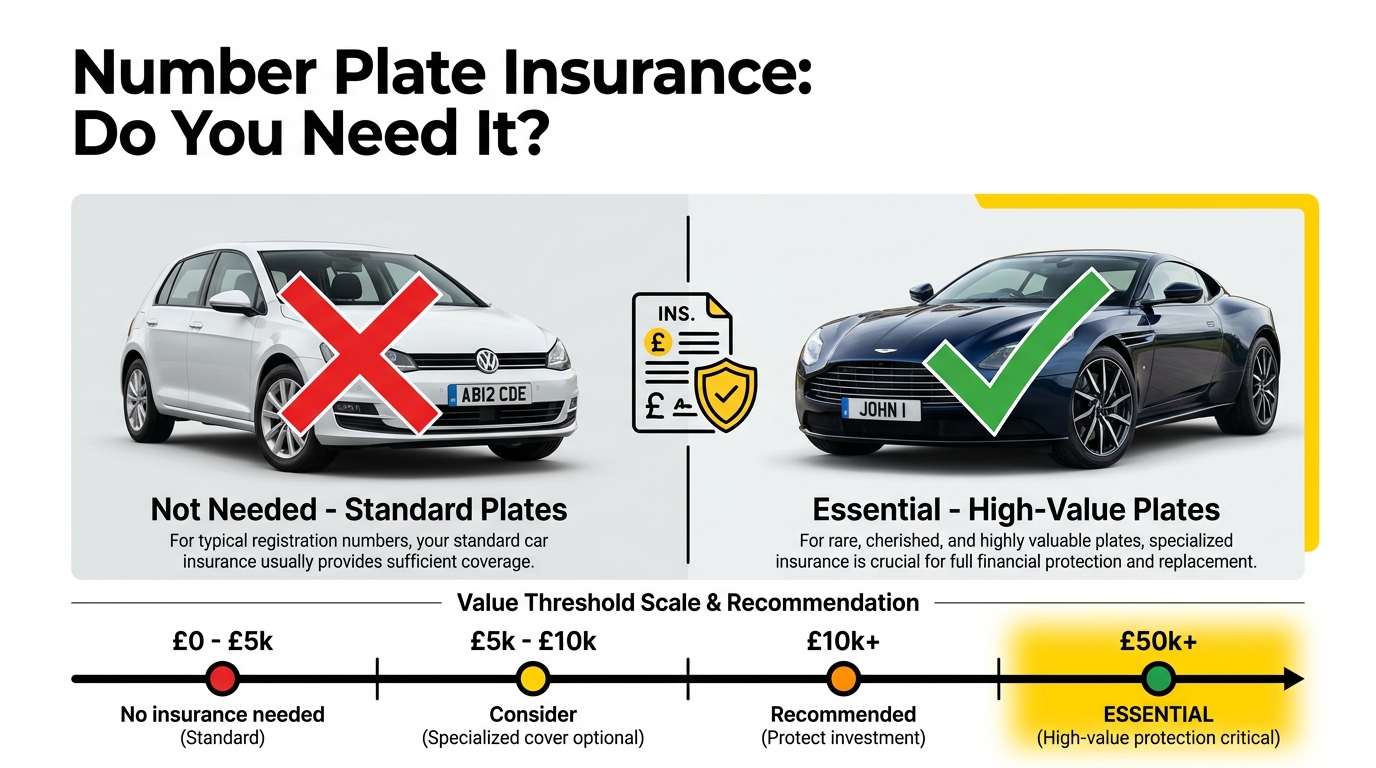

  • Number Plate Insurance: Do You Need It?

    Number Plate Insurance: Do You Need It?

    Executive Summary

    Number plate insurance, more accurately called private plate or cherished plate insurance, protects the financial value of your registration right, not the physical plates on your vehicle. If you own a valuable private number plate purchased from the DVLA or a dealer, standard car insurance typically does not cover the loss of your registration rights if the plate is stolen, transferred fraudulently, or affected by administrative errors.

    For high-value plates worth thousands or tens of thousands of pounds, specialist number plate insurance provides essential protection that standard comprehensive policies exclude. This coverage safeguards your investment during DVLA transfer processes, retention periods, and against cloning or fraudulent use. For standard registrations or low-value private plates, however, the additional premium may not justify the cost.

    As a DVLA-registered manufacturer (RNPS ID: 73132), we regularly handle physical plate replacements for stolen plates, but protecting the registration right itself requires separate insurance coverage. This guide explains when number plate insurance is necessary, what it covers, how it differs from standard car insurance, and whether your valuable registration deserves specialist protection.

    Understanding Number Plate Insurance: What It Actually Covers

    The Critical Distinction: Physical Plates vs Registration Rights

    When discussing “number plate insurance,” it is essential to understand two completely different types of coverage.

    1. Physical Plate Coverage

    This covers the actual metal or acrylic plates attached to your vehicle. If someone steals your physical plates, comprehensive car insurance may cover the replacement costs (subject to your excess). This is relatively straightforward, as the plates are vehicle accessories worth £25 to £100. For a full breakdown of what to do in that situation, see our guide on what happens if your number plate is stolen.

    2. Registration Right Protection

    This protects the legal right to use a specific registration number, which can be worth thousands or even millions of pounds. Private plates (also called cherished plates or personalised registrations) are assets that can be:

    • Bought and sold independently of vehicles
    • Retained on V778 certificates when not assigned
    • Transferred between vehicles
    • Passed to family members or beneficiaries

    The registration right itself is the valuable asset, not the physical plates.

    What Standard Car Insurance Covers (and Does Not Cover)

    Typically Covered:

    • Physical damage to plates in accidents
    • Theft of physical plates (comprehensive policies only, subject to excess)
    • Vandalism damage to plates

    Typically NOT Covered:

    • Loss of registration rights through administrative error
    • Fraudulent transfer of your private plate
    • Costs associated with recovering stolen registration rights
    • Depreciation in plate value
    • Legal fees to prove ownership of the registration
    • Loss of use during DVLA processing delays

    This gap in coverage is where specialist number plate insurance becomes valuable for high-value registrations.

    What Specialist Number Plate Insurance Covers

    Specialist private plate insurance policies typically include the following.

    Registration Right Protection:

    • Coverage for the market value of your registration
    • Protection against fraudulent transfers
    • Coverage if the DVLA makes an administrative error
    • Legal expenses to recover registration rights
    • Compensation if your plate is cloned and used in crimes

    Transfer and Retention Coverage:

    • Protection during V750/V778 transfer processes
    • Coverage while plates are on retention
    • Administrative cost reimbursement
    • Expedited processing fees if delays occur

    Additional Benefits:

    • Agreed value coverage (you and the insurer agree on the plate’s worth)
    • New-for-old replacement if the registration is lost
    • Legal assistance for ownership disputes
    • Coverage for multiple plates under one policy

    Who Actually Needs Number Plate Insurance?

    High-Value Plate Owners

    If your private plate meets any of these criteria, specialist insurance is worth serious consideration.

    Value Thresholds:

    • Plates worth over £5,000 (minimum threshold for consideration)
    • Plates worth over £10,000 (strongly recommended)
    • Plates worth over £50,000 (essential protection)
    • Plates worth over £100,000 (absolutely critical)

    If you’re weighing up a purchase, our guide on how to buy personalised number plates in the UK explains how plates are valued.

    Examples of High-Value Registrations:

    • Single or double character plates (e.g., “A 1”, “F 1”)
    • Popular names (e.g., “JOHN”, “SARAH”, “JAMES”)
    • Desirable words (e.g., “LOVE”, “COOL”, “FAST”)
    • Low-number combinations (e.g., “100”, “500”)
    • Dateless registrations with broad appeal

    Situations Requiring Enhanced Protection

    Frequent Transfers:

    If you regularly move your private plate between vehicles, each transfer creates administrative risk. DVLA processing errors, while rare, can result in temporary or permanent loss of registration rights.

    Retention Periods:

    When plates are on V778 retention certificates (not assigned to a vehicle), they remain valuable assets but lack the protection of being linked to an insured vehicle. Specialist policies cover retained plates.

    Business or Commercial Use:

    If you use your private plate for business purposes, branding, or company vehicles, the commercial value may exceed the personal use value, warranting higher coverage levels.

    Inheritance or Family Assets:

    Plates passed down through families or intended as inheritance should be protected against loss, ensuring they can be transferred to beneficiaries without complications.

    When Number Plate Insurance Is NOT Necessary

    Standard Registrations:

    If your vehicle has its original, age-appropriate registration with no special value, insurance is unnecessary. The registration has no independent market value.

    Low-Value Private Plates:

    Plates purchased for £250 to £500 with limited resale appeal typically do not justify annual insurance premiums of £50 to £150.

    Short-Term Ownership:

    If you plan to sell or transfer the plate within months, the insurance premium may exceed the risk exposure period.

    Already Covered:

    Some high-end classic car insurance policies or collector vehicle policies include private plate coverage as standard, so verify this before purchasing duplicate coverage.

    How Private Plate Insurance Works

    Valuation Methods

    Agreed Value Policies:

    You and the insurer agree on the plate’s worth when purchasing the policy. This provides certainty but requires an accurate valuation upfront.

    Market Value Policies:

    Coverage reflects the current market value at the time of loss. This can fluctuate with private plate market trends and may result in lower payouts if values decline.

    New-for-Old Replacement:

    Some policies offer to replace your lost registration with an equivalent-value plate rather than cash compensation.

    The Claims Process

    If your registration right is lost, stolen, or compromised:

    1. Immediate Notification: Contact your insurer within 24 to 48 hours of discovering the issue
    2. DVLA Reporting: File the appropriate forms with the DVLA (V62 for lost certificates, fraud reports if applicable)
    3. Police Report: If fraud or theft is suspected, obtain a crime reference number
    4. Documentation: Provide V750/V778 certificates, purchase receipts, and valuation evidence
    5. Assessment: The insurer investigates and assesses the claim’s validity
    6. Settlement: Agreed value payment or replacement registration provision

    Typical timeline: 4 to 12 weeks, depending on DVLA processing and investigation complexity.

    Premium Costs and Factors

    Typical Annual Premiums:

    • Plates valued £5,000 to £10,000: £50 to £100
    • Plates valued £10,000 to £25,000: £100 to £250
    • Plates valued £25,000 to £50,000: £250 to £500
    • Plates valued £50,000+: £500 to £2,000+

    Factors Affecting Premiums:

    • Agreed plate value
    • Transfer frequency
    • Retention status (on a vehicle vs on a certificate)
    • Security measures (locked storage of documents)
    • Claims history
    • Policy excess level

    Protecting Your Investment: Beyond Insurance

    DVLA Retention and Transfer Security

    V778 Retention Documents:

    When plates are not assigned to a vehicle, they exist on V778 retention certificates. These documents are critical, so treat them like valuable assets:

    • Store originals in a fireproof safe or bank safety deposit box
    • Keep digital copies in secure cloud storage
    • Never carry the original V778 unless you are actively transferring
    • Use recorded delivery for any DVLA correspondence

    If you’re unclear on how these documents differ, our guide comparing the V5C, V750, and V778 explains what each one does and when you’ll need it.

    V750 Certificates of Entitlement:

    For newly purchased plates not yet assigned, V750 certificates require similar protection. These expire after specific periods and must be renewed or extended.

    Preventing Fraudulent Transfers

    DVLA Security Measures:

    The DVLA has implemented safeguards, but you should also:

    • Register for DVLA online services to monitor your registration status
    • Set up alerts for any transfer attempts
    • Verify that your contact details are current with the DVLA
    • Use strong passwords for DVLA online accounts
    • Never share V5C, V750, or V778 details via email

    Red Flags to Monitor:

    • Unexpected DVLA correspondence about transfers
    • A V5C logbook arriving with a different registration
    • Online account access attempts you did not initiate
    • Requests for your registration documents from unknown parties

    Physical Security for Valuable Plates

    While insurance covers registration rights, preventing physical plate theft remains important.

    Anti-Theft Measures:

    • Use one-way security screws (our number plate fitting guide explains how)
    • Install locking number plate holders
    • Apply tamper-evident seals
    • Park in well-lit, CCTV-covered areas
    • Consider GPS trackers for high-value vehicles with desirable plates

    Documentation:

    • Photograph plates with date stamps
    • Record plate numbers and vehicle assignments
    • Keep purchase receipts and valuation certificates
    • Maintain a transfer history log

    Alternatives to Specialist Number Plate Insurance

    Enhanced Comprehensive Car Insurance

    Some insurers offer add-ons or enhanced policies that include private plate coverage.

    Advantages:

    • A single policy for both vehicle and plate
    • Potentially lower cost than separate policies
    • A simplified claims process

    Disadvantages:

    • Coverage limits may be lower than specialist policies
    • May not cover retention periods
    • Less flexibility in agreed values

    Action: Request quotes from your current insurer before purchasing standalone plate insurance.

    Self-Insurance for Moderate-Value Plates

    For plates worth £2,000 to £10,000, consider the following.

    Cost-Benefit Analysis:

    • Annual premium: £50 to £150
    • Over 10 years: £500 to £1,500 in premiums
    • Probability of loss: Low (DVLA errors are rare)
    • Risk tolerance: Can you absorb a £5,000 loss?

    Middle Ground Approach:

    • Implement strict document security
    • Monitor your DVLA account regularly
    • Accept the risk for plates under £5,000
    • Insure only plates above the £10,000 threshold

    Classic Car and Collector Vehicle Policies

    If your private plate is on a classic or collector vehicle, some specialist insurers may already cover it.

    Specialist Classic Car Insurers:

    Many understand the value of matching number plates and period-correct registrations. Examples include:

    • Hagerty
    • Adrian Flux
    • Lancaster Insurance
    • Footman James

    Typical Coverage:

    • Agreed value for the vehicle including the plate
    • Coverage for retention transfers
    • An understanding of registration importance
    • Sometimes includes spare parts and memorabilia

    For more on choosing the right registration in the first place, our guide on how to buy personalised number plates in the UK is a useful starting point.

    Practical Takeaways

    Do You Need Number Plate Insurance?

    YES, purchase specialist insurance if:

    ✅ Your plate is worth over £10,000
    ✅ You frequently transfer it between vehicles
    ✅ The plate is on long-term retention (V778)
    ✅ It is a family heirloom or intended inheritance
    ✅ You use it for business or commercial purposes
    ✅ You cannot afford to replace it if lost

    NO, insurance is likely unnecessary if:

    ❌ The plate value is under £5,000
    ❌ It is your vehicle’s original registration
    ❌ You purchased it for under £500 with limited resale appeal
    ❌ Your classic car policy already covers it
    ❌ You plan to sell within 12 months

    Essential Protection Steps (With or Without Insurance)

    Immediate Actions:

    • Verify your current DVLA registration status online
    • Locate and secure your V750/V778 documents
    • Photograph all certificates and store them digitally
    • Set up DVLA online account monitoring
    • Check your car insurance policy for existing coverage

    Ongoing Maintenance:

    • Review the plate value annually (market fluctuations)
    • Update insurance coverage if the value increases
    • Renew retention certificates before they expire
    • Monitor for fraud attempts
    • Keep your contact details current with the DVLA

    How Plate-Maker Supports Plate Owners

    As a DVLA-registered manufacturer (RNPS ID: 73132), we support private plate owners through our physical plate services.

    Physical Plate Services:

    • BS AU 145e compliant replacement plates
    • Same-day collection for urgent replacements
    • Premium styles (3D gel, 4D laser, and 5D) for valuable vehicles
    • Document verification to prevent cloning

    What We Don’t Do:

    • We do not sell or trade registration rights
    • We do not provide insurance products
    • We do not handle DVLA transfers

    For registration transfers, always use official DVLA channels or authorised dealers. For physical plates, visit our Ilford workshop with your V5C or V778 to create compliant plates matching your valuable registration. See our same-day collection service in Ilford for urgent replacement needs.

    Next Steps

    • Assess your plate’s value: Research current market prices for similar registrations
    • Review existing coverage: Check your car insurance and classic car policies
    • Get quotes: Contact specialist insurers if your plate is worth £10,000+
    • Secure documents: Implement V750/V778 storage protocols
    • Order quality plates: Ensure your physical plates reflect your registration’s value

    For high-value plates, the physical presentation matters. Our premium 4D laser-cut number plates provide the quality finish that matches your registration’s worth, while maintaining full BS AU 145e compliance.

    Frequently Asked Questions

    What is the difference between number plate insurance and car insurance?

    Number plate insurance protects the financial value of your registration right, the legal entitlement to use a specific number, which can be worth thousands of pounds. Standard car insurance covers physical damage to plates as vehicle accessories but excludes loss of registration rights, fraudulent transfers, or DVLA administrative errors. High-value private plates need both types of coverage for complete protection.

    How much does private plate insurance cost?

    Specialist number plate insurance typically costs 1 to 2% of the plate’s insured value annually. Plates worth £5,000 to £10,000 cost £50 to £100 per year to insure, while plates valued £10,000 to £50,000 range from £100 to £500 annually. Premiums depend on the agreed value, transfer frequency, retention status, and security measures. Some classic car policies include plate coverage at no additional cost.

    Do I need insurance for my private number plate?

    Insurance is recommended if your private plate is worth over £10,000, frequently transferred between vehicles, held on V778 retention, or serving as a family asset. Standard registrations or plates worth under £5,000 typically do not justify the premiums. Check your existing car insurance first, as some comprehensive or classic car policies include limited plate coverage.

    What happens if my private plate is stolen or transferred fraudulently?

    Report suspected fraud to police immediately and obtain a crime reference number. Contact the DVLA on 0300 790 6802 to freeze transfers and investigate. If you have specialist plate insurance, notify your insurer within 24 to 48 hours. Recovery can take 4 to 12 weeks and may require legal documentation proving ownership. Without insurance, you bear all costs and may lose the registration permanently if the DVLA cannot reverse the transfer.

    Can I insure a number plate on retention (V778 certificate)?

    Yes, specialist insurers cover plates on V778 retention certificates, which is actually when coverage is most critical, since the plate is not attached to an insured vehicle. Retention periods can last up to 10 years (renewable), during which the registration remains a valuable asset requiring protection. Make sure your policy explicitly covers retention status and specify the V778 certificate number when purchasing coverage.

    Does comprehensive car insurance cover stolen number plates?

    Comprehensive car insurance typically covers physical plate theft, the actual metal or acrylic plates, subject to your policy excess. However, it does not cover the registration right itself if someone fraudulently transfers your private plate or if the DVLA makes an administrative error. For valuable registrations, you need separate specialist number plate insurance to protect the asset value beyond the physical plates’ replacement cost.

    Conclusion

    Number plate insurance is not necessary for every driver, but for owners of valuable private registrations, it provides essential protection that standard car insurance excludes. The key is understanding what you are insuring: not the £50 physical plates on your vehicle, but potentially the £50,000 registration right that could be lost through fraud, error, or administrative failure.

    If your private plate is worth over £10,000, frequently transferred, or held as a family asset, specialist insurance is a prudent investment costing 1 to 2% of its value annually. For standard registrations or low-value plates, focus instead on document security, DVLA monitoring, and quality physical plates that reflect your vehicle’s presentation.

    At Private Number Plate Maker Ltd, we manufacture BS AU 145e compliant plates for registrations of all values. Whether you have a cherished plate worth six figures or a standard registration, we ensure your physical plates meet legal requirements and present your vehicle professionally. Visit our Ilford workshop with your V5C or V778 documents for same-day service.

    You can design your replacement plates online to match your registration’s value, or contact our team at 020-3576-6603 for advice on premium plate styles for high-value vehicles.

  • 26 Plates Released March 2026: What You Need to Know

    26 Plates Released March 2026: What You Need to Know

    On 1 March 2026, the DVLA began issuing the new 26 plates for all new vehicles registered in Great Britain. The 26 plate will be used until 31 August 2026, when it will be replaced by the 76 plate for the second half of the year.

    The 26 plate format follows the pattern introduced in 2001: two letters indicating the local DVLA registration area, followed by “26”, and three random letters (e.g., AB26 XYZ). This applies to all cars, vans and motorcycles registered between 1 March and 31 August 2026.

    What makes the 2026 release notable is the scale of DVLA bans. The agency has withheld over 400 combinations from the 26 series, citing concerns over offensive, inappropriate or potentially dangerous content. Plates referencing conflict zones, war, violence, religion, racism, homophobia and crude slang have all been removed.

    If your vehicle has a 26 registration and you need replacement plates — whether due to damage, fading, loss, or simply to upgrade to premium styles like 3D gel or 4D acrylic — we can help. As a DVLA-registered manufacturer (RNPS ID: 73132), we produce BS AU 145e-compliant plates from our Ilford workshop.

    What Are 26 Number Plates?

    26 number plates are the registration plates issued to vehicles first registered between 1 March 2026 and 31 August 2026. The “26” is the age identifier, indicating the vehicle was first registered in the first half of 2026.

    The UK number plate system changes every six months. From 1 September 2026, new vehicles will receive a 76 plate — the age identifier for the second half of the year (2026 + 50 = 76).

    The 26 Plate Format

    The 26 plate follows the current UK number plate format, introduced in 2001.

    ComponentDescriptionExample
    First two lettersLocal DVLA registration area (e.g., AB for Anglia, BD for Birmingham)AB
    Age identifierTwo digits indicating the registration period (26 = March-August 2026)26
    Last three lettersRandomly assignedXYZ

    Full example: AB26 XYZ — a vehicle registered in the Anglia region between March and August 2026.

    The front plate must display black characters on a white background, while the rear plate must display black characters on a yellow background.

    When Were 26 Plates Released?

    The 26 plates were released on 1 March 2026. They apply to all new vehicles registered from that date until 31 August 2026. The next release, the 76 plates, will arrive on 1 September 2026.

    This twice-yearly cycle has been in place since 2001, with March releases using the year number (e.g., 20 in 2020, 21 in 2021, 26 in 2026) and September releases adding 50 (e.g., 70 in 2020, 71 in 2021, 76 in 2026).

    Banned 26 Plates: What the DVLA Has Withheld

    Each year, the DVLA withholds registration combinations deemed offensive or inappropriate. For the 2026 series, the DVLA has banned 403 combinations.

    The DVLA reviews all new number plate combinations twice yearly and withholds those that may constitute insults, profanities, sexual innuendos, drug references, or content with racist, sexist or LGBTQ+ implications, in addition to certain political and religious allusions.

    Notable banned 26 plates include:

    Banned PlateReason
    RU26 RUS, RU26 UKRReferences to Russia-Ukraine conflict
    YE26 MENReferences to Yemen conflict
    GA26 AZAReferences to Gaza conflict
    MU26 GERResembles “mugger”
    BA26 OMBResembles “bomb”
    JE26 HADResembles “jihad”
    AN26 US, AN26 HOLOffensive interpretations
    BJ26 AGG, BJ26 STDOffensive interpretations
    HH26 WAR, TE26 ROR, GO26 WARReferences to war
    TR26 NNY, LE26 ZER, FA26 OTTOffensive interpretations
    FU26 KER, AS26 HOL, SC26 TUMOffensive/crude slang
    AA26 NUS, DO26 GGERResemble rude words
    JU26 ANGResembles “gang”
    GA26 GAY, LE26 ZRSSexual orientation references
    NO26 RUS, UK26 RUS, NO26 UKR, UK26 UKR, YE26 RUS, YE26 UKRRussia-Ukraine conflict references
    B26 OMB, C26 ASH, AA26 NUS, AA26 ORT, AA26 RSE, AA26 USE, AA26 YAN, AA26 YPO, AF26 NNY, AN26 NUS, AS26 FKU, AS26 FUL, AS26 FWC, AS26 HLE, AS26 HOL, AS26 OLE, BA26 AYS, BA26 AYY, BA26 AZA, BA26 OMB, BJ26 AGG, BJ26 AGSVarious offensive interpretations

    The Penalty for Illegal Number Plates

    Drivers who display illegal or non-compliant number plates face fines of up to £1,000. In 2020, police stopped 13,720 drivers for having illegal number plates.

    Common violations that can lead to fines include:

    • Wrong font — plates must use the Charles Wright 2001 typeface
    • Incorrect spacing — altering spacing to make the plate spell a word or name is illegal
    • Wrong size or layout — different sizes apply for cars, motorcycles and other vehicles
    • Non-rectangular plates — custom shapes can make a plate illegal

    Additionally, plates that are non-reflective or fail the BS AU 145e standard can cause MOT failure and enforcement action.

    Can I Get Replacement 26 Plates?

    Yes — if your vehicle has a 26 registration and you need replacement plates, we can manufacture them for you. Common reasons for replacement include:

    • Damage — cracked, chipped or broken plates
    • Fading — plates that have become difficult to read
    • Loss or theft — stolen or missing plates
    • Upgrade — replacing standard dealer-fit plates with premium options (3D gel, 4D acrylic, 5D, bevel or ghost)

    As a DVLA-registered supplier (RNPS ID: 73132), we manufacture every plate on-site in our Ilford workshop using BS AU 145e-certified materials. All plates are fully road-legal and MOT-compliant.

    Premium Replacement Options for 26 Plates

    If you want to upgrade your 26 plates, we offer a full range of premium styles:

    StyleDescriptionKey Feature
    Standard 2DFlat printed charactersAffordable, legal, classic
    3D GelRaised, domed resin charactersGlossy, UV-cured, premium look
    4D Laser-Cut3mm acrylic charactersSharp, bold, shadow effect
    5D3mm acrylic + 2mm gel overlayMaximum depth and gloss
    BevelDiamond-cut faceted edgesLight-catching sparkle
    GhostSubtle gradient effectDistinctive, modern styling
    EV Green FlashGreen panel for zero-emission vehiclesRequired for eligible EVs

    All our plates are manufactured to BS AU 145e:2018 standards, ensuring they pass MOT and remain readable by ANPR cameras.

    (add 3D Gel Number Plates link here) (add 4D Laser-Cut Number Plates link here) (add 5D Number Plates link here) (add Bevel Number Plates link here)

    Legal Requirements for 26 Replacement Plates

    Under the Road Vehicles (Display of Registration Marks) Regulations 2001, every replacement number plate must meet specific requirements:

    RequirementSpecification
    FontCharles Wright (mandatory since 2001)
    Character height79mm (cars), 64mm (motorcycles)
    Character width50mm (excluding ‘I’ and ‘1’)
    Stroke thickness14mm
    Character spacing11mm between characters
    Age identifier gap33mm
    Margins11mm minimum
    ReflectivityBS AU 145e standard
    Supplier markingsRNPS ID and postcode

    As a DVLA-registered manufacturer, we include mandatory supplier markings on every plate we produce.

    How to Order Replacement 26 Plates

    Ordering replacement 26 plates is simple:

    1. Choose your style — Select from standard, 3D gel, 4D, 5D, bevel, ghost or EV options.
    2. Design your plate — Use our online plate builder to preview your design.
    3. Upload documents — Provide proof of identity (driving licence or passport) and proof of entitlement (V5C logbook, V750 or V778).
    4. Complete checkout — Order by 2pm Monday-Friday for same-day dispatch.

    We offer next-day UK delivery and same-day collection from our Ilford workshop (order by 2pm, collect within 3 hours).

    Frequently Asked Questions

    What is a 26 number plate?

    A 26 number plate is a registration plate issued to vehicles first registered between 1 March 2026 and 31 August 2026. The “26” indicates the vehicle was registered in the first half of 2026.

    When did 26 plates come out?

    The 26 plates were released on 1 March 2026.

    Are 26 plates still valid?

    Yes — 26 plates are valid for vehicles registered between 1 March 2026 and 31 August 2026. They will be replaced by 76 plates for vehicles registered from 1 September 2026.

    How many 26 plates did the DVLA ban?

    The DVLA banned 403 combinations from the 26 series.

    Can I get replacement 26 plates?

    Yes — we manufacture replacement plates for 26 registrations. All plates are BS AU 145e-compliant and fully road-legal.

    How much do replacement 26 plates cost?

    Prices start from £12.49 per plate for standard 2D plates, with premium options (3D gel, 4D, 5D, bevel, ghost) available from £19.95.

    What documents do I need for replacement 26 plates?

    You need proof of identity (driving licence or passport) and proof of entitlement (V5C logbook, V750 or V778).

    Are 3D or 4D replacement plates legal for 26 registrations?

    Yes — 3D gel and 4D acrylic plates are fully legal when manufactured to BS AU 145e standards with the correct font and spacing.

  • 5D Number Plates for Show Cars: How to Stay Legal While Standing Out

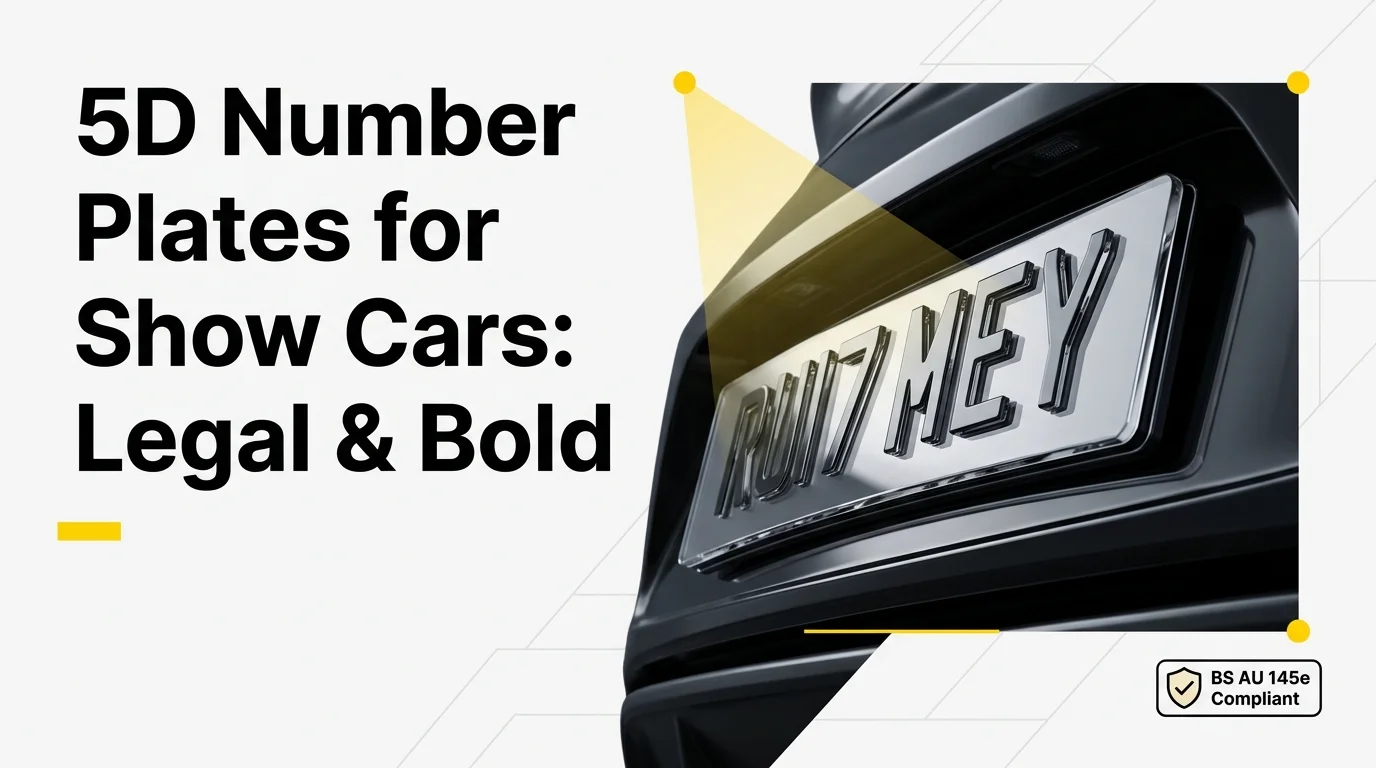
    5D Number Plates for Show Cars: How to Stay Legal While Standing Out

    When your car isn’t just transport – it’s a statement – the details matter. From polished alloys to custom upholstery, every element should reflect pride of ownership. So when it comes to number plates, it’s no surprise that show car owners are increasingly drawn to the bold, sculptural appeal of 5D number plates.

    But here’s the catch: the more distinctive the plate, the more scrutiny it invites – especially at MOT time or during police checks. Unlike daily drivers, show cars often sit under spotlights, not streetlights, and that means aesthetics and compliance must go hand in hand.

    Let’s cut through the confusion: 5D plates can be 100% road legal in the UK – but only when built to exacting standards. In this guide, we’ll explore what makes 5D plates unique, why show car owners love them, and crucially, how to ensure yours meet DVLA and BS AU 145e requirements – without sacrificing that head-turning presence.

    What Exactly Are 5D Number Plates?

    First, a quick reality check: “5D” isn’t an official DVLA or British Standard term. It’s an industry descriptor used by manufacturers and retailers to denote an evolution beyond traditional 3D gel and 4D acrylic plates.

    Here’s how they typically differ:

    Plate TypeMaterial & ProfileVisual EffectThickness (Approx.)
    3DSoft, flexible polyurethane gelSmooth, glossy raised letters2–3 mm
    4DSolid acrylic, laser-cutSharp, clean, high-contrast depth3–5 mm
    5DMulti-layer acrylic (often 2+ tones or finishes)Dimensional, layered, sometimes with subtle gradients or bevelled edges5–8 mm

    A true 5D plate often features two or more acrylic layers – for example, black characters with a chrome or gloss black outline, or a matte base with high-gloss raised digits. The result? A plate that catches light dynamically, adding presence whether mounted on a lowered JDM build, a concours classic, or a modified EV.

    Yet for all their visual impact, 5D plates must still obey the same core rules as any standard plate – size, font, spacing, and reflectivity included.

    Why Show Car Owners Choose 5D Plates

    It’s not just about “looking cool.” For enthusiasts, 5D plates solve real aesthetic challenges:

    • Contrast & definition: On dark or matte-finish vehicles (think blacked-out BMWs or satin-wrapped Audis), flat black plates can disappear. 5D plates add depth that ensures the registration remains legible and intentional.
    • Design synergy: With layered acrylic, you can subtly echo other custom elements – e.g., matching a carbon-look rear diffuser with a gloss/matte dual-finish plate.
    • Photography-ready: Under show lighting or in automotive photography, the layered edges catch highlights, giving plates a premium studio finish.

    One customer recently shared how their 5D plate with a satin-black base and gloss-black characters transformed the rear end of their air-ride VW Golf Mk7 – “It looks like it rolled out of a factory special edition, not an aftermarket add-on.”

    The Legal Framework: What Actually Matters

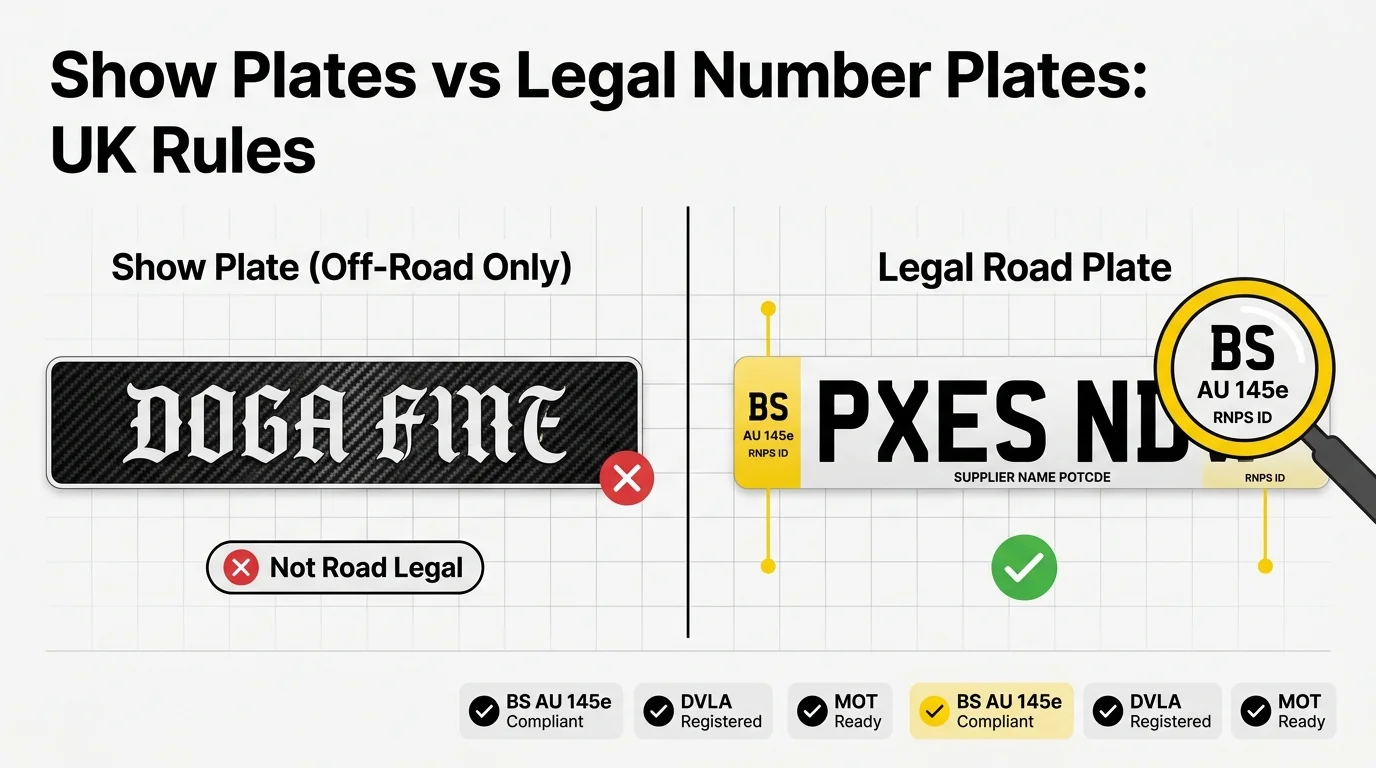
    Legality hinges on compliance with BS AU 145e, the UK standard for number plates. While the DVLA doesn’t regulate “3D,” “4D,” or “5D” as categories, it does enforce strict rules on:

    • Font: Only the Charles Wright 2001 font (with mandatory spacing and character dimensions)
    • Colours: Front = white background, black characters | Rear = yellow background, black characters
      (Note: Green flash EV plates are permitted on the left-hand side only – no full green backgrounds.)
    • Retroreflectivity: Must meet minimum reflectivity thresholds for night-time ANPR readability
    • Material durability: Plates must resist fading, warping, and delamination in British weather

    Crucially, the height, thickness, or material of raised characters isn’t banned – provided the characters themselves remain:

    • Fully opaque (no transparency)
    • Non-reflective (no mirror or chrome characters – though chrome borders or layer accents may be acceptable if not obstructing digits)
    • Spaced correctly (6mm between characters, 9mm between groups)

    As the official GOV.UK guidance on number plate standards confirms: “Characters must not be altered, stylised or have added effects such as italics, outlines or shadows – unless those effects are part of a compliant layered build that doesn’t reduce legibility.”

    That last point is key: a well-engineered 5D plate uses layered acrylic to enhance definition – not disguise or distort.

    Common Pitfalls (And How to Avoid Them)

    Even with the best intentions, show car builds can drift into non-compliance. Here are the top three issues – and how to sidestep them:

    Hidden Characters or Reduced Contrast

    Some “stealth” 5D designs use dark grey on black or subtle gradients. While visually sleek, low-contrast plates fail MOT under lighting tests.
    Fix: Always opt for high-contrast combinations: black-on-white/yellow remains the safest. For a modern twist, consider a gloss black character on a matte black base – still black-on-black, but with enough sheen difference for readability.

    Over-Embellished Borders or Logos

    While side badges (e.g., “GB,” national flags, or EV symbols) are permitted in the left margin, they must not exceed 50mm in width or interfere with spacing. Full-width chrome surrounds? Not compliant.
    Fix: Use minimal, BS-approved national identifiers. If adding a logo (e.g., club emblem), ensure it’s only in the left margin and doesn’t touch the registration marks.

    Non-Standard Plate Sizes or Shapes

    Number plates must be rectangular and meet one of the DVLA-approved dimensions (standard, short, or motorcycle). Curved or angled plates – however dramatic – will fail inspection.
    Fix: Stick to standard sizing. Short plates (e.g., 520mm x 111mm) offer a cleaner look for wide-body builds and are fully legal for eligible registrations.

    5D vs 4D vs 3D: Which Is Right for Your Show Car?

    Not every vehicle needs (or suits) the maximum depth. Here’s how to choose wisely:

    3D Gel Plates

    Best for: Daily-driven show cars, classic restorations, or those prioritising subtle refinement.
    Pros: Lightweight, slight flexibility (good for curved boot lids), lower profile.
    Consider: Gel can yellow over time if low-grade UV inhibitors are used.

    4D Acrylic Plates

    Best for: Performance builds, modern modifieds, EVs – where sharp lines and precision matter.
    Pros: Crisp edges, excellent durability, consistent finish.
    Consider: Slightly heavier; ensure mounting won’t stress thin boot trims.

    5D Layered Acrylic Plates

    Best for: Concours entries, static displays, or builds where plate design is a feature, not just a requirement.
    Pros: Unmatched depth and customisation potential; ideal for photography and show lighting.
    Consider: Requires expert fabrication – poor layer alignment can cause shadows or spacing errors.

    Real-World Durability: Will It Survive UK Weather?

    One concern with high-relief plates is longevity – especially on cars that see real roads, not just showfields.

    High-quality 5D plates use optical-grade cast acrylic, not extruded plastic. Why does that matter?

    • Cast acrylic resists UV yellowing for 5+ years (critical in south-facing garages or summer shows)
    • It’s less prone to micro-fractures from temperature swings (–5°C winter mornings to 40°C summer dashboards)
    • Edges stay sharp – no softening or “mushrooming” like lower-grade resins

    That said, installation is half the battle. Always use high-bond automotive-grade double-sided tape (not foam squares), and avoid mounting over vents or moving panels. For show cars stored long-term, consider removable plate brackets – so you can swap to standard plates for road use if needed.

    Final Checklist: Is Your 5D Plate MOT-Ready?

    Before fitting, run through these must-haves:

    • Uses Charles Wright font – no condensed, stretched, or modified glyphs
    • Characters are black, non-reflective, and solid (no hollows, no mesh)
    • Spacing follows 6-9-6 rules (6mm intra-character, 9mm inter-group, 6mm margins)
    • Rear plate has yellow retroreflective background, front has white
    • No slogan, logo, or image within the registration area
    • Plate is securely fixed, flat, and unobstructed by tow bars or trimStill unsure? The MOT inspection manual lists exactly what testers examine – Section 2 covers number plates in plain language.

    Style That Stands Up – Legally

    At the end of the day, a show car should inspire confidence – not just admiration. When your 5D plate catches the light on the judging ramp, you want to know it’s not just striking, but sound.

    At private-numberplates.uk, every 5D plate is built by a DVLA-registered supplier, using BS AU 145e-certified materials and precision laser cutting. We don’t offer illegal “ghost chrome” or oversized novelty plates – because your passion deserves better than a £1,000 fine and an MOT fail.

    Instead, we specialise in plates that balance ambition with accountability:
    → Explore the subtle depth of our Ghost Number Plates for stealth elegance
    → Go for bold definition with our 4D Number Plates
    → Or push the envelope – responsibly – with our 5D Number Plates

    Design yours today, preview it in real time, and order before 2pm for same-day dispatch.

    Because when your car is a canvas, even the smallest detail should be deliberate – and legal.

  • How Long Do 3D Gel Number Plates Last in UK Weather? Your Complete Durability Guide

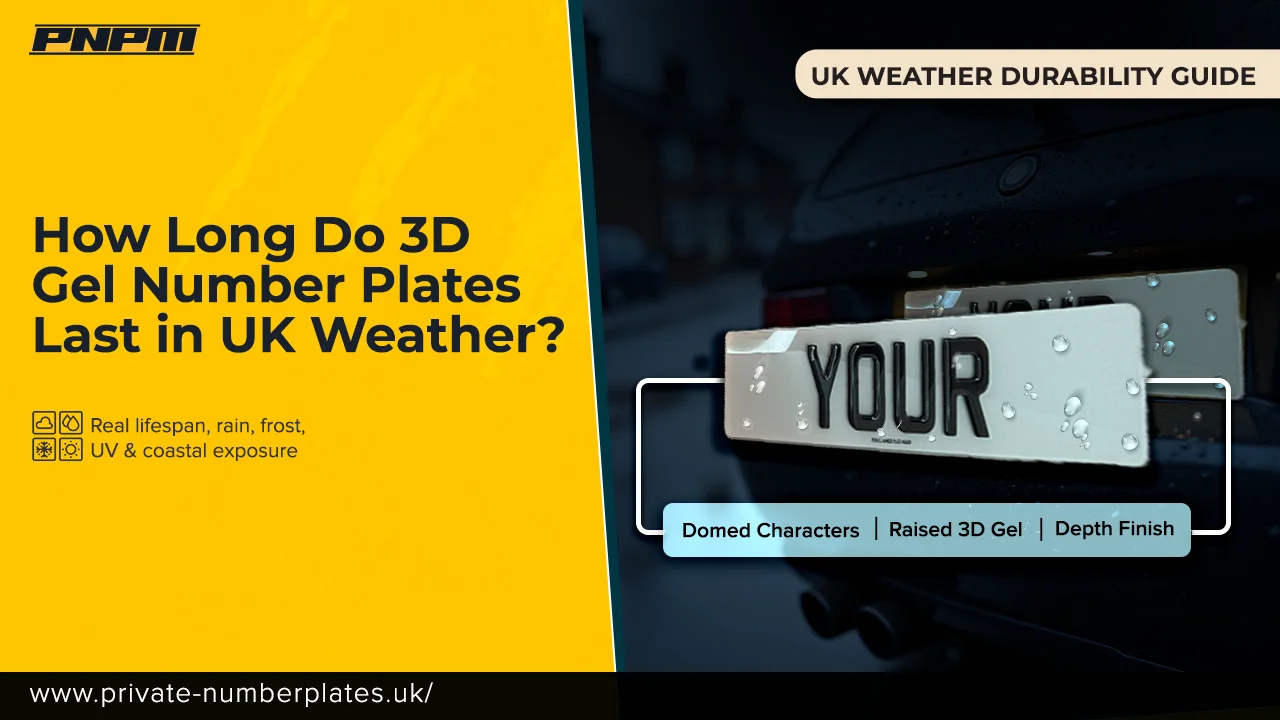
    How Long Do 3D Gel Number Plates Last in UK Weather? Your Complete Durability Guide

    H1: How Long Do 3D Gel Number Plates Last in UK Weather?

    If you’ve ever admired the sleek, raised finish of 3D number plates on a friend’s car or at a show, you’ve likely wondered: Will they survive the UK’s relentless downpours, salty coastal air, and sudden frost? As Britain’s weather throws everything from horizontal rain in Manchester to corrosive sea spray in Cornwall, your number plate’s resilience isn’t just about aesthetics – it’s a legal requirement. Let’s cut through the myths and deliver the definitive answer on 3D gel number plate lifespan in real-world British conditions.

    What Exactly Are 3D Gel Number Plates?

    Unlike traditional flat acrylic plates, 3D gel number plates feature characters formed from a flexible polyurethane resin. This material is poured into moulds, cured under UV light, and bonded to an acrylic base. The result? A smooth, domed, “liquid” appearance that resists cracking and offers exceptional depth. Popular for personalisation, they comply with DVLA standards when manufactured correctly. But their soft-gel surface raises valid questions about durability against UK weather extremes. For those who prefer a more subtle approach, standard 2D plates offer excellent weather resistance while maintaining that classic appearance.

    Why UK Weather Is the Ultimate Number Plate Stress Test

    Britain’s climate is notoriously harsh on vehicles. The Met Office confirms the UK averages 133 days of rain yearly, with coastal regions battling salt-laden winds that accelerate corrosion. Inland, temperature swings from sub-zero winters to summer heatwaves cause materials to expand and contract. Unlike drier climates, constant moisture seeps into microscopic gaps, promoting delamination. Add road grit, UV exposure, and chemical pollutants, and you’ve got a perfect storm for plate degradation. For accurate regional patterns, explore the Met Office’s UK Climate Averages.

    Decoding the Lifespan: Realistic Expectations for 3D Gel Plates

    So, how long do 3D gel number plates last in the UK? Based on manufacturer data, installer feedback, and owner surveys:

    • Premium brands (using UV-stable resins and industrial adhesives): 3–5 years under typical UK conditions.
    • Budget options (thin resin, weak bonding): As little as 12–18 months before yellowing or peeling.

    Crucially, lifespan hinges on where you drive. Coastal drivers near Brighton or Liverpool face salt corrosion that may halve longevity versus sheltered urban areas. A DVLA-compliant plate from a certified supplier typically outlasts cheap imports, which often use non-marine-grade materials. For legal peace of mind, always verify supplier accreditation against the DVLA’s official number plate regulations. Understanding the latest compliance requirements is essential – our comprehensive DVLA regulations guide for 2025 details exactly what you need to know to stay legal on UK roads.

    5 Key Factors That Dictate Your 3D Gel Plate’s Longevity

    1. Resin Quality & UV Resistance

    Cheap polyurethane yellows rapidly under UV exposure – a major flaw in UK summers. Premium plates use aliphatic resins with UV inhibitors. Check if your supplier provides a 3–5 year anti-yellowing guarantee. Reputable manufacturers use only the highest-grade acrylics and resins specifically formulated to withstand UK weather conditions.

    2. Adhesion Strength

    The bond between gel characters and the acrylic base is critical. Moisture ingress here causes “lifting”. Marine-grade acrylic bases with plasma-treated surfaces resist this best. Some premium suppliers even offer same-day dispatch on orders placed before 2pm, showing their confidence in their manufacturing process.

    3. Installation Precision

    Poor fitting creates gaps for water ingress. Always use professional installers who clean surfaces with isopropyl alcohol and apply plates above 10°C (common UK winters require garage fitting).

    4. Exposure Frequency

    Frequent motorway driving bombards plates with stone chips and diesel residue. Daily coastal commutes introduce salt. Rural drivers face pollen and tree sap buildup. This is why many enthusiasts opt for 4D laser-cut number plates in particularly harsh environments, as their precision-cut acrylic characters offer exceptional durability alongside visual impact.

    5. Maintenance Habits

    Ignoring dirt or using abrasive cleaners (like kitchen scourers) scratches gel surfaces. The RAC’s guide to number plate care recommends gentle washing with pH-neutral soaps.

    Red Flags: When Your 3D Gel Plates Need Replacement

    Don’t wait for an MOT failure or police fine. Replace plates immediately if you notice:

    • Visible lifting at character edges (water traps here).
    • Cloudy/yellowed resin (UV damage compromising reflectivity).
    • Cracks or chips deeper than 1mm.
    • Faded characters – legally, plates must remain legible at 20m.
      The AA’s breakdown of number plate rules emphasises that non-compliant plates risk £1,000 fines and invalidated insurance. For the latest standards, the BS AU 145e specification requires plates to withstand UV exposure, water immersion, and temperature extremes – factors that directly impact how long your plates will last in British conditions.

    Maximising Lifespan: Proven Care Tips for UK Drivers

    Extend your plates’ life with these EEAT-backed practices:

    • Clean monthly: Use a microfibre cloth, lukewarm water, and mild detergent. Avoid pressure washers.
    • Apply UV protectant: Specialised acrylic sealants (like Meguiar’s PlastX) shield against sun damage.
    • Park strategically: Garages or shaded spots reduce UV/salt exposure. If coastal, rinse plates weekly with fresh water.
    • Inspect quarterly: Check for micro-cracks after frost or hail.

    For ultimate peace of mind, consider sourcing your plates from a certified DVLA supplier who uses premium materials specifically engineered for UK weather conditions. Their expertise ensures you get both aesthetic appeal and weather resistance.

    Legal Implications: Safety Isn’t Just About Looks

    Faded or damaged plates aren’t merely unsightly – they’re dangerous. In low light or fog, compromised reflectivity delays recognition by ANPR cameras or fellow drivers. The DVLA mandates BS AU 145e standard compliance for all UK plates, covering reflectivity, spacing, and font. Illegal modifications (e.g., oversized gel characters) risk failing MOTs. Always source plates from DVLA-registered suppliers – verify via the government’s vehicle registration portal.

    3D Gel vs. Traditional Plates: The Weather Resistance Verdict

    Feature3D Gel Plates4D Laser-Cut PlatesStandard Acrylic Plates
    UK RainExcellent (water beads off gel)Exceptional (solid acrylic)Good (but prone to edge seepage)
    Coastal SaltModerate (resin degrades faster)Excellent (non-porous material)Better (if marine-grade acrylic)
    UV ExposureVariable (premium = excellent)Outstanding (UV-stable acrylic)Consistent (if UV-stabilised)
    Winter FrostGood (flexible resin resists cracks)Excellent (rigid but durable)Poor (acrylic becomes brittle)
    Avg. Lifespan3–5 years (premium)5–7 years5–7 years

    For daily drivers in harsh climates, premium 3D gel plates often outperform budget acrylics but require vigilant care. Enthusiasts valuing aesthetics often accept shorter lifespans – just ensure replacements meet legal standards.

    The Final Mileage: Investing Wisely in UK Conditions

    How long 3D gel number plates last in the UK ultimately depends on your choices. A £25 eBay plate may peel within a year, while a £70 DVLA-certified set from a reputable maker can endure 4+ years with proper care. Factor in regional weather: if you drive daily along the A39 Atlantic Highway, budget for replacements sooner than a city commuter.

    Unlike generic number plate suppliers who compromise on materials to cut costs, premium providers focus exclusively on creating plates that balance aesthetics with weather resilience. When shopping around, look for suppliers who offer same-day dispatch and use only the highest-grade materials specifically designed for British conditions.

    Remember: no plate lasts forever in Britain’s climate. But with informed buying, professional fitting, and simple upkeep, your 3D gel plates can shine legally and beautifully for years. For peace of mind, always cross-check supplier claims against independent reviews on trusted forums like Honest John’s number plate discussions.

    Ready for plates built for Britain? Whether you prefer the liquid depth of 3D gel plates, the bold definition of 4D laser-cut characters, or the classic reliability of standard 2D options, ensuring DVLA compliance is non-negotiable. For the most up-to-date guidance on what makes a legal plate in 2025, our complete compliance guide covers everything from spacing requirements to material specifications.

  • Show Plates vs Legal Number Plates: What’s Actually Allowed on UK Roads?

    Show Plates vs Legal Number Plates: What’s Actually Allowed on UK Roads?

    When personalising your vehicle, understanding the strict boundary between decorative show plates and road-legal number plates is essential. Many UK drivers mistakenly believe that flashy custom designs permissible at car shows can be used daily on public roads. The Driver and Vehicle Licensing Agency (DVLA) maintains comprehensive regulations governing number plates used on UK roads, with specific requirements for size, colour, font, and materials that must be strictly followed.

    The legal framework is governed by the Road Vehicles (Display of Registration Marks) Regulations 2001, which outlines precise specifications for dimensions, character spacing, and reflective properties. Unlike purely decorative show plates with minimal restrictions, road-legal plates must conform to British Standard BS AU 145e. This ensures legibility to both human observers and the UK’s extensive automatic number plate recognition (ANPR) network. For vehicle owners seeking compliant personalisation, trusted suppliers like Private Number Plate Makers UK provide DVLA-authorised options that balance style with legality—such as the premium 5D number plate, which combines dual-layer acrylic depth and high-gloss finish while remaining fully BS AU 145e and DVLA compliant.

    The Critical Distinction: Show Plates vs DVLA-Compliant Plates

    Show plates represent custom-designed registration displays intended solely for non-road use at exhibitions or private property. These decorative plates offer unlimited creative freedom with colours, fonts, and symbols that would never meet road requirements. Many enthusiasts purchase show plates for events while keeping standard DVLA-compliant plates for daily driving.

    Conversely, road-legal number plates must adhere to strict visual standards:

    • Black characters on white background (front plate)
    • Black characters on yellow background (rear plate)
    • Mandatory Charles Wright font
    • Precise character dimensions: 79mm height, 50mm width (except 1 and I)
    • 14mm stroke width

    Even minor deviations render plates illegal regardless of aesthetic appeal. For vehicle owners seeking personalisation within legal boundaries, DVLA-registered suppliers offer compliant options including premium 3D gel and 4D laser-cut plates that maintain regulatory adherence while providing distinctive styling. Unlike generic suppliers, specialised providers like those at Private Number Plate Maker, focus exclusively on creating premium plates that meet all UK legal requirements while remaining competitively priced.

    BS AU 145e Standards: The Technical Requirements You Must Know

    The BS AU 145e standard mandates that plates must use retro-reflective material maintaining visibility at night while preventing excessive glare. The regulation specifies minimum impact resistance and durability requirements to withstand typical UK weather conditions. Plates must display:

    • BS AU 145e certification mark
    • Manufacturer’s name or trademark
    • Supplier’s name and postcode
    • Date of manufacture (month and year)

    Any plate lacking these markings automatically fails to meet legal requirements. This explains why plates from non-certified sources frequently lead to enforcement issues despite appearing similar to compliant plates. Reputable suppliers use only highest-grade acrylics and resins specifically engineered for UK weather conditions. For those needing reliable replacements that meet these standards, standard number plates provide a cost-effective solution that passes MOT requirements without compromising on quality.

    3D and 4D Number Plates: Premium Customisation Within Legal Boundaries

    The growing popularity of 3D gel and 4D laser-cut plates has created confusion about their legal status. When manufactured by DVLA-registered suppliers using approved materials and maintaining correct dimensions, both are entirely road-legal. Dimensional enhancements must not compromise character legibility or reflective properties.

    For enthusiasts seeking premium custom plates without breaking regulations, DVLA-authorised suppliers provide options balancing personal expression with compliance. Using a custom plate designer tool from a registered supplier ensures your personalisation remains within legal boundaries while achieving distinctive styling. These services include verification that your chosen design meets all regulatory requirements before manufacturing begins. Many certified suppliers offer rapid turnaround services with same-day dispatch for orders placed before 2pm, making legal customisation both accessible and convenient.

    Enforcement Consequences: Fines and MOT Failures for Illegal Plates

    Using non-compliant number plates carries significant consequences:

    • Fixed Penalty Notices of £100 from police officers
    • Potential court fines reaching £1,000 in serious cases
    • Automatic MOT failure (plate compliance is mandatory inspection criteria)
    • ANPR system failures leading to penalty charge notices

    The Driver and Vehicle Standards Agency (DVSA) explicitly states that plates with decorative borders, unusual fonts, incorrect spacing, or unauthorised national flags will result in MOT failure. Road safety organisations emphasise that properly maintained legal plates aren’t merely bureaucratic requirements but essential safety features enabling vehicle identification in emergencies.

    Verifying Your Number Plate Supplier’s DVLA Registration Status

    The DVLA maintains a strict registration system requiring suppliers to verify purchasers’ entitlement and retain records. Before ordering custom plates, always verify your supplier appears on the DVLA’s official register of approved number plate suppliers. Genuine DVLA-registered suppliers will:

    • Request proof of identity and vehicle entitlement before manufacturing
    • Display their DVLA registration number prominently
    • Include registered business information on finished plates
    • Refuse non-compliant designs
    • Provide BS AU 145e compliance documentation

    Purchasing from unregistered suppliers risks receiving illegal products and may support criminal activity, as stolen vehicles often receive replacement plates from vendors who don’t verify customer entitlement. Certified suppliers undergo rigorous vetting to ensure compliance.

    Creating Compliant Personalised Plates That Express Your Identity

    Personalised number plates represent one of the few fully legal ways to individualise your vehicle’s appearance while maintaining complete regulatory compliance. It’s important to understand that suppliers like Private Number Plate Maker UK manufacture physical plates for already-registered numbers – they do not register the numbers themselves. The DVLA handles all number registration and transfers.

    When designing your personalised plate, remember that the registration itself creates uniqueness – not modifications to standard dimensions. The most sophisticated legal customisation comes through premium manufacturing techniques such as 3D gel or 4D laser-cut characters, creating distinctive visual effects while adhering to font requirements. Specialised tools like the custom plate designer allow previewing your registration in various legal styles before purchasing, bridging the gap between creative expression and regulatory compliance.

    Final Considerations: Balancing Personal Expression with Legal Requirements

    The distinction between show plates and legal plates reflects a balance between personal expression and road safety. While show plates belong strictly in off-road contexts, DVLA-compliant plates protect you from enforcement action while ensuring proper vehicle identification.

    When selecting a supplier, prioritise DVLA registration and BS AU 145e certification over price or design flexibility. Reputable suppliers understand regulations thoroughly and guide you toward customisations enhancing appearance while maintaining compliance. The British Standards Institution publishes detailed specifications for number plate manufacturing standards, while the Metropolitan Police offers enforcement perspectives on vehicle identification requirements.

    For vehicle owners seeking premium quality without compromise, Private Number Plates UK offers custom plates from £12.49 each with 3D & 4D options from £19.95. Their DVLA-registered status guarantees all plates meet BS AU 145e standards while their specialised plate maker tool provides complete design control within legal boundaries.

    By understanding these distinctions and requirements, UK vehicle owners can confidently personalise their vehicles while remaining fully compliant – keeping both your style and driving privileges intact. Whether you choose standard printed plates or premium dimensional options, ensuring DVLA compliance remains the non-negotiable foundation of any road-legal number plate solution.