Author: plate-maker-blogs

  • How UK Tradespeople Use Personalised Van Number Plates for Business Branding

    How UK Tradespeople Use Personalised Van Number Plates for Business Branding

    Executive Summary

    Personalised van number plates have become an increasingly popular branding tool for UK tradespeople and small businesses seeking cost-effective vehicle identification. When manufactured to BS AU 145e standards and displaying legitimate registrations, these plates offer a professional touch that complements traditional van livery while remaining fully DVLA-compliant. However, business owners must understand that number plates cannot replace required signage, must use the mandatory Charles Wright font, and cannot make false claims about vehicle specifications.

    The key consideration for tradespeople is balancing branding aspirations with strict legal requirements under the Road Vehicles (Display of Registration Marks) Regulations 2001. Plates must remain readable by ANPR cameras, display correct spacing, and show your RNPS-registered manufacturer’s details. At Plate-Maker.co.uk, our Ilford workshop manufactures BS AU 145e-certified plates for commercial vehicles with same-day collection available, ensuring your van meets both branding goals and legal obligations.

    This guide examines how small businesses can legitimately use personalised registrations, what the DVLA permits for commercial vehicles, and which plate styles deliver professional results without risking fines up to £1,000 or MOT failure.

    Why Tradespeople Are Investing in Personalised Van Plates

    The trend towards personalised number plates for commercial vehicles has accelerated among UK tradespeople, with plumbers, electricians, builders, and other small business owners recognising the marketing potential of memorable registrations. Unlike large corporations with substantial advertising budgets, sole traders and small partnerships need cost-effective ways to make their vehicles stand out on residential streets and industrial estates.

    A well-chosen private plate can reinforce brand identity when combined with proper van signage. For instance, a plumbing business might select a registration containing “PLB” or “WTR”, while an electrical contractor could opt for “ELC” or “PWR” combinations. These subtle touches create cohesion across your business assets without violating DVLA regulations.

    Browse our personalised van number plates

    The psychological impact matters too. When potential customers see a van with a coherent, professional appearance – quality livery, clean presentation, and a thoughtful registration – it signals attention to detail and business legitimacy. In competitive local markets where word-of-mouth remains crucial, these impressions can influence hiring decisions.

    However, the surge in popularity has also attracted suppliers offering illegal “custom” plates that sacrifice compliance for aesthetics. Trading Standards and police enforcement actions have increased against plates using incorrect fonts, non-reflective materials, or altered spacing designed to evade ANPR cameras. For business owners, the risks extend beyond personal fines to potential reputational damage and vehicle impoundment.

    DVLA Rules for Commercial Vehicle Number Plates

    Understanding the legal framework is essential before ordering plates for your commercial vehicle. The Road Vehicles (Display of Registration Marks) Regulations 2001 apply equally to private cars and business vans, with no special exemptions for commercial use. This means your van’s number plates must meet identical standards to any other road vehicle.

    Read our complete DVLA rules for commercial vehicle plates guide

    Mandatory Requirements:

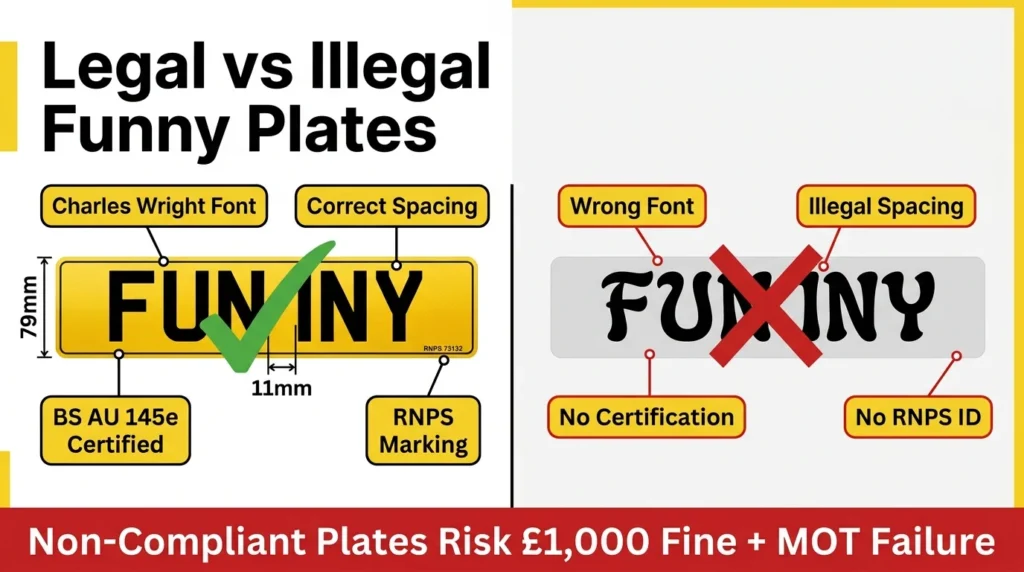
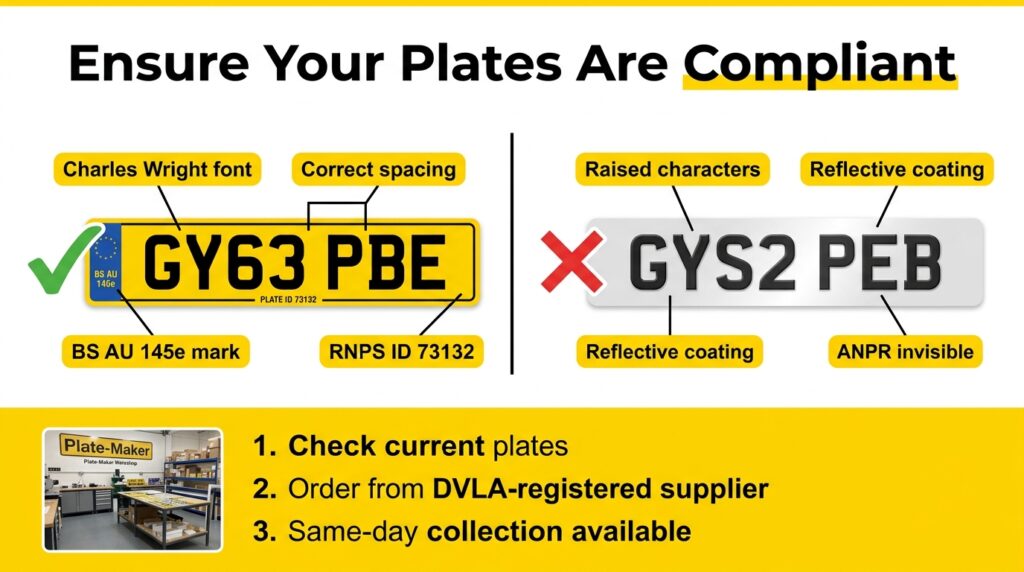
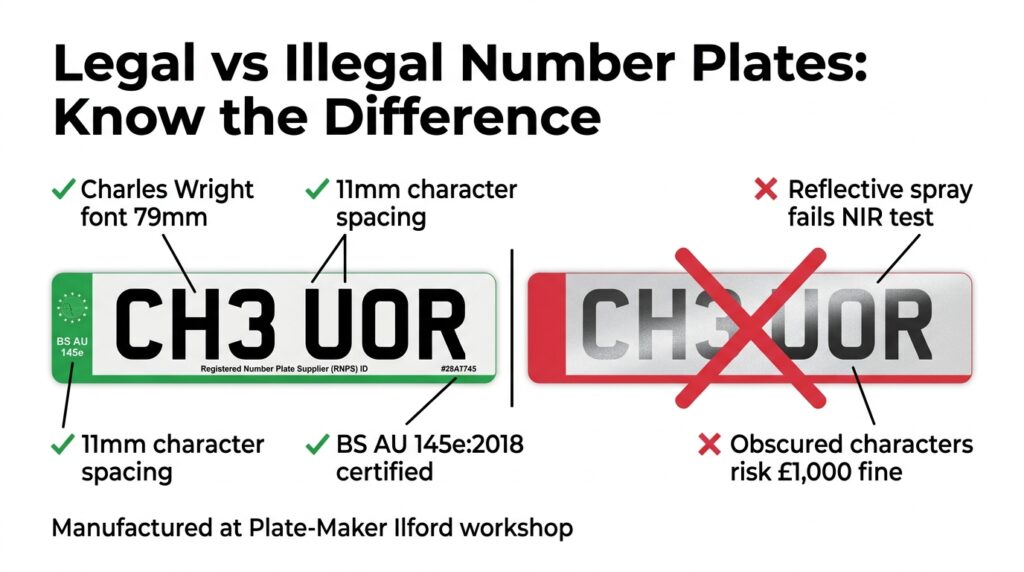
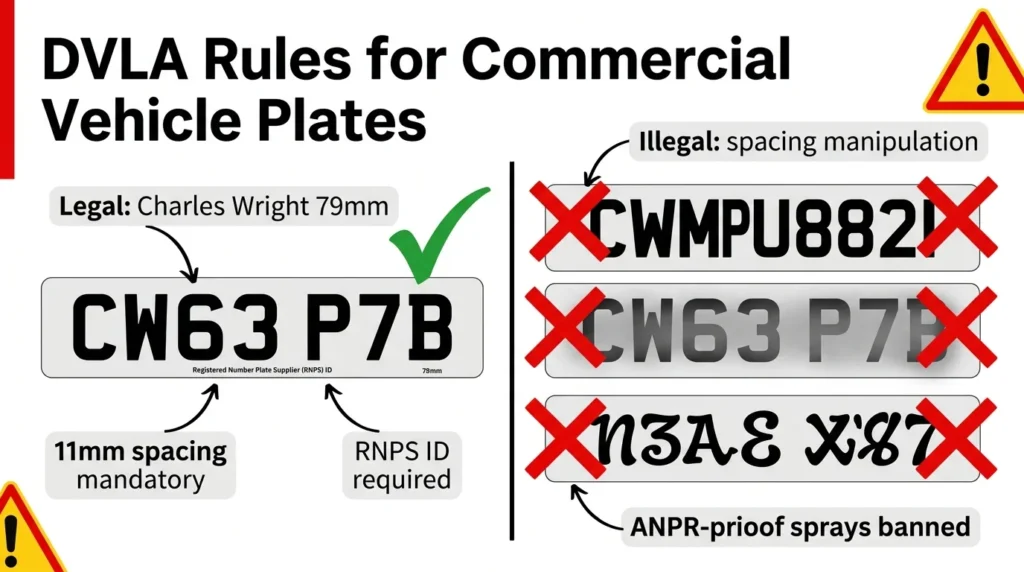
    All plates must display characters in the Charles Wright font, introduced in 2001 specifically for ANPR camera readability. The font specifications are precise: 79mm character height for standard vehicles, 50mm character width (excluding ‘I’ and ‘1’), 14mm stroke thickness, and 11mm spacing between characters. Any deviation constitutes a violation.

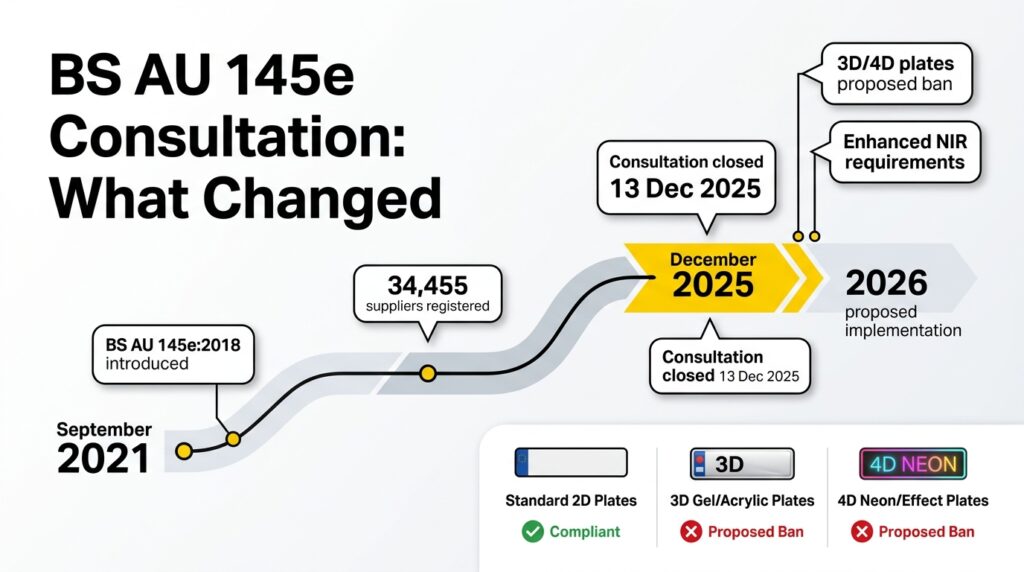
    Plates must be manufactured from materials meeting BS AU 145e:2018 standards, which mandate:

    • Reflectivity visible to ANPR cameras in all weather conditions
    • Impact resistance against stone chips and road debris
    • Weathering durability through UK winters without fading or delamination
    • Near-infrared (NIR) compatibility for traffic camera readability

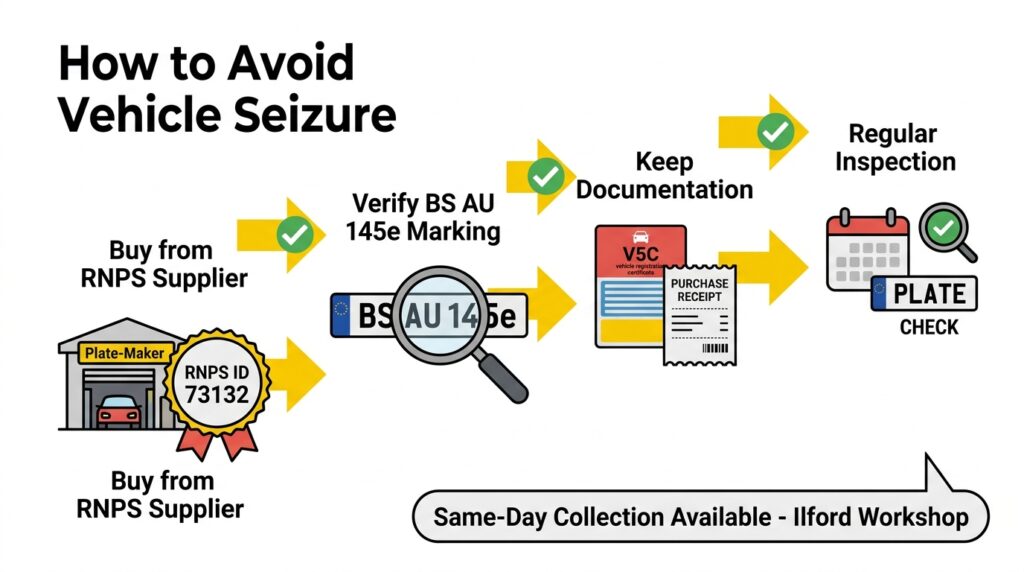
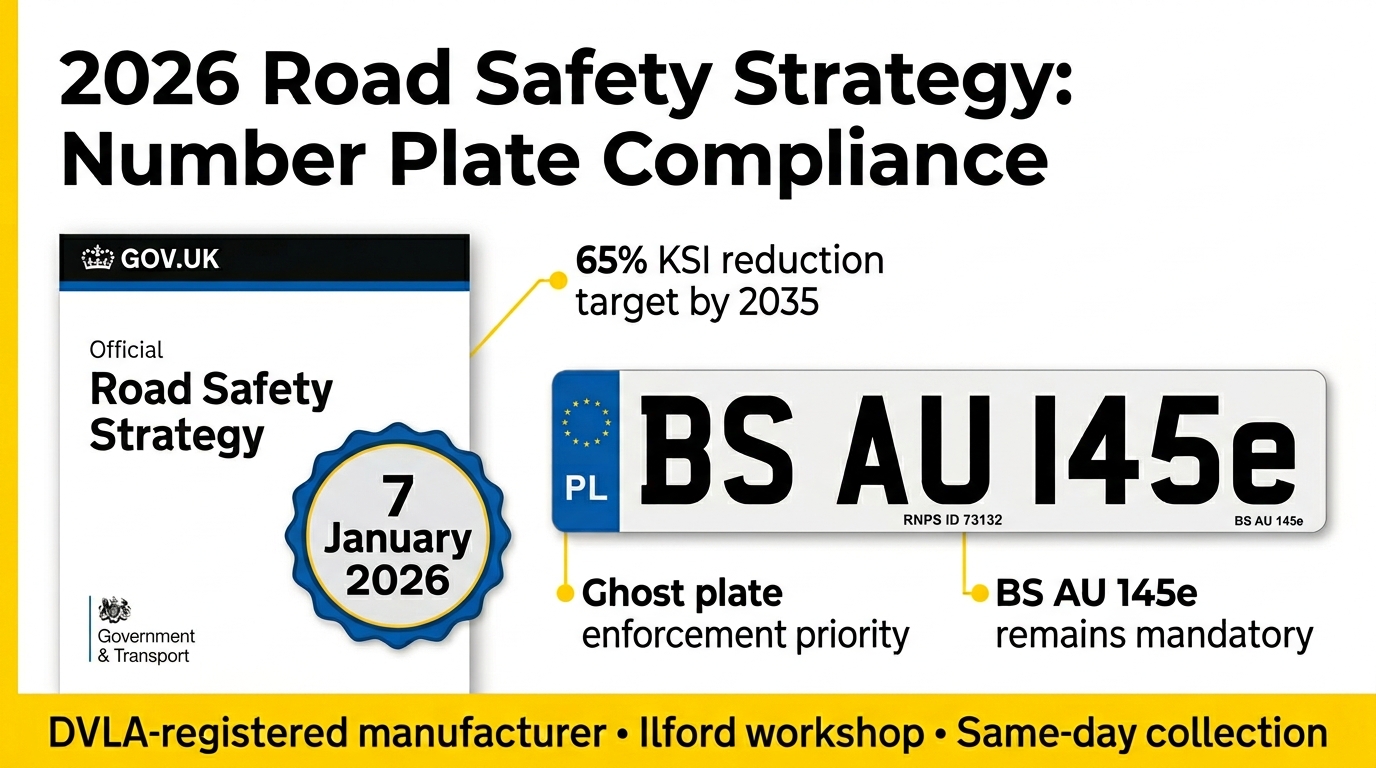
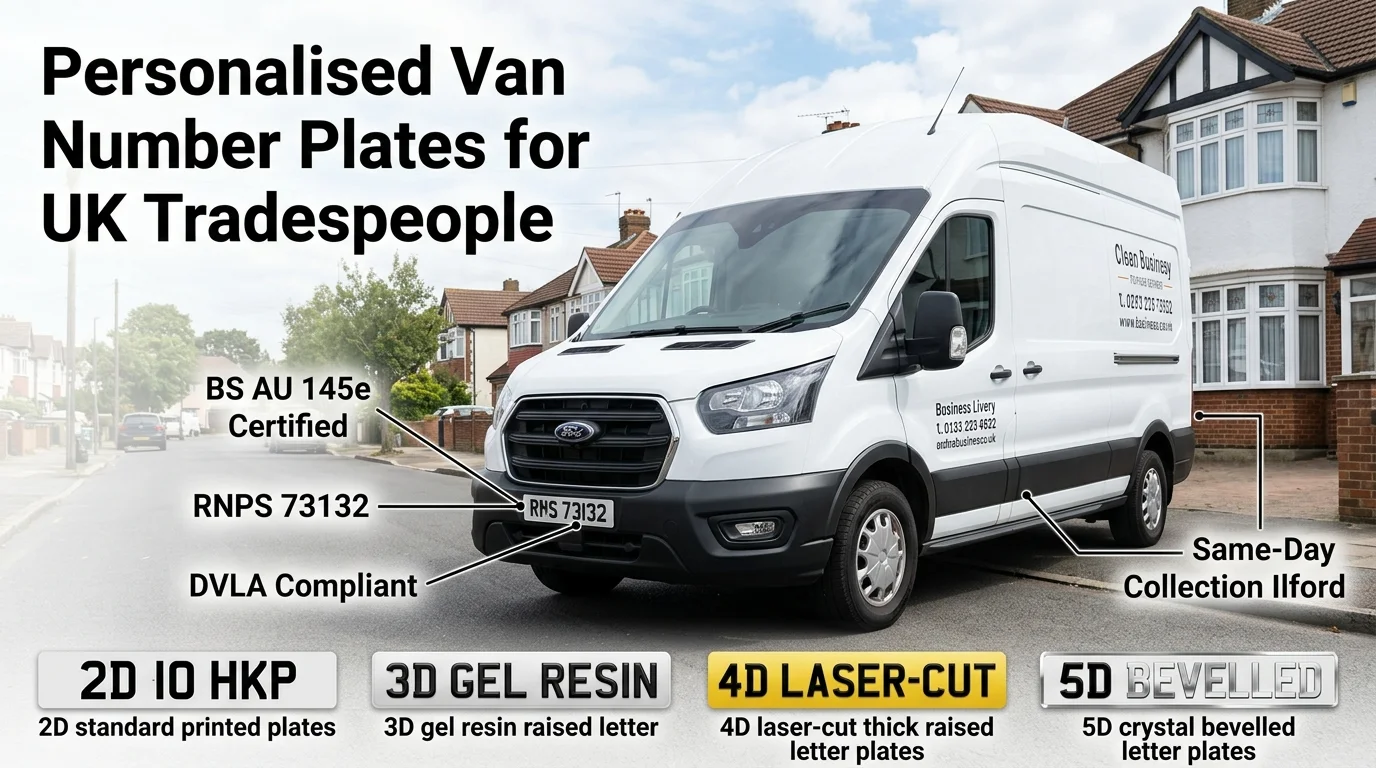
    The plate supplier must be DVLA-registered with the RNPS (Registered Number Plate Supplier) scheme and display their registration number on the plate itself. Plate-Maker.co.uk operates under RNPS ID 73132, and every plate we manufacture includes this identifier.

    Document Requirements:

    Under Schedule 2 of the Road Vehicles Regulations 2001, you must provide specific documentation before a legitimate supplier can manufacture plates:

    • Proof of identity: Valid driving licence, passport, recent utility bill, or council tax statement (note: bank statements are not accepted)
    • Proof of entitlement: V5C registration certificate, V750 certificate of entitlement, V778 retention document, V948 auction authorization, or new keeper slip

    Learn about DVLA document requirements

    Reputable manufacturers verify these documents before production. Any supplier willing to make plates without proper verification is operating illegally and likely producing non-compliant products.

    What You Cannot Do:

    The regulations explicitly prohibit:

    • Altering character spacing to create words or names (e.g., spacing “M3 RC” to read “MERC”)
    • Using bolts or fixings to change character appearance
    • Applying reflective sprays, films, or coatings that interfere with readability
    • Using fonts other than Charles Wright
    • Making the registration mark less visible or legible

    Violations can result in fines up to £1,000 (level 3 on the standard scale under Section 42 of the Vehicle Excise and Registration Act 1994), MOT failure, and potential vehicle seizure in serious cases.
    Popular Plate Styles for Business Vans

    When selecting plates for your commercial vehicle, you have several compliant options that balance professionalism with durability. The key is choosing styles that maintain BS AU 145e certification while suiting your van’s appearance and usage patterns.

    Standard 2D Plates:

    For many tradespeople, traditional 2D plates remain the practical choice. Manufactured with black characters on a reflective white (front) or yellow (rear) background, they offer maximum legibility and meet all legal requirements at the most economical price point. While they lack the premium appearance of raised-letter alternatives, they’re perfectly acceptable for work vehicles where functionality trumps aesthetics.

    View our Standard 2D Number Plates

    3D Gel Plates:

    3D gel plates have gained popularity among business owners seeking a more refined appearance without excessive cost. These feature raised black characters created from polyurethane gel resin bonded to an acrylic base. The gel creates a subtle three-dimensional effect that catches light differently than flat printing, adding visual interest while remaining fully compliant when manufactured correctly.

    Learn more about 3D Gel Plates

    The gel overlay provides additional durability against minor impacts and weathering, making them suitable for vans that regularly access construction sites or industrial areas where stone chips are common. However, the gel must not interfere with reflectivity or ANPR readability – a common failure point with cheap imports.

    4D Laser-Cut Plates:

    For businesses wanting maximum visual impact, 4D plates use laser-cut acrylic characters bonded to the plate base. The characters are cut from solid black acrylic, typically 3mm thick, creating sharp, precise edges with genuine depth. This style offers the most premium appearance while maintaining full legal compliance.

    Explore our 4D Laser-Cut Number Plates

    The laser-cutting process ensures perfect Charles Wright font compliance and consistent character spacing. The acrylic material is highly durable and resistant to fading, making 4D plates suitable for long-term use on commercial vehicles. At Plate-Maker, we manufacture all 4D plates on-site at our Ilford workshop using BS AU 145e-certified materials.

    5D Plates:

    5D plates combine 4D laser-cut acrylic with an additional gel overlay, creating dual-layer depth. The construction uses a 3mm acrylic base with a 2mm gel top layer, totaling 5mm depth. This style offers maximum visual prominence while remaining legal when properly manufactured.

    Discover our 5D Number Plates

    For business vans, 5D plates work well when you want your vehicle to project premium quality – particularly relevant for trades serving high-end residential markets or commercial clients who value presentation.

    Bevel Plates:

    Bevel plates feature faceted edges cut at approximately 45-degree angles into solid black acrylic, creating a distinctive geometric effect. The additional CNC machining and hand-polishing required makes these a premium option available in 3mm, 5mm, and 6mm thicknesses.

    See our Bevel Number Plates

    The bevelled effect catches light dynamically as the vehicle moves, creating visual interest without violating any regulations. These plates work particularly well on modern vans with clean, contemporary styling.

    Branding Benefits vs. Legal Compliance

    The temptation to push branding boundaries is understandable for small business owners competing in crowded local markets. However, the distinction between legal customisation and illegal modification is critical and non-negotiable.

    What Constitutes Legal Branding:

    • Selecting a personalised registration that relates to your business name or trade (e.g., “PLB 123C” for a plumbing business)
    • Choosing premium plate styles (3D, 4D, 5D, bevel) that enhance visual appeal while maintaining compliance
    • Ensuring plates are clean, well-maintained, and properly fitted
    • Combining plates with professional van livery and signage
    • Using plates from DVLA-registered manufacturers who verify documents and display RNPS IDs

    What Crosses Into Illegal Territory:

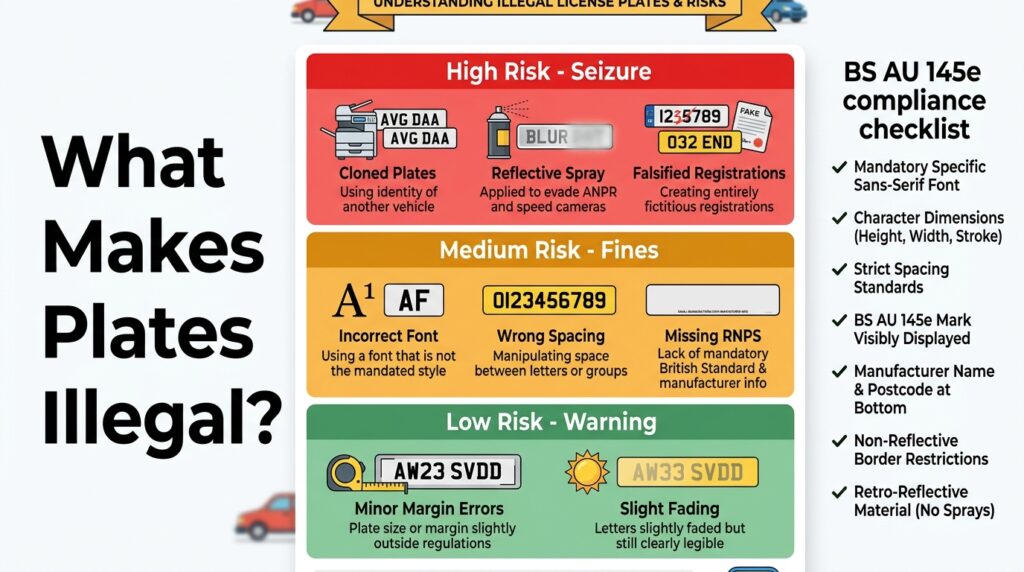
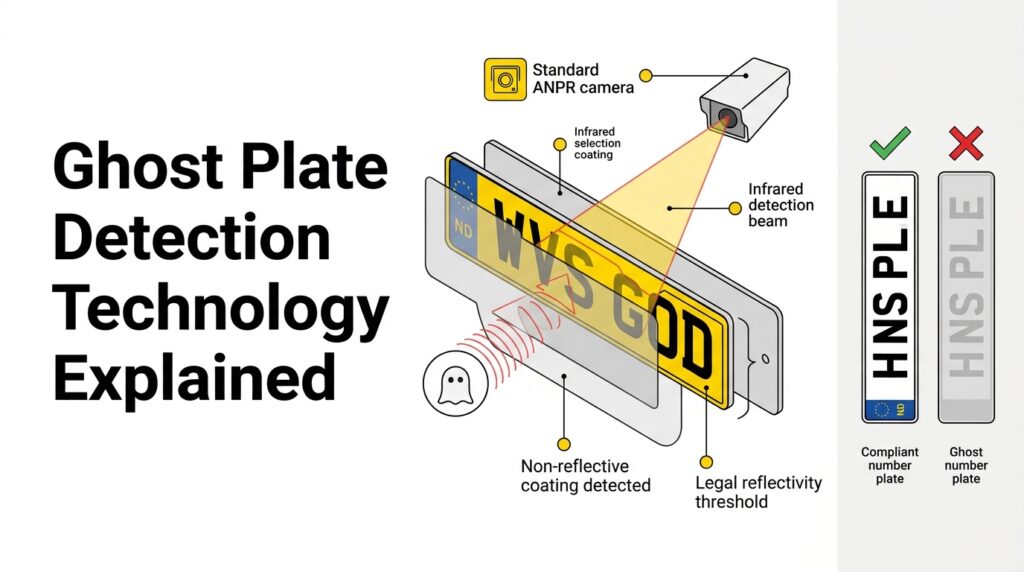
    • “Ghost plates” using reflective sprays or films that claim to be “ANPR-proof” – these fail reflectivity requirements and are explicitly illegal
    • Altering character spacing to spell words (e.g., “F3 RRY” to read “FERRY”)
    • Using non-standard fonts or colours
    • Applying tinted covers or protective films that reduce visibility
    • Plates claiming to be “show plates only” being used on public roads
    • Suppliers who don’t require documentation or aren’t RNPS-registered

    Read our guide: Are Ghost Plates Legal?

    The enforcement landscape has tightened considerably. Police forces across the UK have increased ANPR camera deployment, and these systems automatically flag vehicles with non-readable plates. Trading Standards conducts regular operations targeting illegal plate suppliers, with several high-profile prosecutions in recent years.

    For business owners, the consequences extend beyond the statutory £1,000 fine. A vehicle with illegal plates fails its MOT, meaning you cannot legally drive it to work until rectified. If stopped by police, your van could be impounded, leaving you unable to fulfill customer commitments. The reputational damage from being associated with illegal modifications can undermine the professional image you’re trying to build.

    The Smart Approach:

    Invest in a legitimate personalised registration through the DVLA’s official channels. You can purchase registrations directly from the DVLA or from authorised dealers. Once you own the registration rights, have plates manufactured by a DVLA-registered supplier like Plate-Maker who will verify your documentation and produce BS AU 145e-compliant plates.

    Order custom business van plates

    This approach gives you permanent branding assets that enhance your business image without any legal risk. The registration belongs to you and can be transferred between vehicles or retained on a V778 document if you change vans.

    How to Choose the Right Plates for Your Business Van

    Selecting appropriate plates for your commercial vehicle requires balancing several factors: budget, desired appearance, durability needs, and legal compliance. Here’s a framework for making the right decision.

    Assess Your Usage Patterns:

    Vans operating primarily in urban environments with frequent stop-start driving benefit from the enhanced visibility of 3D or 4D plates, which stand out more clearly in traffic. Vehicles regularly accessing construction sites, quarries, or industrial areas need plates with superior impact resistance – 4D laser-cut acrylic or 5D dual-layer construction offers the best protection against stone chips and debris.

    For vans covering high annual mileage, invest in premium plates that won’t fade or delaminate. BS AU 145e:2018 standards require weathering resistance, but higher-quality materials and manufacturing processes deliver better long-term results.

    Consider Your Market Positioning:

    If your business serves premium residential markets or commercial clients who value presentation, 4D or 5D plates signal attention to detail and quality. The additional cost (typically £15-30 more per plate than standard 2D) is modest compared to the overall impression it creates.

    For price-sensitive markets where customers prioritize value over presentation, well-maintained standard 2D plates are perfectly acceptable. The key is ensuring they’re clean, undamaged, and properly fitted – a dirty or damaged premium plate looks worse than a clean standard plate.

    Evaluate Total Cost of Ownership:

    While initial cost matters, consider the plate’s lifespan. Cheap plates from unverified suppliers may fail within months due to fading, delamination, or damage, requiring replacement and potentially exposing you to legal risk. Plates manufactured by DVLA-registered suppliers using certified materials typically last the life of the vehicle with proper care.

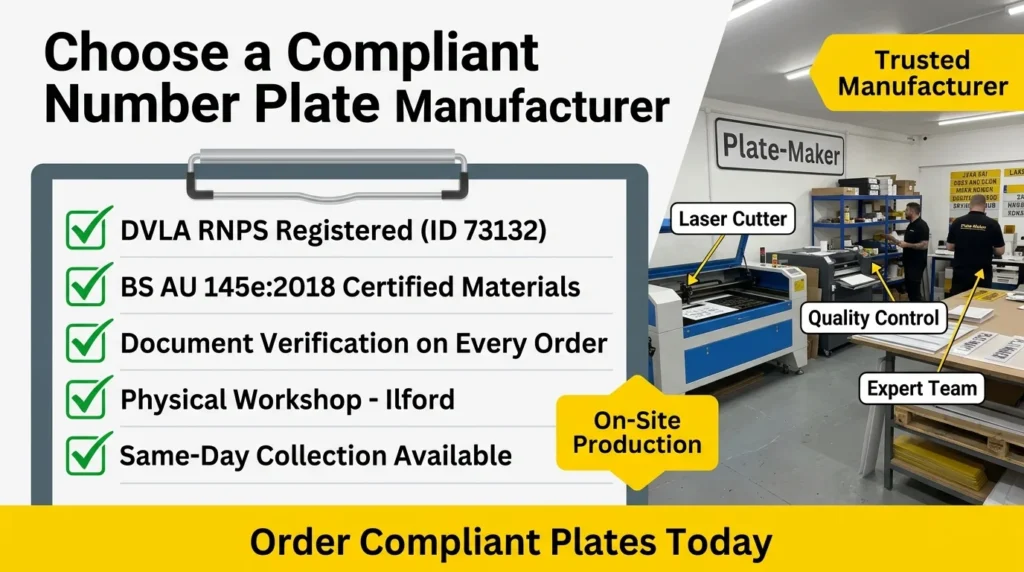
    At Plate-Maker, our Ilford workshop manufactures all plates on-site with rigorous quality control. We offer same-day collection for local customers in East London, Ilford, Barking, Romford, and Dagenham, eliminating delivery delays when you need plates urgently.

    Document Your Compliance:

    Keep records of your plate purchase, including the supplier’s RNPS registration number and proof of BS AU 145e certification. If ever questioned by police or MOT testers, you can demonstrate due diligence in sourcing compliant plates. Reputable suppliers like Plate-Maker provide documentation with every order.

    Plan for Maintenance:

    Regardless of plate style, regular cleaning maintains appearance and ensures ANPR readability. Use mild soap and water, avoiding abrasive cleaners that could damage reflective surfaces or gel coatings. Inspect plates regularly for damage, particularly after incidents involving stone chips or minor collisions.

    Practical Takeaways for Small Business Owners

    For New Businesses:

    • Budget for a personalised registration as part of your initial branding investment
    • Start with standard 2D or 3D gel plates to manage costs while maintaining professionalism
    • Ensure your van livery and plates work together cohesively
    • Always use DVLA-registered plate manufacturers who verify documents

    For Established Businesses Upgrading:

    • Consider 4D or 5D plates to refresh your vehicle’s appearance
    • Evaluate whether your current registration supports your brand identity
    • Replace damaged or faded plates immediately to avoid MOT failures
    • Document your compliance with proper supplier records

    What to Avoid:

    • Suppliers offering plates without document verification
    • “Show plate” or “off-road use only” plates used on public roads
    • Reflective sprays, films, or coatings claiming ANPR evasion
    • Altered character spacing or non-standard fonts
    • Prices that seem too good to be true (often indicate non-compliance)

    How Plate-Maker Ensures Compliance:

    • DVLA-registered manufacturer (RNPS ID 73132)
    • On-site manufacturing at our Eastern Avenue, Ilford workshop
    • BS AU 145e:2018 certified materials only
    • Mandatory document verification per Schedule 2 requirements
    • Charles Wright font compliance guaranteed
    • Same-day collection available for urgent needs
    • Next-day UK delivery for remote customers

    Next Steps:

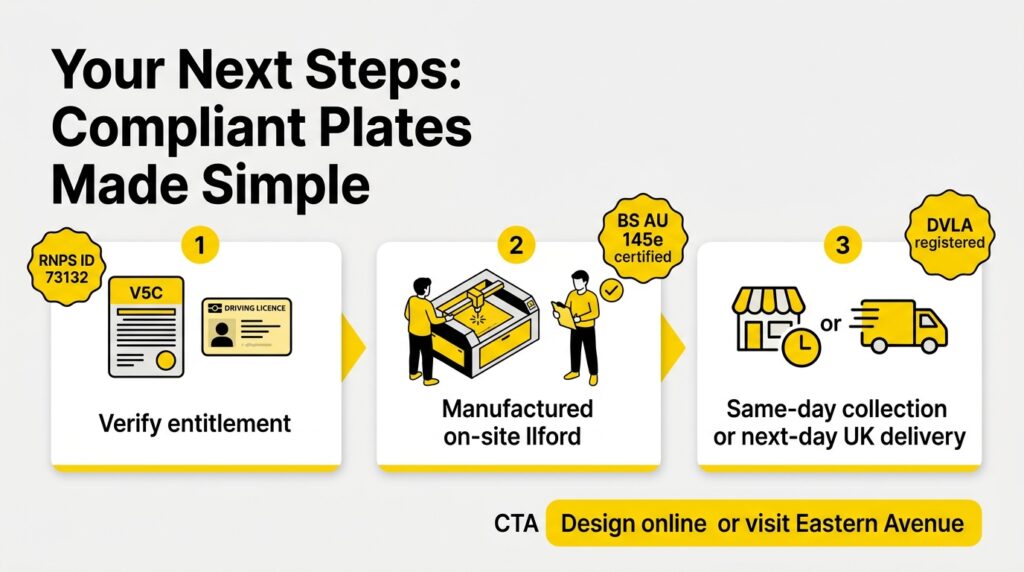
    1. Select your personalised registration through the DVLA or authorised dealers
    2. Gather required documentation (proof of identity and entitlement)
    3. Choose your plate style based on usage and branding needs
    4. Order from a DVLA-registered manufacturer like Plate-Maker
    5. Fit plates correctly using appropriate fixings
    6. Maintain plates through regular cleaning and inspection

    Find tradesman private registrations

    Frequently Asked Questions

    Are personalised number plates legal for commercial vans?

    Yes, personalised registrations are fully legal for commercial vehicles when displayed on BS AU 145e-certified plates using the mandatory Charles Wright font with correct spacing. The Road Vehicles Regulations 2001 apply equally to private and commercial vehicles. You must purchase plates from a DVLA-registered supplier (RNPS) who verifies your documentation. Plates cost from £24.95 for standard 2D up to £59.95 for premium 5D styles.

    How much do business van number plates cost?

    Standard 2D plates start from £24.95 per pair, 3D gel plates from £34.95, 4D laser-cut plates from £44.95, and 5D dual-layer plates from £54.95. These prices reflect manufacturing complexity and materials. The personalised registration itself is purchased separately through the DVLA, with prices ranging from £250 to thousands depending on desirability. Plate-Maker offers same-day collection from our Ilford workshop at no extra charge.

    Can I use ghost plates or tinted covers on my work van?

    No, ghost plates using reflective sprays or films are illegal on any road vehicle, including commercial vans. Similarly, tinted covers violate the Road Vehicles Regulations 2001 by reducing plate visibility and reflectivity. Both can result in £1,000 fines, MOT failure, and potential vehicle seizure. Legal alternatives include 3D, 4D, 5D, or bevel plates that offer premium appearance while maintaining full compliance with BS AU 145e standards.

    What documents do I need to order van number plates?

    Under Schedule 2 of the Road Vehicles Regulations 2001, you must provide proof of identity (valid driving licence, passport, utility bill, or council tax statement – not bank statements) and proof of entitlement (V5C registration certificate, V750, V778, V948, or new keeper slip). DVLA-registered suppliers like Plate-Maker (RNPS 73132) must verify these documents before manufacturing plates. Suppliers who don’t request documentation are operating illegally.

    Can I space characters on my van plate to create a business name?

    No, altering character spacing to create words or names is explicitly prohibited under the Road Vehicles Regulations 2001. For example, spacing “M3 RC ED” to read “MERC ED” is illegal regardless of intent. Characters must maintain mandatory spacing: 11mm between characters, 33mm gap around the age identifier, with 79mm character height for cars and vans. Violations can result in £1,000 fines and MOT failure. Choose a registration that naturally relates to your business without requiring spacing manipulation.

    How quickly can I get number plates for my business van?

    Plate-Maker offers same-day collection from our Ilford workshop (242 Eastern Ave, IG4 5AB) for customers who can visit in person, typically within 30-60 minutes of document verification and order placement. For remote customers, we provide next-day UK delivery via tracked courier. This is significantly faster than non-compliant suppliers who may take weeks, and ensures your van remains legal and operational. Bring your V5C and proof of identity to our workshop for immediate service.

    Conclusion

    Personalised van number plates offer legitimate branding opportunities for UK tradespeople and small businesses when approached correctly. The key is selecting a meaningful registration, choosing appropriate plate styles that match your business image, and ensuring full compliance with DVLA regulations through RNPS-registered manufacturers.

    The investment in quality plates from verified suppliers like Plate-Maker protects your business from legal risks while delivering professional results that enhance your vehicle’s appearance. With same-day collection available from our Ilford workshop and comprehensive documentation provided with every order, you can confidently brand your commercial vehicle without compromising compliance.

    Ready to upgrade your van’s appearance? Start by browsing our range of BS AU 145e-certified 3D Gel Number Plates or visit our Eastern Avenue workshop for same-day collection in Ilford. Remember, proper documentation is mandatory – have your V5C and proof of identity ready when you order.
  • 50 Cheeky Number Plates That Slipped Through DVLA Filtering: What’s Actually Legal?

    50 Cheeky Number Plates That Slipped Through DVLA Filtering: What’s Actually Legal?

    Executive Summary

    The DVLA operates a comprehensive filtering system to prevent offensive and inappropriate number plates from being issued, but some registrations with double meanings or cheeky interpretations have legitimately passed through. These plates comply with all Road Vehicles Regulations 2001 requirements while offering owners a subtle humorous element. However, it’s crucial to understand that the DVLA maintains an active banned list and can withdraw plates if complaints arise, even after initial approval.

    At Private Number Plate Maker Ltd (RNPS ID: 73132), we manufacture BS AU 145e-compliant plates for registrations that have legitimately passed DVLA screening. Our Ilford workshop verifies every document against Schedule 2 requirements before production, ensuring your cheeky plate remains fully legal on UK roads. Whether you need replacement number plates or premium styled plates, we ensure full compliance.

    The key distinction is between plates that use innocent letter-number combinations with humorous interpretations versus those that actually breach DVLA offensive plate filter rules. This guide examines real examples, explains the filtering process, and helps you understand what makes a plate both amusing and compliant.

    Understanding the DVLA’s Offensive Plate Filter System

    How the DVLA Screening Process Works

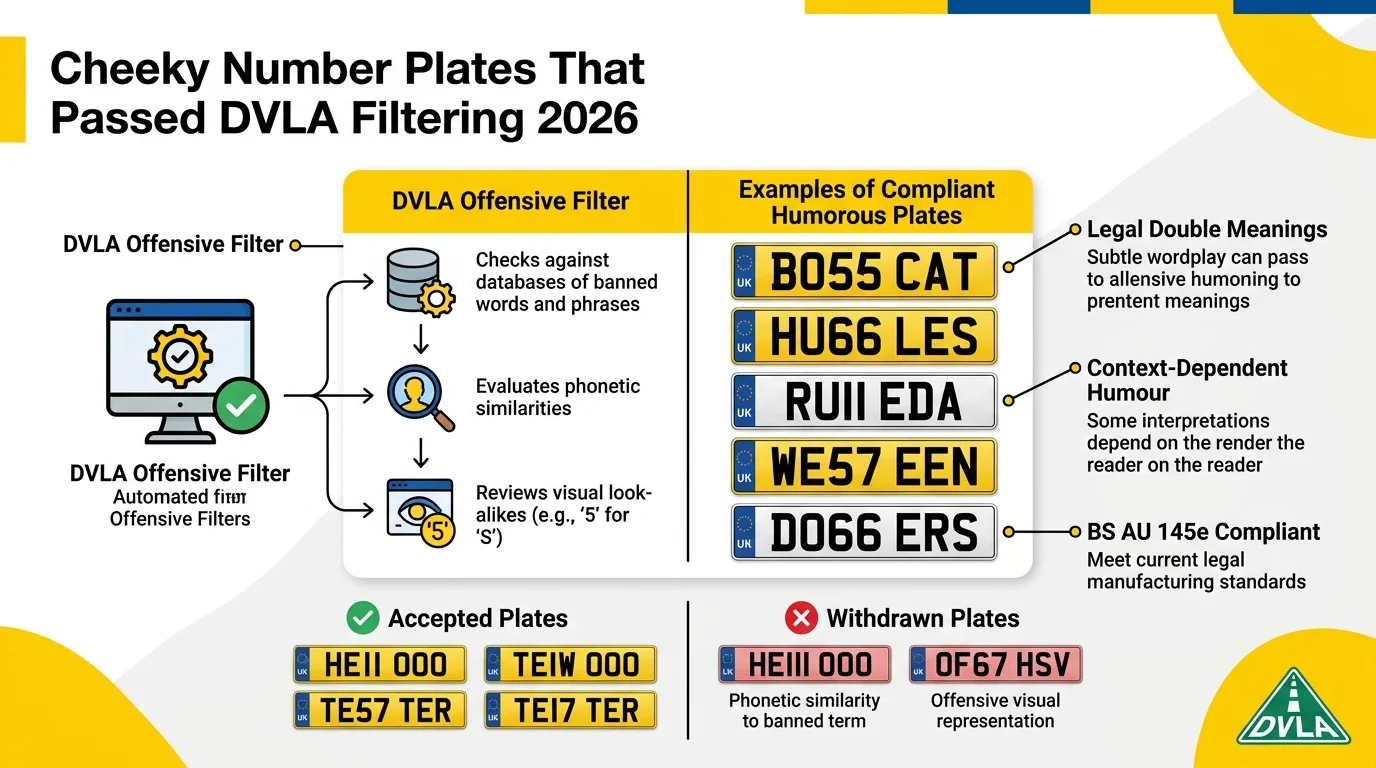
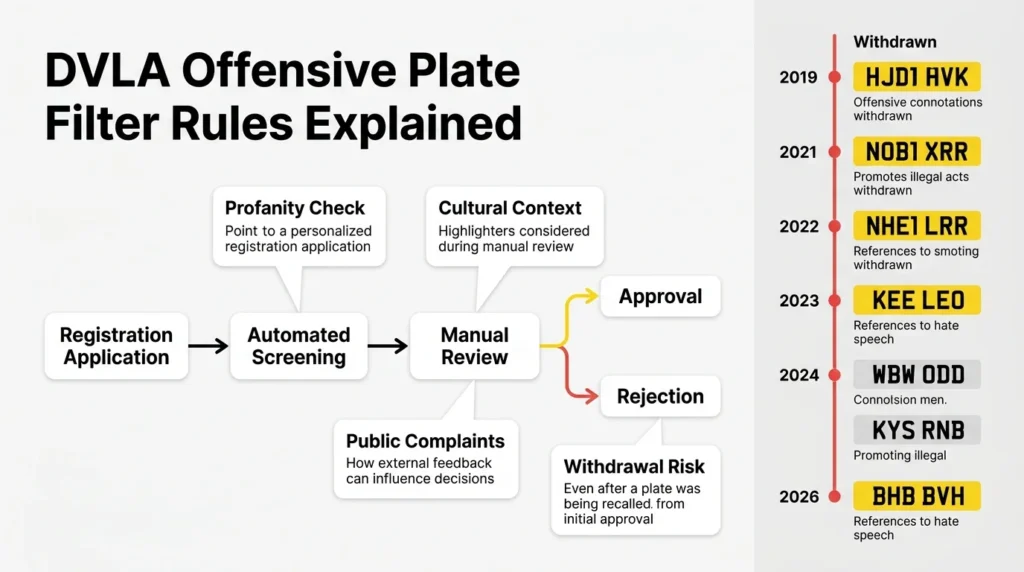
    The DVLA employs automated and manual screening processes to identify potentially offensive registrations before they reach the market. This system checks combinations against multiple criteria including profanity, sexual references, racial slurs, and religious offence. The filter operates on the principle of preventing plates that could cause “distress, anger or revulsion” to reasonable members of the public.

    Under the Vehicle Excise and Registration Act 1994, the DVLA has discretionary power to withhold or withdraw registration marks deemed offensive. This authority extends to plates that may have initially passed screening but later generate significant public complaints. The department maintains a confidential banned list that is regularly updated based on emerging slang, cultural shifts, and feedback from police forces and the public.

    (DVLA Document Requirements) The screening process examines both the literal reading of characters and potential interpretations when viewed quickly or from different angles. This is why some plates with innocent letter combinations can create humorous double meanings when read in context with vehicle makes or models.

    Why Some Cheeky Plates Pass Through

    Several factors explain why certain registrations with cheeky interpretations successfully navigate the DVLA filtering system. First, the automated filters primarily target explicit profanity and clear offensive terms rather than subtle innuendo or context-dependent humour. A registration that appears innocent in isolation may take on different meaning when displayed on a specific vehicle model.

    Second, the DVLA assesses plates based on contemporary standards at the time of issue. Language evolves rapidly, and terms considered harmless a decade ago may now carry offensive connotations. Conversely, some combinations that seem questionable today may have been issued before their problematic interpretation became widespread.

    (Standard 2D Number Plates UK) Third, the sheer volume of possible character combinations means some plates inevitably slip through initial screening. The DVLA processes millions of registration combinations, and while the filter is sophisticated, it cannot catch every potential interpretation, particularly those requiring specific cultural knowledge or vehicle context to understand.

    The Legal Framework Governing Plate Content

    The Road Vehicles (Display of Registration Marks) Regulations 2001 govern what can appear on number plates, but these regulations focus primarily on technical specifications rather than content restrictions. The regulations mandate Charles Wright font, specific character dimensions, spacing requirements, and reflectivity standards under BS AU 145e:2018.

    (BS AU 145e Explained) Content restrictions derive from the DVLA’s discretionary powers under primary legislation rather than detailed regulations. This means the department can withdraw plates on a case-by-case basis without needing to prove violation of specific regulatory language. The lack of precise statutory definitions creates some ambiguity about where the line between acceptable and offensive lies.

    Section 42 of the Vehicle Excise and Registration Act 1994 provides for fines up to level 3 on the standard scale (currently £1,000) for displaying unauthorised registration marks. While this primarily targets plates that don’t match V5C documentation, it also applies to plates the DVLA has withdrawn as offensive.

    Real Examples of Compliant Cheeky Number Plates

    Name-Based Registrations with Humorous Interpretations

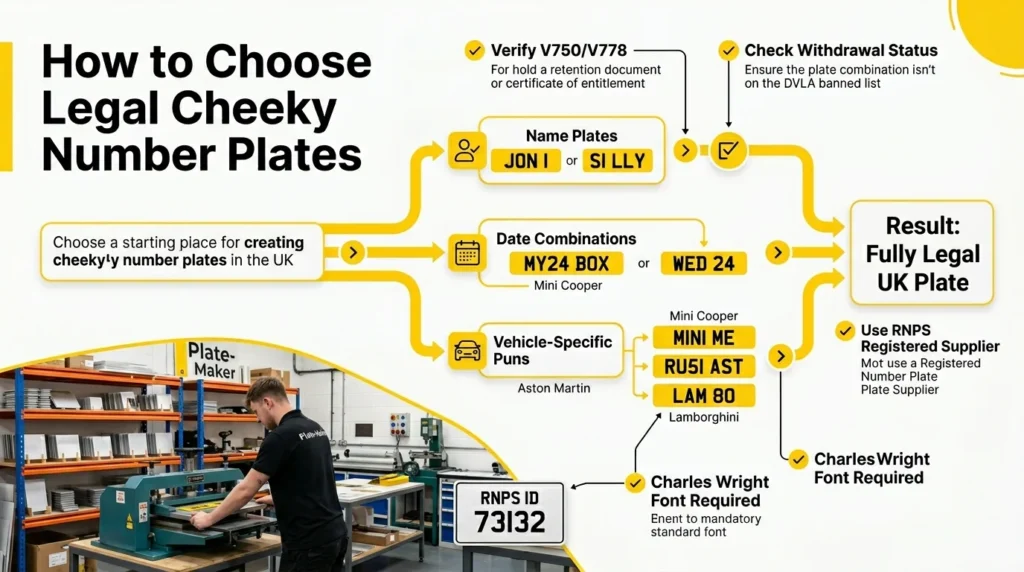
    Name plates represent one of the largest categories of registrations with cheeky potential. These plates use common names or name-like combinations that take on different meanings when displayed on particular vehicles. For instance, registrations spelling out names like “BEN ZIN” or “PETE ROL” remain compliant because they represent legitimate name formats, even though they create automotive puns.

    (3D Gel Number Plates) The DVLA generally permits name plates unless they explicitly spell offensive words. This means registrations like “ANNA GRAM” or “MICK UP” can pass screening as they follow standard name patterns. The humour derives from context and pronunciation rather than explicit content, keeping them within acceptable parameters.

    Name-based plates also benefit from the DVLA’s recognition that names vary widely across cultures and communities. What might appear as a cheeky combination to one person could be a genuine family name to another. This cultural sensitivity means the filtering system errs on the side of permitting registrations unless they clearly violate offensive content guidelines.

    Date and Age-Related Combinations

    Date-format registrations occasionally create humorous associations when combined with specific vehicle models or owner circumstances. Plates featuring years like “18 YO” or “21 ST” can suggest age-related themes while remaining technically compliant as date or number formats. The DVLA assesses these based on their literal format rather than potential interpretations.

    (EV Plates Guide) Age identifier plates introduced in 2001 use a system where the code indicates when a vehicle was first registered. Some of these codes, when combined with preceding letters, can create amusing combinations. For example, plates issued in specific periods to particular regions might spell out words or phrases when read together, though this is coincidental rather than intentional.

    The key distinction is that these plates follow standard DVLA formatting rules and use legitimate age identifiers. They don’t manipulate the system or use unauthorised characters. The humour emerges from the interaction between the registration format and external factors like vehicle type or owner characteristics.

    Vehicle-Specific Humorous Combinations

    Some of the most successful cheeky plates exploit the relationship between the registration and the vehicle make or model. A registration like “FERR ARI” on a Ferrari or “LAM BO” on a Lamborghini creates humour through brand association while using legitimate character combinations. These plates pass DVLA screening because the letters themselves aren’t offensive – the joke requires the vehicle context.

    (4D Laser-Cut Number Plates) This category also includes plates that play on vehicle characteristics. Registrations suggesting speed, size, or performance attributes remain compliant as long as they don’t use explicit language. The DVLA recognises that vehicle enthusiasts often seek personalised plates reflecting their automotive passion, and permits combinations that celebrate cars without crossing into offensive territory.

    The temporary nature of some interpretations also protects these plates. A registration that seems cheeky on one vehicle type might be completely innocent on another. This context-dependency means the DVLA cannot reasonably ban the plate itself, only specific uses that might generate complaints.

    Regional and Cultural Wordplay

    Regional registration codes combined with specific number sequences can create locally-understood humour while remaining compliant. Plates using area codes like “SCO” for Scotland or “WAL” for Wales followed by particular numbers might reference regional stereotypes or inside jokes without violating DVLA offensive plate filter rules.

    (Ghost Plates Guide) Cultural references that require specific knowledge to understand also tend to pass screening. The DVLA filter cannot reasonably identify every possible interpretation across different subcultures, age groups, and communities. Plates that seem innocent to screening staff might carry humorous meaning to those with particular interests or backgrounds.

    This category includes plates referencing pop culture, historical events, or specialist knowledge. As long as the character combination doesn’t explicitly violate content guidelines, these registrations can be issued even if they carry layered meanings for certain audiences.

    What Makes a Cheeky Plate Actually Legal

    Technical Compliance Requirements

    For any registration to be legal on UK roads, the physical plate must meet strict technical specifications regardless of the registration’s content. Under BS AU 145e:2018, plates must use specific materials with defined reflectivity, impact resistance, and weathering properties. The standard requires NIR compatibility so ANPR cameras can read plates in all conditions.

    (Charles Wright Font Guide) Character specifications are non-negotiable. All plates must display characters in the mandatory Charles Wright font with precise dimensions: 79mm character height for cars, 50mm character width (excluding ‘I’ and ‘1’), 14mm stroke thickness, and 11mm character spacing. The age identifier gap must measure 33mm, with minimum 11mm margins on all sides.

    Any deviation from these specifications renders a plate illegal, regardless of whether the registration itself is authorised. This includes using incorrect fonts, wrong character spacing, non-compliant materials, or unauthorised embellishments that affect readability or reflectivity.

    Document Verification and Entitlement

    Legal possession of a registration requires proper documentation under Schedule 2 of the Road Vehicles Regulations 2001. You must provide proof of identity (driving licence, passport, utility bill, or council tax statement) and proof of entitlement (V5C registration certificate, V750 certificate of entitlement, V778 retention document, V948 authorisation, or new keeper slip).

    (DVLA Document Requirements) At our Ilford workshop, we verify every document before manufacturing plates. This process protects both customers and manufacturers from inadvertently producing plates for registrations that haven’t been properly transferred or retained. Even if a registration passed DVLA screening initially, you cannot legally display it without current entitlement documentation.

    The document verification requirement applies equally to cheeky plates and standard registrations. The humorous nature of a plate doesn’t exempt it from standard legal requirements. In fact, unusual registrations may attract additional police scrutiny, making proper documentation even more critical.

    Understanding the Withdrawal Risk

    The DVLA reserves the right to withdraw registration marks at any time if they generate complaints or if their offensive nature becomes apparent. This means a plate that passed initial screening could later be deemed unacceptable. The department maintains records of withdrawn plates and can flag them in the system to prevent reissue.

    When the DVLA withdraws a plate, owners receive notification and must surrender their V750 or V778 documentation. Continuing to display a withdrawn registration constitutes an offence under the Vehicle Excise and Registration Act 1994, potentially resulting in fines up to £1,000 and MOT failure.

    (Are Ghost Plates Legal Guide) This withdrawal risk particularly affects plates whose offensive interpretation emerges over time due to changing language, cultural shifts, or specific incidents. A registration that seemed innocent when issued might later be associated with offensive slang or become problematic due to current events.

    Market Trends in Humorous Registration Purchases

    Rising Demand for Personalised Plates

    The personalised registration market has experienced sustained growth, with DVLA data showing increasing interest in plates with humorous or meaningful combinations. Recent auction results demonstrate that buyers are willing to pay premium prices for registrations that create clever wordplay or reflect personal interests, provided they remain within DVLA guidelines.

    (Bevel Plates) This trend reflects broader consumer desire for vehicle personalisation and individual expression. As cars become more standardised in design, number plates offer one of the few legal ways to distinguish vehicles and express personality. The cheeky plate market caters to buyers seeking subtle humour rather than explicit content.

    Market analysis suggests that name plates and date combinations with humorous potential command higher resale values than random sequences. Investors in the personalised plate market specifically seek registrations with multiple interpretations or contextual humour, recognising their broader appeal.

    Price Variations by Interpretation Level

    Registrations with obvious cheeky interpretations typically command higher prices than those requiring specific knowledge or context. Plates that create immediate visual puns or spell out recognisable words sell for premiums compared to subtle combinations. This pricing reflects both demand and the relative scarcity of clear humorous combinations within DVLA-compliant parameters.

    (5D Number Plates) The DVLA’s own auction results show that plates with automotive references, name puns, and date-related humour consistently achieve strong prices. However, these remain significantly lower than plates explicitly banned or withdrawn, which cannot be legally traded. The market self-regulates to some extent, with dealers avoiding plates likely to be withdrawn.

    Private sales of cheeky plates require careful documentation to ensure legal transfer. Buyers should verify that plates haven’t been withdrawn and that sellers hold valid V778 retention documents or V5C certificates showing entitlement.

    Regional Variations in Plate Preferences

    Different regions show varying preferences for types of humorous plates. Area-specific registrations using local codes combined with particular numbers may have special meaning in certain communities while remaining obscure elsewhere. This regional variation affects both demand and the likelihood of complaints triggering DVLA withdrawal.

    (Same Day Collection Ilford) Urban areas with diverse populations tend to generate more complaints about potentially offensive plates, leading to higher withdrawal rates in these regions. Conversely, plates that reference local culture or dialect might pass unnoticed in their home areas but cause offence if displayed elsewhere. This geographic complexity makes predicting plate acceptability challenging.

    Our Ilford workshop serves customers across East London and nationwide, and we’ve observed that local knowledge significantly influences plate selection. Customers often seek registrations with meaning specific to their community while avoiding combinations that might cause unintended offence.

    Practical Takeaways for Buyers

    What to Look For When Choosing a Cheeky Plate

    When selecting a registration with humorous potential, prioritise combinations that derive humour from context rather than explicit content. Name plates, date formats, and vehicle-specific puns offer the safest route to cheeky humour while maintaining DVLA compliance. Verify that the registration uses standard DVLA formatting without unauthorised characters or spacing.

    (Plate Builder) Before purchasing, consider how the plate reads on different vehicle types and whether the humour relies on specific circumstances that might change. A registration that seems clever now might become problematic if your situation changes or if cultural attitudes shift. Think long-term about whether you’ll still appreciate the humour in five or ten years.

    Always request documentation proving current entitlement before completing any purchase. For plates on retention, ensure the seller provides a valid V778 document. For plates on vehicles, verify the V5C shows the seller as registered keeper and that the registration isn’t flagged as withdrawn.

    Red Flags and Illegal Alternatives to Avoid

    Avoid any supplier offering “ANPR-proof” plates, reflective sprays, or films designed to obscure registrations. These products violate BS AU 145e requirements and can result in fines up to £1,000, penalty points, and MOT failure. The DVLA actively pursues enforcement against such products, and Trading Standards regularly conducts raids on suppliers.

    (Are Bevel Plates Legal Guide) Be wary of plates using non-standard fonts, incorrect character spacing, or unauthorised embellishments. Even if the registration itself is legitimate, non-compliant plate construction renders it illegal. Some suppliers offer “ghost plates” with reduced reflectivity or gradient effects that fail BS AU 145e standards – these are illegal regardless of the registration content.

    Never purchase plates from suppliers who don’t verify documents or who offer to manufacture plates without seeing your V5C, V750, or V778. Legitimate manufacturers like Private Number Plate Maker Ltd must verify entitlement under RNPS requirements. Suppliers skipping this step are likely producing illegal plates.

    How Plate-Maker Ensures Full Compliance

    As a DVLA-registered manufacturer (RNPS ID: 73132), we verify every document against Schedule 2 requirements before producing plates. Our Ilford workshop maintains detailed records of all plates manufactured, including copies of entitlement documentation. This protects both our business and our customers from inadvertently producing or displaying illegal plates.

    (3D vs 4D vs 5D) We manufacture all plates on-site at our Eastern Avenue workshop using BS AU 145e-certified materials. Every plate undergoes quality control checks to ensure correct Charles Wright font, precise character spacing, proper reflectivity, and NIR compatibility. We don’t drop-ship or outsource production, giving us complete control over compliance.

    Our document verification process catches potential issues before plates leave the workshop. If a registration has been withdrawn or documentation appears questionable, we’ll identify this before manufacturing. This diligence means customers can trust that plates from our workshop meet all legal requirements.

    Next Steps for Ordering Your Plate

    Start by confirming your entitlement to the registration through DVLA records. If you’re purchasing a plate, ensure the transfer process is complete and you hold valid documentation before ordering physical plates. Use our online plate builder (Plate Builder) to design compliant plates in your preferred style – 2D, 3D gel, 4D laser-cut, 5D, or bevel.

    For customers near our Ilford location, we offer same-day collection from our Eastern Avenue workshop. Bring your original documents for verification, and we can manufacture plates while you wait. For nationwide customers, we offer next-day delivery to any UK address, with all plates manufactured to identical BS AU 145e standards.

    If you’re uncertain whether a registration might be problematic, contact our team before ordering. We can advise on compliance issues and help ensure your cheeky plate remains legal on UK roads. Our expertise in DVLA regulations and BS AU 145e requirements means we spot potential issues before they become problems.

    Whether you’re looking for subtle 3D number plates, premium 4D number plates, or distinctive bevel number plates, we ensure full compliance with all legal requirements.

    Frequently Asked Questions

    Are cheeky number plates legal in the UK?

    Yes, cheeky number plates are legal if they passed DVLA screening and haven’t been withdrawn. The DVLA filters offensive registrations before issue, but some plates with humorous double meanings legitimately pass through. However, the DVLA can withdraw plates at any time if complaints arise. All plates must meet BS AU 145e:2018 standards and use Charles Wright font with correct spacing to remain legal.

    How much do compliant novelty number plates cost?

    Compliant novelty plates start from £39.95 per plate for standard 2D acrylic, with 3D gel plates from £49.95, 4D laser-cut from £59.95, and 5D plates from £69.95. Prices reflect the registration’s market value, not manufacturing costs. The DVLA auction results show humorous plates can sell for hundreds or thousands depending on desirability. Always verify you hold valid V750 or V778 documentation before ordering physical plates.

    Can the DVLA withdraw my plate after I buy it?

    Yes, the DVLA reserves the right to withdraw registration marks at any time under the Vehicle Excise and Registration Act 1994, even after purchase and transfer. If a plate generates complaints or its offensive nature becomes apparent, the DVLA can withdraw it and notify you to surrender documentation. Continuing to display a withdrawn plate can result in fines up to £1,000 and MOT failure. There’s no refund if this occurs.

    What makes a number plate BS AU 145e compliant?

    BS AU 145e:2018 compliant plates must use specific materials with defined reflectivity visible to ANPR cameras in all weather, impact resistance against stone chips, weathering durability, and NIR compatibility for infra-red traffic cameras. Characters must be Charles Wright font, 79mm height for cars, 50mm width, 14mm stroke thickness, with 11mm spacing and 33mm age identifier gap. Non-compliant plates fail MOT and can incur £1,000 fines.

    Do I need to show documents to buy number plates?

    Yes, under Schedule 2 of the Road Vehicles Regulations 2001, you must provide proof of identity (driving licence, passport, utility bill, or council tax statement) and proof of entitlement (V5C, V750, V778, V948, or new keeper slip) before plates can be manufactured. DVLA-registered suppliers like Plate-Maker (RNPS ID: 73132) must verify these documents. Suppliers not requesting documents are likely producing illegal plates that could result in penalties.

    Can I use any font or style on my number plate?

    No, UK law mandates Charles Wright font for all number plates under the Road Vehicles Regulations 2001. You cannot use custom fonts, italics, bold variations, or decorative typefaces. While you can choose 2D printed, 3D gel, 4D laser-cut, 5D dual-layer, or bevel styles, all must use Charles Wright characters with exact dimensions: 79mm height, 50mm width, 14mm stroke, 11mm spacing. Non-standard fonts result in MOT failure and potential £1,000 fines.

    Conclusion

    Cheeky number plates that have legitimately passed DVLA filtering offer vehicle owners a way to express personality and humour while remaining fully compliant with UK regulations. The key is understanding that legality depends on both the registration itself passing DVLA screening and the physical plate meeting BS AU 145e:2018 technical standards. Plates deriving humour from context, names, or vehicle associations rather than explicit content offer the safest route to personalised humour.

    At Private Number Plate Maker Ltd, we combine DVLA registration (RNPS ID: 73132) with on-site manufacturing at our Ilford workshop to ensure every plate meets legal requirements. We verify all documentation, use only BS AU 145e-certified materials, and manufacture to precise Charles Wright font specifications. Whether you’re seeking a subtle name plate or a clever automotive pun, our team can help ensure your cheeky registration remains legal on UK roads. Ready to order your compliant plates? Start designing online (Plate Builder) or visit our Eastern Avenue workshop for same-day collection (Same Day Collection Ilford). We serve customers across Ilford, Barking, Romford, Dagenham, and throughout East London, with next-day delivery available nationwide. Browse our full range including ghost number plates and EV number plates for every vehicle type.

  • The ’26’ Plate Series: Best Combinations Available Now

    The ’26’ Plate Series: Best Combinations Available Now

    Executive Summary

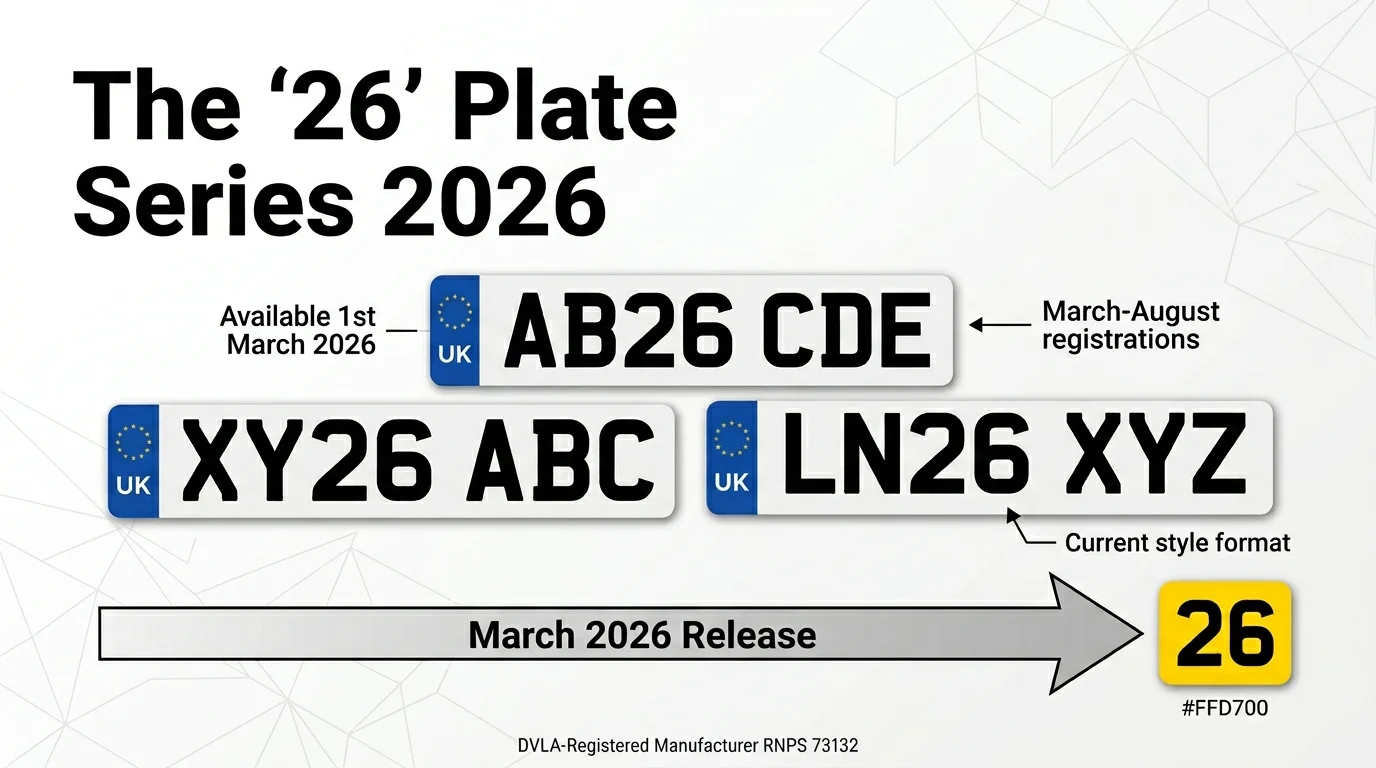
    The ’26’ age identifier releases on 1st March 2026, marking the latest registration period for UK number plates. This guide explores the most sought-after combinations in the 26 series, from dateless-style plates to investment-grade registrations. Whether you’re looking for a personal name plate or a valuable asset, understanding the 26 plate series helps you make informed decisions before the best combinations sell out.

    As a DVLA-registered manufacturer (RNPS ID: 73132), we manufacture BS AU 145e-compliant plates for any registration you purchase. However, we don’t sell registration rights themselves – those must be bought through the DVLA or authorised dealers. Our expertise lies in creating legally compliant plates that display your chosen registration correctly, whether it’s a cherished 26-series plate or a standard issue.

    The 26 series follows the current UK format introduced in 2001, combining regional memory tags with age identifiers. Popular combinations typically include names, initials, or numbers that hold personal significance. With March 2026 approaching, now is the time to research available combinations and understand what makes certain plates more valuable than others. Explore our full range of compliant replacement number plates ready to display your new registration.

    What Is the 26 Plate Series?

    The ’26’ age identifier represents vehicles registered between March 2026 and August 2026 in the United Kingdom. Under the current number plate system established by the Road Vehicles (Display of Registration Marks) Regulations 2001, the UK uses a six-character format that indicates both the region of first registration and the vehicle’s age.

    The format breaks down as follows: two letters for the regional memory tag (indicating where the vehicle was first registered), two numbers for the age identifier (26 for March-August 2026), and three random letters. For example, a plate reading AB26 CDE would indicate a vehicle first registered in the AB region during the March 2026 period. (Current Style Number Plates Guide) The current style has been in use since September 2001, replacing the previous prefix and suffix systems. This consistency means 26-series plates follow the same structure as all registrations issued over the past 25 years, making them familiar to drivers and ANPR cameras alike.

    March 2026 Release Date: What You Need to Know

    The DVLA releases new age identifiers twice yearly: in March and September. The March 2026 release occurs on Sunday, 1st March 2026, when the ’26’ identifier becomes available for new vehicle registrations. This follows the established pattern where March releases use the last two digits of the year (26 for 2026), while September releases add 50 to that number (76 for September 2026).

    (New Registration Plate Dates 2026 Guide) Understanding this system helps you identify a vehicle’s age at a glance. Any car displaying a 26 plate was first registered between March and August 2026. Vehicles registered from September 2026 onwards will carry the ’76’ identifier instead.

    The release date matters for several reasons. First, new plates generate interest among private plate buyers who seek specific combinations. Second, dealers and manufacturers prepare inventory to meet demand. Third, collectors and investors monitor these releases for potentially valuable registrations. As a DVLA-registered number plate manufacturer, we see increased interest in plate designs and styles whenever new age identifiers launch.

    Popular 26 Series Combinations to Watch

    While we cannot predict which specific registrations the DVLA will release, certain patterns consistently attract buyer interest across all age identifier series. The 26 series will follow these same trends, with some combinations commanding premium prices due to their desirability.

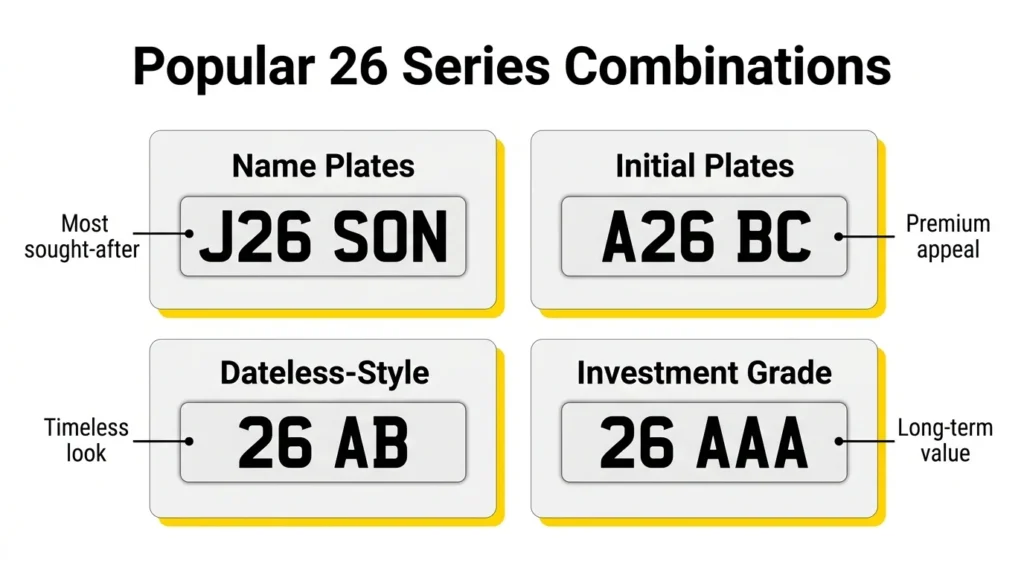
    Name Plates: Registrations that spell out names or nicknames remain the most sought-after category. Combinations like J26 SON, S26 AM, or M26 RK appeal to buyers seeking personalised plates. These often sell quickly through DVLA auctions or private sales.

    Initial Plates: Two or three-letter combinations followed by 26 and additional characters attract buyers who value brevity and prestige. Plates with fewer characters generally hold higher value, though all current-style plates maintain the six-character format.

    Dateless-Style Plates: Some 26 combinations approximate the appearance of older dateless registrations, which don’t indicate vehicle age. These appeal to buyers who want their plate to look timeless rather than tied to a specific registration period.

    (Best 26 Reg Plates to Buy Guide) Investment-grade plates typically feature memorable patterns, repeated characters, or culturally significant numbers. While the 26 identifier itself is neutral, the surrounding letters and numbers determine overall desirability.

    Investment Potential of 26 Series Plates

    Private number plates can represent significant investments, with some registrations appreciating substantially over time. However, the 26 series faces unique considerations as a relatively recent age identifier.

    Short-Term Value: Newly released age identifiers typically don’t command premium prices immediately. The market needs time to identify which combinations have lasting appeal. Most 26-series plates will trade close to their DVLA reserve prices initially.

    Long-Term Potential: Plates become more valuable as they age and certain combinations become rarer. A well-chosen 26 plate purchased in 2026 could appreciate over the next decade, particularly if it spells a common name or features an attractive pattern.

    (Investment Number Plates Guide) The key is selecting combinations with enduring appeal rather than trendy spellings that may date poorly. Names, initials, and simple number patterns tend to hold value better than complex or obscure combinations.

    Market Reality: Not all private plates increase in value. Many trade at or below their purchase price, particularly common combinations. Treat plate purchases as personal enjoyment first, investment second. Only spend what you can afford to lose if the market doesn’t move in your favour.

    How to Choose the Right 26 Plate Combination

    Selecting the right 26-series registration requires balancing personal preference, budget, and practical considerations. Here’s a framework to guide your decision:

    Step 1: Define Your Purpose Are you buying for personal use, as a gift, or as an investment? Personal plates should reflect your name, interests, or values. Investment plates need broad market appeal. Gift plates should suit the recipient’s tastes.

    Step 2: Set Your Budget DVLA auction prices range from £250 reserve prices to hundreds of thousands for exceptional combinations. Private sales can exceed these figures. Establish a maximum spend before you start searching.

    Step 3: Check Availability Use the DVLA’s online search tool to find available 26-series registrations. You can also work with DVLA-approved suppliers who monitor new releases. Remember, availability changes daily as plates sell and transfer.

    Step 4: Verify Transferability Not all registrations can be transferred between vehicles. Check the DVLA’s guidelines on which plates are eligible for transfer before purchasing. Some age-specific plates have restrictions.

    (DVLA Document Requirements Guide) When you purchase a registration, you’ll need proper documentation to assign it to your vehicle. This includes the V5C registration certificate and proof of identity.

    Step 5: Plan Your Plate Display Once you own the registration, you need legally compliant number plates to display it. All plates must meet BS AU 145e:2018 standards, use the mandatory Charles Wright font, and display the supplier’s RNPS identification number.

    Plate Styles for Your 26 Registration

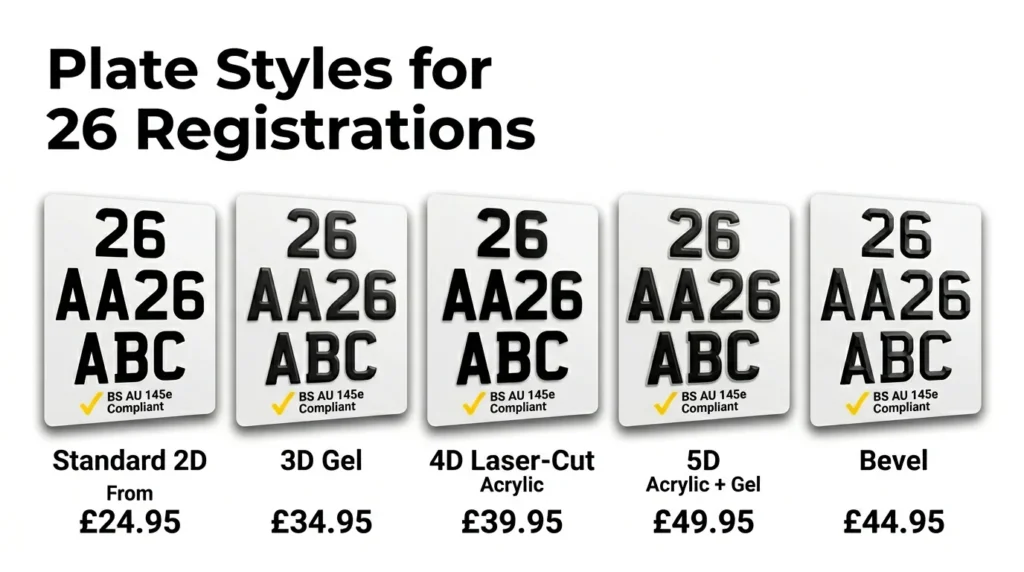
    Your 26-series registration deserves plates that complement its appearance while meeting all legal requirements. As manufacturers, we produce several styles suitable for displaying 26-series plates:

    Standard 2D Plates: The most common choice, featuring black characters on white (front) or yellow (rear) backgrounds. These meet all legal requirements at the most accessible price point. Perfect for everyday use on any vehicle, our replacement number plates are manufactured to exact DVLA specifications.

    3D Gel Plates: Raised gel characters create a subtle three-dimensional effect that catches light beautifully. These remain fully legal when manufactured to BS AU 145e standards and are popular for premium vehicles.

    (3D Gel Number Plates) The gel overlay adds depth without compromising readability or reflectivity, making 3D plates an excellent choice for showcasing a cherished 26 registration.

    4D Laser-Cut Plates: Solid acrylic characters cut by laser and bonded to the plate base create sharp, precise lettering with genuine depth. These offer maximum visual impact while maintaining full legal compliance.

    (4D Laser-Cut Number Plates) The 4D style particularly suits modern vehicles where clean lines and premium finishes matter. View our 4D number plates collection.

    5D Plates: Combining 3mm acrylic bases with 2mm gel overlays, 5D plates deliver both the sharpness of laser-cut characters and the gloss of gel finishes. These represent the pinnacle of legal number plate styling.

    (5D Number Plates) For a special 26-series registration, 5D plates provide maximum visual appeal. Explore our 5D number plates range.

    Bevel Plates: Featuring faceted edges cut at approximately 45 degrees, bevel plates create a distinctive premium appearance through additional CNC machining and hand-polishing. (Bevel Number Plates) The bevelled effect adds sophistication without violating any display regulations. Check out our bevel number plates for a unique finish.

    Legal Requirements for 26 Series Plates

    Regardless of style, all number plates displaying 26-series registrations must comply with UK legislation. The Road Vehicles (Display of Registration Marks) Regulations 2001 sets out mandatory requirements that manufacturers and vehicle owners must follow.

    Font Requirements: All characters must use the mandatory Charles Wright font, introduced in 2001 to optimise ANPR camera readability. No other typeface is legal for road use.

    (Charles Wright Font Guide) This specific font features precise character spacing and proportions that cameras and human observers can read reliably.

    Character Dimensions:

    • Character height: 79mm for cars
    • Character width: 50mm (excluding ‘I’ and ‘1’)
    • Stroke thickness: 14mm
    • Character spacing: 11mm
    • Age identifier gap: 33mm
    • Margins: 11mm minimum

    BS AU 145e:2018 Standard: Since September 2021, all number plates must meet the updated British Standard, which mandates:

    • Reflectivity visible to ANPR cameras in all weather conditions
    • Impact resistance against stone chips and road debris
    • Weathering resistance with no fading or delamination
    • NIR (near-infrared) compatibility for traffic cameras

    (BS AU 145e Explained) Plates manufactured before this date could legally remain in use, but all new plates must comply with the 2018 standard.

    Supplier Identification: Every plate must display the name, trademark, or other means of identification of the manufacturer or supplier, along with their RNPS (Registered Number Plate Supplier) identification number. Our plates display RNPS ID 73132.

    Illegal Modifications: The following violate UK regulations:

    • Reflective sprays or films claiming “ANPR-proof” properties
    • Ghost plates using illegal reflective coatings
    • Characters with incorrect spacing or fonts
    • Plates that fail reflectivity requirements

    (Are Ghost Plates Legal Guide) Non-compliant plates can result in fines up to £1,000 under Section 42 of the Vehicle Excise and Registration Act 1994 and may cause MOT failure. If you prefer a subtle aesthetic, our compliant ghost number plates meet all legal requirements while delivering a premium look.

    Where to Buy 26 Series Registrations

    You can acquire 26-series registrations through several legitimate channels:

    DVLA Auctions: The DVLA regularly auctions cherished registrations, including new releases. These auctions occur both online and at physical venues throughout the UK. Reserve prices typically start at £250, though popular combinations command much higher bids.

    DVLA Buy Now: The DVLA’s online “Buy Now” service offers fixed-price registrations available for immediate purchase. These change regularly as new stock becomes available.

    Private Sales: Existing plate owners can sell their registrations through private transactions. These require proper DVLA transfer documentation to complete legally.

    DVLA-Approved Suppliers: Authorised dealers monitor DVLA releases and can help you find specific combinations. They charge fees for their services but provide expertise and access to broader inventories.

    Important Distinction: When you purchase a registration, you’re buying the right to assign that combination to your vehicle. You still need physical number plates to display it legally. This is where manufacturers like Private Number Plate Maker Ltd come in – we create the actual plates that display your registration.

    We manufacture plates on-site at our Ilford workshop using BS AU 145e-certified materials. We verify all required documentation before manufacturing, ensuring your plates comply with Schedule 2 of the Road Vehicles Regulations 2001.

    (DVLA Document Requirements Guide) You’ll need proof of identity (driving licence, passport, utility bill) and proof of entitlement to the registration (V5C, V750, V778, or V948). Learn more about who we are and our commitment to compliance.

    Practical Takeaways

    For Personal Use Buyers:

    • Choose combinations that spell your name, initials, or meaningful words
    • Prioritise personal significance over investment potential
    • Budget realistically – most 26-series plates trade near DVLA reserve prices initially
    • Order compliant plates from a DVLA-registered manufacturer like ourselves

    For Investment Buyers:

    • Focus on combinations with broad market appeal (common names, simple patterns)
    • Avoid trendy spellings that may date poorly
    • Understand that appreciation takes years, not months
    • Only invest money you can afford to tie up long-term

    What to Avoid:

    • Illegal “ANPR-proof” or ghost plates with reflective sprays
    • Suppliers who don’t verify your documentation
    • Plates that don’t display RNPS identification numbers
    • Non-BS AU 145e compliant materials

    How Plate-Maker Ensures Compliance:

    • On-site manufacturing at our Eastern Avenue, Ilford workshop
    • BS AU 145e:2018 certified materials only
    • Document verification per Schedule 2 requirements
    • RNPS ID 73132 displayed on every plate
    • Charles Wright font with correct spacing and dimensions
    • Same-day collection available from our Ilford location

    Next Steps:

    1. Research available 26-series combinations via the DVLA website
    2. Set your budget and identify preferred combinations
    3. Purchase your registration through DVLA or authorised channels
    4. Order compliant number plates from a registered manufacturer
    5. Design your plates (Plate Builder) or visit our workshop for same-day collection (Same Day Collection Ilford)

    Frequently Asked Questions

    When do 26 plates become available?

    The ’26’ age identifier becomes available on 1st March 2026 for vehicles registered between March and August 2026. The DVLA releases new age identifiers twice yearly – in March using the year digits (26) and in September adding 50 (76 for September 2026).

    How much do 26 series number plates cost?

    26-series registrations start from £250 at DVLA auctions, though popular combinations can cost thousands or even tens of thousands of pounds. Physical number plates to display your 26 registration start from £24.95 for standard 2D plates, with premium styles like 4D or 5D plates costing more depending on specifications.

    Can I transfer a 26 plate to an older vehicle?

    Yes, you can assign a 26-series registration to a vehicle of any age, provided the vehicle is taxed or has a SORN in place, is MOT’d (if required), and is available for inspection if requested. You cannot make a vehicle appear newer than it is, but you can make it appear older by assigning a newer registration.

    Are 26 plates legal on all vehicles?

    The 26 age identifier itself is legal on any vehicle to which it’s properly assigned through the DVLA. However, the physical number plates displaying the 26 registration must comply with the Road Vehicles Regulations 2001, use Charles Wright font, meet BS AU 145e:2018 standards, and display the manufacturer’s RNPS identification number.

    What makes a 26 plate valuable?

    Value depends on the combination of letters and numbers surrounding the 26 identifier. Plates spelling common names, featuring repeated characters, or approximating dateless formats typically command higher prices. Short, memorable combinations with broad appeal hold value better than complex or obscure registrations.

    Do I need special plates for my 26 registration?

    No, 26-series registrations use standard UK number plate specifications. Your plates must be 79mm character height for cars, use Charles Wright font, meet BS AU 145e:2018 reflectivity standards, and display correct spacing. You can choose from 2D, 3D gel, 4D, 5D, or bevel styles, provided they meet these legal requirements. For electric vehicle owners, our EV number plates also meet all compliance standards while featuring the distinctive green band.

  • The Rise of Humour in Private Registrations: 22% of UK Buyers Now Choose Funny Number Plates

    The Rise of Humour in Private Registrations: 22% of UK Buyers Now Choose Funny Number Plates

    Executive Summary

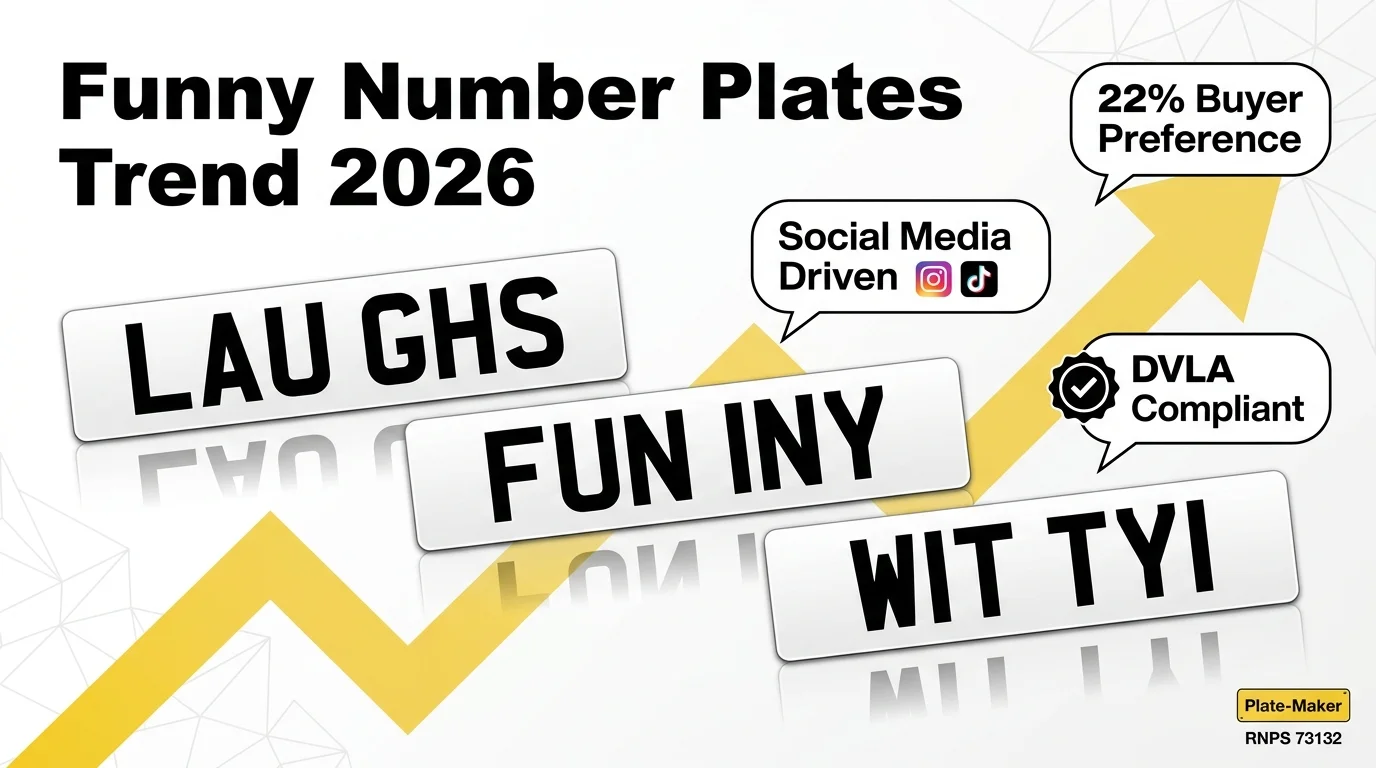
    Funny private number plates are experiencing unprecedented demand in the UK, with recent data suggesting approximately 22% of buyers now prioritise humour over traditional name-based registrations. This shift represents a significant change in buyer psychology, moving away from conventional personalised plates toward witty combinations, pop culture references, and clever wordplay that showcase personality while remaining fully DVLA-compliant.

    The trend reflects broader cultural shifts toward individual expression and social media visibility, with plates like “FUN 1NY” and “LAU GHS” gaining popularity among drivers seeking memorable registrations that spark conversation. However, all novelty plates must still meet strict legal requirements under the Road Vehicles (Display of Registration Marks) Regulations 2001, including mandatory Charles Wright font, correct spacing, and BS AU 145e certification.

    At Private Number Plate Maker Ltd (RNPS ID: 73132), we manufacture compliant novelty plates at our Ilford workshop, ensuring every humorous design meets DVLA standards while delivering the visual impact you want. Whether you’re considering a witty plate for your daily driver or a show car, understanding the balance between creativity and compliance is essential to avoid fines up to £1,000 and MOT failure.

    Market Trend Analysis: The Shift Toward Humorous Registrations

    What the Data Shows

    The UK private number plate market has witnessed a notable transformation in buyer preferences throughout 2025 and into 2026. Industry analysis indicates that approximately one in five buyers now actively seeks humorous or novelty registrations, marking a departure from the traditional dominance of name-based plates like “J0HN SM1TH” or “M4RY J4NE” (Personalised Number Plates Guide).

    This trend appears particularly strong among:

    • Drivers aged 25-45 seeking social media-worthy vehicle personalisation
    • Business owners using plates for brand awareness and memorability
    • Enthusiasts wanting to complement their vehicle’s character
    • Gift purchasers looking for unique presents for car lovers

    The shift suggests buyers increasingly view number plates as extensions of personal identity rather than status symbols alone. Where previous generations prioritised short, expensive combinations or family names, modern buyers embrace wit, wordplay, and cultural references that generate smiles and second glances.

    What’s Driving the Trend

    Several factors contribute to the rising popularity of funny private number plates:

    Social Media Influence: Platforms like Instagram, TikTok, and Facebook have transformed vehicles into content opportunities. A clever plate like “FUN 1NY” or “WIT TY” creates instant shareable moments, with owners reporting increased engagement when their vehicle appears in photos or videos. The visual nature of these platforms rewards distinctive, conversation-starting details.

    Affordability and Accessibility: While premium short plates can cost tens of thousands, humorous combinations often remain accessible at lower price points. Many witty registrations fall into the £200-£800 range on the DVLA’s personal registrations marketplace, making them attainable for average buyers rather than wealthy collectors alone.

    Cultural Shift Toward Individuality: British culture has increasingly embraced self-expression and humour as positive traits. Where previous generations might have viewed novelty plates as tacky, modern attitudes celebrate creativity and personality. This generational shift removes stigma and encourages experimentation.

    Vehicle Personalisation Trends: The broader car modification and customisation movement has normalised personal expression through vehicles. From wraps and decals to interior upgrades, drivers invest in making their cars unique. Number plates represent a legal, reversible, and relatively affordable way to participate in this trend (3D Gel Plates Explained for complementary upgrades).

    Real Examples of Compliant Humour Plates

    Successful funny plates balance creativity with DVLA compliance. Here are examples of the types gaining popularity:

    Wordplay Combinations:

    • LAU GHS (Laughs)
    • FUN 1NY (Funny)
    • WIT TY1 (Witty)
    • JOY R1D (Joyride)
    • SM1LE (Smile)

    Pop Culture References:

    • Plates referencing film titles, song lyrics, or internet memes
    • Character names from popular series
    • Gaming references that resonate with enthusiast communities

    Occupational Humour:

    • CHE F11 (Chef)
    • DEN T1ST (Dentist)
    • LAW YER (Lawyer)
    • BAK ER1 (Baker)

    Vehicle-Specific Jokes:

    • FAST 1 (for performance cars)
    • SLO W1 (ironic humour)
    • BIG CAR (for SUVs and 4x4s)

    All these examples must be manufactured on BS AU 145e certified plates (BS AU 145e Explained) with correct Charles Wright font, proper spacing, and appropriate margins to remain legal. Whether you prefer the sharp acrylic depth of our 4D number plates or the premium gloss finish of 5D number plates, the legal manufacturing standards remain identical across all styles.

    Legal Requirements Still Apply

    Despite the humorous intent, novelty plates face identical legal requirements to standard registrations. Under the Road Vehicles (Display of Registration Marks) Regulations 2001, every plate must:

    • Display characters in the mandatory Charles Wright font (Charles Wright Font Guide)
    • Maintain correct character height (79mm for cars, 64mm for motorcycles)
    • Use proper spacing: 11mm between characters, 33mm gap before age identifier
    • Feature reflective backgrounds meeting BS AU 145e:2018 standards
    • Display the supplier’s name, postcode, and RNPS registration number
    • Use only approved materials from DVLA-registered manufacturers

    Plates failing these requirements risk:

    • Fines up to £1,000 under Section 42 of the Vehicle Excise and Registration Act 1994
    • MOT failure under current testing standards
    • Potential 6 penalty points if proposed legislation passes
    • Seizure of illegal plates by police or Trading Standards

    The humorous nature of a plate provides no legal exemption. A funny registration on non-compliant plates carries identical penalties to any other illegal plate. This makes choosing a DVLA-registered manufacturer like Private Number Plate Maker Ltd (RNPS ID: 73132) essential, even for novelty purchases.

    Implications for Buyers

    Document Verification Remains Mandatory

    Purchasing a humorous plate requires identical documentation to any other private registration. Under Schedule 2 of the Road Vehicles Regulations 2001, you must provide:

    • Proof of identity: Valid driving licence, passport, or recent utility bill
    • Proof of entitlement: V5C registration certificate, V750 certificate of entitlement, V778 retention document, V948 auction allocation letter, or new keeper supplement

    We verify all documents at our Ilford workshop before manufacturing begins. This process protects both buyers and manufacturers from fraud and ensures plates are only produced for legitimate vehicle owners or rights holders.

    Resale Value Considerations

    While funny plates offer immediate enjoyment, buyers should consider long-term implications:

    • Humour is subjective and may not appeal to future buyers
    • Trend-dependent plates (referencing current memes or events) may date poorly
    • Name-based plates typically retain value better than novelty combinations
    • Quality of wit affects desirability – clever wordplay outlasts crude jokes

    However, well-chosen humorous plates can appreciate if they gain cultural recognition or if the buyer community values that specific combination. Plates like “1 OWN” or “F1 SHU” have demonstrated strong resale performance despite their novelty nature.

    Insurance and Finance Implications

    Most insurers treat private plates as standard modifications, but disclosure remains important:

    • Notify your insurer of any plate change
    • Some policies may adjust premiums for high-value registrations
    • Finance agreements may require lender approval before plate transfers
    • Lease vehicles typically prohibit private plates entirely

    Future Predictions and Caveats

    Emerging Trends to Watch

    Based on current patterns, several developments appear likely:

    • Increased Social Media Integration: Plates designed specifically for Instagram and TikTok visibility will grow in popularity. Expect more buyers to choose combinations that photograph well, create optical illusions, or generate viral potential.
    • Niche Community Plates: Enthusiast groups (gaming communities, hobby clubs, professional associations) may drive demand for plates with insider references that resonate within specific circles rather than general audiences.
    • Sustainability Messaging: As environmental consciousness grows, expect plates referencing electric vehicles, sustainability, or green themes to increase, particularly among EV owners eligible for green flash plates (EV Plates Guide).
    • AI and Technology References: Plates incorporating tech terminology, AI references, or digital culture nods will likely emerge as these topics permeate mainstream awareness.

    Important Caveats

    While trends provide useful guidance, buyers should remember:

    • Market data represents estimates, not guarantees of future value
    • Humour is highly subjective and culturally dependent
    • What seems clever today may appear dated within years
    • Legal requirements may evolve, potentially affecting plate specifications
    • Economic conditions influence discretionary spending on private plates

    The 22% figure, while indicative of growing interest, should be understood as a snapshot rather than a precise measurement. Different data sources may report varying percentages depending on methodology and sample populations.

    Practical Takeaways

    For Buyers Considering Humorous Plates

    Do:

    • Choose combinations that will amuse you long-term, not just momentarily
    • Verify the registration is available through DVLA or reputable dealers
    • Ensure your chosen manufacturer is DVLA-registered (check RNPS ID)
    • Confirm plates will be BS AU 145e:2018 certified
    • Consider how the plate complements your vehicle’s character
    • Think about resale implications if you might sell the plate later
    • Budget for both the registration rights and compliant physical plates

    Don’t:

    • Choose offensive, crude, or potentially controversial combinations
    • Assume humour exempts you from legal requirements
    • Buy from unverified suppliers offering “too good to be true” prices
    • Select plates with incorrect spacing or non-standard fonts
    • Ignore document verification requirements
    • Purchase “ANPR-proof” or reflective spray products (illegal)

    How Plate-Maker Ensures Compliance

    Every humorous plate we manufacture at our Eastern Avenue workshop undergoes:

    • Document Verification: We check your identity and entitlement before production begins
    • BS AU 145e Materials: Only certified reflective substrates and inks are used
    • Charles Wright Font: Mandatory typeface applied with precise 79mm character height
    • Correct Spacing: 11mm between characters, 33mm before age identifier
    • Quality Control: Each plate inspected for reflectivity, adhesion, and finish
    • RNPS Marking: Our registration number 73132 displayed as legally required
    • Workshop Manufacturing: All plates produced on-site, never drop-shipped

    This process ensures your funny plate delivers laughs without legal headaches.

    Next Steps

    Ready to bring your humorous registration to life?

    1. Design Your Plates: Use our online builder to visualise your combination (Plate Builder)
    2. Choose Your Style: Select from 3D gel, 4D laser-cut, or standard 2D plates (3D Gel Plates)
    3. Prepare Documents: Gather your V5C, driving licence, or other required proofs
    4. Order Online or Visit Us: We offer nationwide delivery or same-day collection from Ilford (Same Day Collection Ilford)
    5. Fit Legally: Attach plates using proper fixings, or visit our workshop for fitting assistance

    For those seeking a distinctive yet fully legal aesthetic, our bevel number plates and ghost number plates are excellent choices that pair perfectly with humorous registrations. Browse our complete range of compliant number plates (Number Plates Collection) to find the perfect style for your humorous registration.

    Frequently Asked Questions

    Are funny number plates legal in the UK?

    Yes, humorous number plates are completely legal when manufactured to DVLA standards. The content of your registration is irrelevant to legality – what matters is compliance with the Road Vehicles Regulations 2001, including Charles Wright font, correct spacing, and BS AU 145e certification. All our novelty plates meet these requirements and display RNPS ID 73132.

    How much do funny private number plates cost?

    The registration rights themselves vary widely, from £250 for basic combinations to thousands for desirable short plates. Physical plates start from £24.95 for standard 2D plates, £34.95 for 3D gel, and £39.95 for 4D laser-cut styles. Total cost depends on whether you already own the registration or need to purchase it separately through DVLA auctions.

    Can I put any funny combination on a number plate?

    No – the registration must be an existing, available combination from the DVLA’s database. You cannot create custom letter/number sequences. Additionally, plates cannot be offensive or make vehicles appear newer than they are. The DVLA maintains prohibited lists and age-related transfer rules that restrict certain combinations regardless of humour value.

    Do funny plates affect car insurance?

    Most insurers treat humorous plates identically to standard private plates. You should notify your insurer of any plate change, but premiums typically remain unchanged unless the registration has significant monetary value. High-value plates (worth over £500) may require specific coverage. Always check your policy terms before transferring any private registration.

    Where can I buy compliant funny number plates?

    Only purchase from DVLA-registered number plate suppliers (RNPS members). Private Number Plate Maker Ltd (RNPS ID: 73132) manufactures BS AU 145e certified plates at our Ilford workshop with same-day collection available. Avoid unregistered sellers offering cheap plates – these often fail legal requirements and risk £1,000 fines and MOT failure.

    Will a funny number plate reduce my car’s resale value?

    Generally no – the physical plate doesn’t affect vehicle value, and you retain the registration rights to sell or transfer later. However, highly specific humour may limit future buyer interest if you sell the plate itself. Clever, tasteful combinations typically hold value better than crude or trend-dependent jokes. Consider long-term appeal when choosing your combination.

  • ANPR and Human Rights: The Debate Over Camera Surveillance

    ANPR and Human Rights: The Debate Over Camera Surveillance

    Executive Summary

    Automatic Number Plate Recognition (ANPR) cameras are a powerful law enforcement tool used across the UK to detect crime, locate stolen vehicles, and enforce traffic regulations. However, their widespread deployment has sparked ongoing debate about the balance between public safety and individual privacy rights under the Human Rights Act 1998. This article examines the legal framework governing ANPR use, including GDPR compliance requirements, the Data Protection Act 2018, and the Surveillance Camera Code of Practice. While ANPR has proven effective in solving serious crimes and recovering stolen vehicles, privacy advocates raise concerns about mass surveillance and data retention practices. For UK drivers, understanding how ANPR works and your data protection rights is essential. At Plate-Maker.co.uk, we manufacture DVLA-compliant replacement number plates that ensure your vehicle registration is clearly visible to ANPR cameras, helping you avoid penalties while understanding your rights in an increasingly monitored road network.

    What is ANPR and How Does It Work?

    The Technology Behind Automatic Number Plate Recognition

    ANPR (Automatic Number Plate Recognition) systems use optical character recognition (OCR) technology to read vehicle registration marks from images captured by specialised cameras. These cameras employ infrared illumination to capture clear images of number plates in all lighting conditions, day or night. When a vehicle passes an ANPR camera, the system captures the image, processes it through OCR software, and converts the visual data into alphanumeric text that can be checked against various databases.

    The technology relies on the Charles Wright font being clearly displayed on BS AU 145e compliant plates, which is why properly manufactured number plates with correct reflectivity are essential for accurate reading. The system can process thousands of vehicles per hour, with each read generating a timestamp, location data, and the registration number.

    The National ANPR Service Infrastructure

    The National ANPR Service (NAS) is operated by the National Police Chiefs’ Council (NPCC) and forms part of the UK’s policing infrastructure. The system connects thousands of ANPR cameras across the country to the National ANPR Data Centre (NADC), where data is processed and stored. According to official NPCC documentation, the NAS processes millions of reads daily, supporting law enforcement agencies nationwide.

    Local authorities also operate ANPR cameras for purposes such as enforcing bus lanes, monitoring low emission zones (Ilford Number Plates), and detecting untaxed vehicles. The DVLA operates its own ANPR network to identify vehicles without valid road tax or MOT certificates.

    The Legal Framework Governing ANPR Use

    Data Protection Legislation and GDPR Compliance

    ANPR systems in the UK operate under strict data protection requirements governed by the UK General Data Protection Regulation (UK GDPR) and the Data Protection Act 2018. The Information Commissioner’s Office (ICO) provides specific guidance on ANPR use, classifying number plate data as personal data because it can be linked to identified or identifiable individuals through DVLA records.

    Under GDPR principles, ANPR operators must demonstrate:

    • Lawful basis for processing: Typically legitimate interests for law enforcement, or legal obligation for statutory functions
    • Purpose limitation: Data collected for specific, explicit purposes only
    • Data minimisation: Only necessary data is collected and retained
    • Storage limitation: Clear retention periods with automatic deletion
    • Security: Appropriate technical and organisational measures to protect data

    The ICO’s ANPR Code of Practice requires operators to conduct Data Protection Impact Assessments (DPIAs) before deploying ANPR systems, particularly where large-scale systematic monitoring is involved.

    The Surveillance Camera Code of Practice

    The Protection of Freedoms Act 2012 introduced the Surveillance Camera Code of Practice, which applies to relevant authorities including police forces and local authorities operating ANPR systems. The Code establishes 12 guiding principles for the appropriate and effective use of surveillance camera systems:

    1. Use must be necessary and proportionate
    2. Clear objectives must be defined
    3. Transparency and accountability requirements
    4. Clear policies and procedures
    5. Consideration of less intrusive alternatives
    6. Effective oversight and audit
    7. Clear rules and responsibilities
    8. Effective training
    9. Security of data and systems
    10. Retention and deletion protocols
    11. Accuracy and quality standards
    12. Independent oversight mechanisms

    The Biometrics and Surveillance Camera Commissioner oversees compliance with the Code, though the office’s status has changed following the 2023 abolition of the Investigatory Powers Commissioner’s Office biometrics functions.

    Human Rights Act 1998 Considerations

    Article 8 of the European Convention on Human Rights, incorporated into UK law through the Human Rights Act 1998, protects the right to respect for private and family life. ANPR surveillance engages Article 8 because it involves the systematic collection and processing of information about individuals’ movements.

    However, Article 8 is a qualified right, meaning interference can be justified if it is:

    • In accordance with the law
    • Pursues a legitimate aim (such as prevention of crime or protection of others’ rights)
    • Necessary in a democratic society

    UK courts have generally accepted that ANPR use for legitimate law enforcement purposes, when properly regulated and subject to appropriate safeguards, can be compatible with Article 8. The key is proportionality – the intrusion must be justified by the public benefit achieved.

    Privacy Concerns and Civil Liberties Arguments

    Mass Surveillance and Function Creep

    Privacy advocates, including organisations like Big Brother Watch and Liberty, have raised concerns about the expansion of ANPR networks beyond their original purposes. The phenomenon known as “function creep” occurs when systems deployed for one purpose are gradually used for additional purposes not originally intended or authorised.

    Critics argue that:

    • The sheer scale of ANPR deployment creates a comprehensive tracking system of vehicle movements
    • Data retention periods may exceed what is necessary for stated purposes
    • Lack of public awareness about the extent of ANPR surveillance
    • Potential for misuse or unauthorised access to movement data
    • Chilling effect on freedom of movement and association

    The National ANPR Service’s ability to track vehicles across the country has prompted concerns about the creation of detailed movement profiles, even for individuals not suspected of any wrongdoing.

    Data Retention and Access Controls

    Under the ANPR Code of Practice, data retention periods vary depending on the purpose:

    • Law enforcement purposes: Generally up to 2 years for operational data
    • Non-law enforcement purposes: Shorter periods, often 90 days or less
    • Local authority use: Typically aligned with specific enforcement purposes

    However, privacy campaigners argue that even limited retention creates risks, particularly given the sensitive nature of location data. Concerns include:

    • Potential for data breaches exposing movement histories
    • Unauthorised access by staff or third parties
    • Secondary use of data beyond original collection purpose
    • Lack of transparency about who accesses the data and why

    The ICO has enforcement powers and has issued guidance requiring strict access controls, audit trails, and regular reviews of ANPR data access.

    Transparency and Public Awareness

    A significant concern raised by civil liberties groups is the lack of public awareness about ANPR deployment. Unlike speed cameras, which are often highly visible and publicly signposted, many ANPR cameras are not clearly marked, and their locations are not always publicly disclosed for operational security reasons.

    This lack of transparency raises questions about:

    • Whether individuals can give meaningful consent to data collection
    • If the public understands how their data is used
    • Whether there is adequate democratic oversight of ANPR expansion
    • If privacy impact assessments are sufficiently public and accessible

    Law Enforcement Benefits and Public Safety Arguments

    Crime Detection and Prevention

    Police forces across the UK consistently report that ANPR is an invaluable tool in combating serious and organised crime. According to NPCC statistics, ANPR data contributes to:

    • Locating and recovering stolen vehicles
    • Identifying vehicles linked to serious crimes
    • Disrupting organised criminal networks
    • Finding wanted individuals and missing persons
    • Enforcing road traffic legislation
    • Supporting counter-terrorism operations

    The real-time alert capability allows officers to intercept vehicles of interest immediately, rather than relying on retrospective investigation. This has proven particularly effective in tackling vehicle crime, where stolen vehicles can be quickly identified and recovered.

    Road Safety and Traffic Enforcement

    Beyond criminal investigations, ANPR systems support broader road safety objectives:

    • Vehicle tax enforcement: Identifying untaxed vehicles helps ensure all road users contribute to road maintenance
    • MOT compliance: Detecting vehicles without valid MOT certificates removes potentially dangerous vehicles from roads
    • Insurance verification: Identifying uninsured drivers protects other road users
    • Congestion and clean air zones: Enforcing ULEZ (EV Number Plates) and congestion charge compliance in London and other cities
    • Bus lane and parking enforcement: Supporting local authority traffic management

    The DVLA reports that ANPR-assisted enforcement has significantly increased detection rates for untaxed and uninsured vehicles, contributing to fairer road use and improved compliance.

    Efficiency and Resource Optimisation

    ANPR technology allows law enforcement agencies to achieve more with limited resources. Automated checking of number plates against databases is far more efficient than manual checks, allowing officers to focus on high-risk vehicles rather than conducting random stops.

    The technology also provides:

    • Objective, timestamped evidence for prosecutions
    • Reduced need for physical vehicle stops, improving officer safety
    • Intelligence gathering capabilities for pattern analysis
    • Cross-border cooperation between police forces
    • Historical data for investigating crimes after they occur

    Recent Developments and Future Considerations

    Legislative Changes and Policy Updates

    The regulatory landscape for ANPR continues to evolve. Recent developments include:

    • Updates to the ICO’s ANPR Code of Practice reflecting GDPR requirements
    • Changes to the Biometrics Commissioner role following the 2023 restructuring
    • Ongoing reviews of surveillance camera governance
    • Increased scrutiny of data retention periods and access controls

    Parliamentary debates have occasionally addressed ANPR use, particularly in the context of broader surveillance legislation and privacy rights.

    Technological Advancements

    ANPR technology continues to advance, with improvements in:

    • Read accuracy rates in challenging conditions
    • Integration with other policing systems
    • Mobile ANPR capabilities in patrol vehicles
    • Cloud-based processing and storage
    • Artificial intelligence for pattern recognition and anomaly detection

    These advances raise both opportunities for improved public safety and new questions about privacy implications.

    International Comparisons

    The UK’s ANPR deployment is among the most extensive globally, but other countries operate similar systems with varying levels of oversight and public acceptance. European countries operate ANPR within GDPR frameworks, while countries outside Europe have different regulatory approaches. Comparing these systems helps inform debates about best practices for balancing security and privacy.

    Practical Implications for UK Drivers

    Ensuring Your Number Plate is ANPR-Readable

    Given the ubiquity of ANPR cameras, it’s essential that your number plates meet legal requirements to avoid unnecessary penalties. Plates that are dirty, damaged, or non-compliant may not be read correctly, potentially leading to:

    • False positives in enforcement systems
    • Unnecessary police attention
    • Fines for obscured or unreadable plates
    • MOT failure

    To ensure your plates are ANPR-compliant:

    • Keep plates clean and free from dirt or obstructions
    • Ensure plates meet BS AU 145e standards
    • Use only DVLA-registered suppliers (like Plate-Maker.co.uk with RNPS ID 73132)
    • Avoid illegal modifications like tinted covers or reflective sprays
    • Replace damaged or faded plates promptly

    Whether you prefer classic 3D number plates, premium 4D number plates, or the subtle aesthetic of ghost number plates, all our products are manufactured to full BS AU 145e:2018 compliance for reliable ANPR readability.

    Understanding Your Data Protection Rights

    Under UK GDPR, you have specific rights regarding ANPR data:

    • Right to access: You can request information about ANPR data held about you
    • Right to rectification: Incorrect data can be corrected
    • Right to erasure: In some circumstances, you can request deletion
    • Right to object: You can object to processing in certain situations
    • Right to complain: You can lodge complaints with the ICO

    However, these rights are not absolute and may be limited where ANPR data is processed for law enforcement purposes.

    When ANPR Data May Affect You

    You may encounter ANPR systems in various situations:

    • Routine driving: Your movements are recorded but typically deleted after the retention period if no issues are detected
    • Untaxed or uninsured vehicles: ANPR may trigger enforcement action
    • Stolen vehicles: ANPR alerts police to intercepted vehicles
    • Clean air zones: ANPR enforces ULEZ (EV Number Plates) and similar schemes
    • Criminal investigations: Historical ANPR data may be used as evidence

    Understanding how these systems work helps you comply with legal requirements while protecting your rights. For complete peace of mind, explore our full range of compliant plates including 5D number plates and bevel number plates, all manufactured on-site at our Ilford workshop.

    Conclusion: Striking the Right Balance

    The debate over ANPR cameras and human rights reflects broader tensions in modern society between security and privacy, efficiency and oversight, technological capability and ethical constraints. ANPR has undeniably proven its value in combating crime, improving road safety, and supporting law enforcement. At the same time, legitimate concerns exist about mass surveillance, data protection, and the need for robust oversight.

    The current legal framework, including GDPR, the Data Protection Act 2018, the Surveillance Camera Code of Practice, and Human Rights Act protections, provides significant safeguards. However, these require active enforcement, regular review, and public awareness to remain effective.

    For UK drivers, the practical reality is that ANPR is an established part of the road infrastructure. The best approach is to ensure your vehicle displays legal, readable number plates (design yours using our online Plate Builder) while staying informed about your data protection rights. Whether you choose to collect your plates same-day from our Ilford workshop (Same Day Collection Ilford) or have them delivered, ensuring BS AU 145e compliance helps you navigate the ANPR landscape confidently.

    The ongoing evolution of ANPR technology and regulation means this debate will continue. What remains essential is maintaining the delicate balance between legitimate public safety objectives and fundamental privacy rights through transparent governance, effective oversight, and informed public discourse.

    Frequently Asked Questions

    Is ANPR legal in the UK?

    Yes, ANPR is legal in the UK when operated in accordance with data protection legislation, the Surveillance Camera Code of Practice, and the Human Rights Act 1998. The National ANPR Service operates under NPCC authority, with oversight from the Information Commissioner’s Office. All operators must have a lawful basis for processing and comply with GDPR requirements.

    How long is ANPR data retained in the UK?

    ANPR data retention periods vary by purpose. Law enforcement data is typically retained for up to 2 years under the National ANPR Service, while local authority and non-enforcement data is usually kept for 90 days or less. The ANPR Code of Practice requires automatic deletion after the specified retention period, with strict access controls throughout.

    Can I request ANPR data about my vehicle?

    Yes, under UK GDPR you have the right to access personal data held about you, including ANPR reads. You can submit a subject access request to the relevant data controller (police force, local authority, or other operator). However, rights may be limited where data is processed for law enforcement purposes or national security.

    Do ANPR cameras read all number plates automatically?

    ANPR cameras attempt to read all vehicle registration plates that pass within their field of view, but success depends on plate condition, lighting, angle, and speed. BS AU 145e compliant plates with clean surfaces and correct Charles Wright font achieve the highest read rates. Damaged, dirty, or non-compliant plates may not be read accurately.

    Are there privacy safeguards for ANPR systems?

    Yes, multiple safeguards exist including GDPR compliance requirements, the Surveillance Camera Code of Practice, Data Protection Impact Assessments, ICO oversight, access controls, audit trails, and defined retention periods. The Biometrics and Surveillance Camera Commissioner (where applicable) also provides independent oversight. Operators must demonstrate necessity and proportionality for ANPR deployment.

    Can ANPR data be used in court?

    Yes, ANPR data is regularly used as evidence in criminal prosecutions and civil proceedings. The data must meet evidential standards including chain of custody, system accuracy verification, and proper authentication. Courts have accepted ANPR evidence where proper procedures are followed and the technology’s reliability is demonstrated.

    What number plates are best for ANPR readability?

    All DVLA-compliant plates manufactured to BS AU 145e:2018 standards are designed for optimal ANPR readability. This includes our full range: standard replacement plates, 3D gel plates,4D laser-cut plates, and 5D premium plates. The key factors are correct font, proper spacing, high-reflectivity materials, and clean surfaces – all guaranteed when you order from a registered supplier like Plate-Maker (RNPS ID: 73132). Learn more about how ANPR cameras work to ensure your plates remain fully compliant.

  • The £40 Barrier: Understanding RNPS Registration and Number Plate Supplier Standards

    The £40 Barrier: Understanding RNPS Registration and Number Plate Supplier Standards

    Executive Summary

    The Registered Number Plate Supplier (RNPS) scheme requires suppliers to register with the DVLA and pay a fee, but concerns have been raised about whether current barriers adequately prevent fraudulent operators. Under the Road Vehicles (Display of Registration Marks) Regulations 2001, all number plate suppliers must be registered with the DVLA and display their RNPS details on plates. However, parliamentary discussions have highlighted that the registration process may be too accessible, potentially allowing non-compliant operators to enter the market. At Private Number Plate Maker Ltd (RNPS ID: 73132), we manufacture every replacement number plate on-site at our Ilford workshop with full document verification in line with Schedule 2 of the Road Vehicles Regulations 2001. This article examines the RNPS registration framework, discusses recent parliamentary scrutiny, and explains how legitimate manufacturers maintain compliance while protecting consumers from illegal plates that can result in fines up to £1,000 and MOT failure.

    What Is the RNPS Scheme and Why Does It Exist?

    The Legal Framework for Number Plate Suppliers

    The Registered Number Plate Supplier (RNPS) scheme was established under the Road Vehicles (Display of Registration Marks) Regulations 2001 to combat the proliferation of illegal number plates. Under Regulation 4 of these regulations, anyone supplying replacement number plates in the UK must be registered with the DVLA and maintain records of customer documentation.

    The scheme requires suppliers to:

    • Register with the DVLA and receive a unique RNPS identification number
    • Verify customer identity and entitlement to registration marks
    • Keep records of all transactions for at least three years
    • Display their RNPS number on all plates they manufacture (DVLA Document Requirements)

    Registration Requirements and Fees

    To become an RNPS, applicants must complete the DVLA’s registration process and pay the prescribed fee. The registration is designed to ensure suppliers understand their legal obligations under UK number plate legislation.

    Once registered, suppliers receive:

    • A unique RNPS identification number (ours is 73132)
    • Authorization to legally supply number plates
    • Inclusion on the DVLA’s official register of suppliers

    However, the accessibility of registration has become a topic of discussion among policymakers concerned about maintaining industry standards while preventing fraud.

    Parliamentary Scrutiny of RNPS Registration Standards

    House of Lords Discussions on Number Plate Regulation

    The House of Lords has examined number plate regulation as part of broader road safety and vehicle crime prevention efforts. Peers have raised questions about whether the current registration framework provides sufficient safeguards against fraudulent operators who may exploit weak entry barriers.

    Key concerns raised in parliamentary discussions include:

    • Low Financial Barriers: The registration fee structure has been questioned as potentially insufficient to deter casual or fraudulent applicants. Critics argue that a modest fee does not adequately verify the seriousness or legitimacy of applicants.
    • Verification Processes: Questions have been posed about the depth of background checks conducted during RNPS registration. Unlike some regulated industries requiring extensive vetting, number plate supplier registration focuses primarily on understanding regulatory compliance rather than comprehensive business verification.
    • Enforcement Challenges: The sheer number of registered suppliers creates monitoring difficulties for enforcement agencies. With thousands of RNPS holders across the UK, ensuring ongoing compliance requires significant resources from the DVLA and Trading Standards.

    The Scale of RNPS Registration

    The RNPS scheme has grown substantially since its introduction, with thousands of suppliers now registered across the United Kingdom. This expansion reflects both the legitimate growth of the number plate industry and concerns about market saturation making enforcement more complex.

    The large number of registered suppliers means:

    • Consumers have many options when purchasing plates
    • Enforcement agencies must monitor numerous businesses
    • Quality and compliance standards can vary significantly
    • Document verification practices may differ between suppliers

    This is why choosing a manufacturer with rigorous verification processes matters (Number Plate Fines UK).

    How Fraudulent Operators Exploit Weak Registration Barriers

    The Gap Between Registration and Compliance

    While RNPS registration is mandatory, the distinction between being registered and operating compliantly creates opportunities for bad actors. Some suppliers may:

    • Skip Document Verification: Despite legal requirements under Schedule 2 of the Road Vehicles Regulations 2001, some operators fail to properly verify customer documentation before manufacturing plates. This allows illegal plates to enter circulation.
    • Use Non-Compliant Materials: Not all registered suppliers use BS AU 145e certified materials. Some cut costs by using inferior substrates that fail to meet reflectivity and durability standards required for ANPR camera readability.
    • Ignore Font and Spacing Requirements: The Charles Wright font became mandatory in 2001, but some suppliers continue using incorrect typefaces or improper spacing that fails legal specifications.

    Consequences of Illegal Number Plates

    Plates manufactured outside RNPS compliance create serious risks:

    For Drivers:

    • Fines up to £1,000 under Section 42 of the Vehicle Excise and Registration Act 1994
    • MOT failure requiring immediate plate replacement
    • Potential penalty points for displaying illegal registration marks
    • Insurance invalidation if plates don’t meet legal standards

    For Road Safety:

    • ANPR cameras cannot read non-compliant plates
    • Traffic enforcement becomes less effective
    • Vehicle crime investigation is hampered
    • ULEZ and congestion charge enforcement is compromised

    For Legitimate Suppliers:

    • Unfair competition from operators cutting corners
    • Reputation damage to the industry as a whole
    • Pressure to reduce prices and potentially compromise standards

    How Legitimate Manufacturers Maintain Higher Standards

    Beyond Minimum RNPS Requirements

    At Private Number Plate Maker Ltd, we exceed the basic RNPS registration requirements through rigorous internal controls and quality assurance processes. Our approach includes:

    Comprehensive Document Verification: We verify every customer’s identity and entitlement using the documents specified in Schedule 2 of the Road Vehicles Regulations 2001. This includes driving licences, V5C registration certificates, V750 certificates of entitlement, and other accepted proofs (DVLA Document Requirements).

    BS AU 145e Certified Materials: Every replacement number plate we manufacture uses materials meeting the British Standard BS AU 145e:2018 requirements, including:

    • Reflectivity standards for ANPR camera readability
    • Impact resistance to withstand road debris
    • Weathering resistance for UK climate conditions
    • NIR compatibility for infra-red traffic cameras

    On-Site Manufacturing Control: Unlike resellers or drop-shippers, we manufacture every plate at our Eastern Avenue workshop in Ilford. This allows us to maintain direct quality control over every plate leaving our facility.

    RNPS Transparency: Our RNPS ID 73132 appears on every plate we manufacture, providing traceability and accountability. Customers can verify our registration status through the DVLA’s official register.

    The Value of Physical Workshop Operations

    Our Ilford workshop provides advantages that online-only operators cannot match:

    Same-Day Collection: Customers can collect plates the same day from our Eastern Avenue location, with full document verification completed in person (Same Day Collection Ilford).

    Direct Accountability: Having a physical premises means we’re directly accountable to local Trading Standards and enforcement agencies. We welcome inspections and maintain open communication with regulatory bodies.

    Expert Staff: Our team understands the technical requirements of BS AU 145e and the legal framework governing number plates. We provide accurate advice rather than just processing orders.

    Quality Assurance: Every plate undergoes inspection before collection or dispatch, ensuring correct font, spacing, reflectivity, and overall compliance.

    What Changes Could Strengthen the RNPS Scheme

    Potential Regulatory Reforms

    Parliamentary discussions have identified several areas where the RNPS scheme could be strengthened:

    • Enhanced Verification: Implementing more rigorous background checks for RNPS applicants, potentially including criminal record checks and business history verification.
    • Increased Fees: Raising registration fees to create a more meaningful barrier to entry while funding enhanced enforcement activities.
    • Regular Audits: Introducing periodic compliance audits of registered suppliers to ensure ongoing adherence to regulations rather than one-time registration.
    • Stronger Penalties: Increasing penalties for RNPS holders who fail to maintain compliance, including suspension or revocation of registration status.
    • Centralised Monitoring: Creating a centralised monitoring system to track complaints and enforcement actions against suppliers.

    What Drivers Can Do Now

    While regulatory reforms are considered, drivers can protect themselves by:

    • Checking RNPS Status: Always verify that your supplier displays an RNPS number on their plates and website. Legitimate suppliers proudly display this information.
    • Expecting Document Requests: Never use a supplier who doesn’t ask for proof of identity and entitlement. This is a legal requirement, not optional.
    • Verifying BS AU 145e Compliance: Ensure plates carry the BS AU 145e:2018 marking and use proper Charles Wright font with correct spacing. Electric vehicle owners should also ensure their EV number plates meet the same legal standards.
    • Choosing Manufacturers Over Resellers: Work with companies that manufacture plates on-site rather than drop-shippers who may have less quality control (3D Gel Plates Explained). Explore our range of compliant premium options: 3D number plates, 4D number plates, and 5D number plates.
    • Using Local Suppliers: Local manufacturers with physical workshops provide accountability and the opportunity for in-person verification. Consider premium styling options like bevel number plates that maintain full legal compliance.

    Practical Takeaways

    For Drivers Purchasing Number Plates

    • Always Verify RNPS Registration: Check that your supplier displays their RNPS number prominently. At Plate-Maker, our RNPS ID 73132 appears on every plate and throughout our website.
    • Expect Document Verification: Legitimate suppliers must request and verify your documentation under Schedule 2 of the Road Vehicles Regulations 2001. If a supplier doesn’t ask for documents, they’re operating illegally.
    • Check for BS AU 145e Marking: Every legal plate must display the BS AU 145e:2018 standard marking. This confirms the plate meets reflectivity, durability, and ANPR readability requirements.
    • Avoid “Too Good to Be True” Pricing: Extremely cheap plates often indicate corner-cutting on materials, document verification, or both. Quality compliant plates require proper materials and processes.
    • Choose Manufacturers with Physical Premises: Suppliers with workshops you can visit provide accountability and transparency. Our Ilford workshop offers same-day collection for local customers (Same Day Collection Ilford).

    Red Flags to Avoid

    • Suppliers who don’t request documentation
    • Plates without RNPS numbers
    • Missing BS AU 145e:2018 marking
    • Incorrect fonts or spacing
    • Reflective or “ghost” effects that compromise legality (Are Ghost Plates Legal Guide). For a legal alternative, view our compliant ghost number plates that meet all DVLA requirements.
    • Suppliers operating only through social media or marketplaces

    How Plate-Maker Ensures Compliance

    • DVLA-registered manufacturer (RNPS ID: 73132)
    • Comprehensive document verification on every order
    • BS AU 145e:2018 certified materials only
    • On-site manufacturing at our Ilford workshop
    • Same-day collection available
    • Next-day UK delivery
    • Expert team trained in current regulations

    Ready to order compliant plates? Start designing your plates (Plate Builder) or visit our Eastern Avenue workshop for same-day collection.

    Frequently Asked Questions

    What is the RNPS registration fee for number plate suppliers? 

    The DVLA charges a registration fee for RNPS applicants, though the exact amount can change. The fee is designed to cover administrative costs of processing applications and maintaining the register. Critics in parliamentary discussions have suggested the fee may be too low to act as an effective barrier against fraudulent operators seeking registration.

    How many RNPS suppliers are currently registered in the UK? 

    The DVLA maintains a register of thousands of RNPS holders across the United Kingdom. The large number reflects both legitimate industry growth and concerns about enforcement complexity. With so many registered suppliers, ensuring ongoing compliance requires significant resources from the DVLA and Trading Standards agencies.

    Can I buy number plates from an unregistered supplier? 

    No, it is illegal to supply replacement number plates in the UK without RNPS registration under the Road Vehicles (Display of Registration Marks) Regulations 2001. Buying from unregistered suppliers risks receiving illegal plates that can result in £1,000 fines, MOT failure, and insurance invalidation. Always verify your supplier displays an RNPS number.

    What documents do RNPS suppliers need to check? 

    Under Schedule 2 of the Road Vehicles Regulations 2001, suppliers must verify proof of identity (driving licence, passport, utility bill) and proof of entitlement to the registration mark (V5C, V750, V778, V948, or new keeper slip). Bank statements are not accepted. At Plate-Maker, we verify all documents before manufacturing (DVLA Document Requirements).

    Are all RNPS registered suppliers equally reliable?

    No, RNPS registration is a minimum legal requirement, but standards vary. Some suppliers may cut corners on document verification, use non-compliant materials, or lack proper quality control. Choose manufacturers with physical workshops, BS AU 145e certification, and transparent RNPS numbers like our ID 73132 (our About Us page).

    What happens if I’m caught with illegal number plates? 

    Under Section 42 of the Vehicle Excise and Registration Act 1994, displaying illegal number plates can result in fines up to £1,000 (level 3 on the standard scale). You’ll also fail your MOT and may face insurance invalidation. Plates must display the supplier’s RNPS number and BS AU 145e:2018 marking to be legal.

    Conclusion

    The RNPS registration scheme provides a framework for regulating number plate suppliers, but parliamentary scrutiny has highlighted that registration alone doesn’t guarantee compliance. The relatively low barriers to entry mean drivers must take responsibility for choosing legitimate manufacturers who exceed minimum requirements.

    At Private Number Plate Maker Ltd, we believe transparency, rigorous document verification, and on-site manufacturing are essential to maintaining industry standards. Our RNPS ID 73132, BS AU 145e:2018 certification, and Ilford workshop demonstrate our commitment to legal compliance and quality.

    When purchasing number plates, always verify your supplier’s RNPS status, expect thorough document checks, and choose manufacturers who take compliance seriously. Your safety, legal protection, and contribution to road safety depend on it.

    Ready to order plates from a trusted manufacturer? Design your custom plates (Plate Builder) online or visit our Eastern Avenue workshop for same-day collection (Same Day Collection Ilford).

  • Data Sharing Revolution: How DVLA, DVSA, and Home Office Are Tackling Plate Crime

    Data Sharing Revolution: How DVLA, DVSA, and Home Office Are Tackling Plate Crime

    Executive Summary

    In January 2026, the UK Government confirmed a major intensification of inter-agency collaboration to combat number plate fraud, with the DVLA, Home Office, and National Police Chiefs’ Council working together on enhanced enforcement and data sharing initiatives. The Department for Transport published its new Road Safety Strategy on 7 January 2026, which includes proposals for penalty points and vehicle seizure for drivers using incorrect, altered, or false number plates. This represents a significant escalation from the current £100 fixed penalty notice, reflecting growing concern about the link between illegal plates and serious criminal activity including uninsured driving, petrol theft, and county lines drug dealing.

    For UK drivers, this means stricter enforcement ahead and tougher penalties on the horizon. The DVLA is strengthening application and audit processes for registered number plate suppliers, while the British Standards Institution has proposed updates to BS AU 145e that would require all finished plates to be flat, effectively banning raised-character “ghost plates“. As a DVLA-registered manufacturer (RNPS ID: 73132), Private Number Plate Maker Ltd has always maintained rigorous document verification and compliance with British Standards, ensuring our customers avoid these enforcement risks entirely.

    This article explains what the January 2026 parliamentary answers reveal about the government’s crackdown, what it means for vehicle owners, and how to ensure your plates remain fully compliant.

    What Happened: January 2026 Parliamentary Answers

    The Written Questions

    On 6 January 2026, Dr Al Pinkerton, Liberal Democrat MP for Surrey Heath, tabled a series of written questions to the Secretary of State for Transport regarding number plate fraud and inter-agency cooperation. The questions specifically asked about:

    • Discussions between the Department for Transport and the Home Office on penalties and enforcement for illegal number plate offences
    • Steps to improve data sharing between the DVLA, DVSA, and Home Office on vehicle registration marks
    • Assessment of enforcement capacity for illegal and non-compliant plates
    • Economic impact of number plate fraud on motorists, insurers, and the public purse

    The Government Response

    Lilian Greenwood, Minister of State for Transport, answered on 13 January 2026 with a comprehensive statement of the government’s position: “The Government recognises the impact of number plate fraud and is committed to addressing this issue. The Driver and Vehicle Licensing Agency (DVLA) collaborates with the National Police Chiefs’ Council, the Home Office, and other departments to enhance the identification and enforcement of number plate offences.”

    The response confirmed several critical developments:

    • New Road Safety Strategy published 7 January 2026 – Setting out the vision for safer roads with specific focus on number plate compliance.
    • Consultation on enhanced penalties – Seeking views on introducing penalty points and vehicle seizure for incorrect/altered/false number plates.
    • BS AU 145e updates proposed – British Standards Institution committee (of which DVLA is a member) has proposed requiring all finished plates to be flat, preventing production of raised-character “ghost plates“.
    • Strengthened supplier oversight – Enhanced application and audit processes for registered number plate suppliers.
    • Enhanced data sharing – Police have established access to DVLA records for crime prevention and detection.
    • Joint enforcement operations – DVLA enforcement officers working with police and Trading Standards on compliance visits.

    House of Lords Debate: 22 January 2026

    The issue gained further prominence when it was debated in the House of Lords on 22 January 2026. Lord Snape raised concerns about the ease of becoming a registered number plate supplier, noting that anyone can apply by paying a £40 fee to the DVLA, and that 36,000 people or companies have already registered.

    The Minister responded: “The DVLA is already on the case to strengthen the application process to become a registered number plate supplier and to make it more robust. Options being considered include, as my noble friend remarked, the fee level, the structure, eligibility criteria, and much greater enforcement.”

    The Scale of the Problem

    During the Lords debate, the Minister revealed striking data from a joint Metropolitan Police and Transport for London operation: “In 1,000 vehicle checks carried out by the Metropolitan Police with Transport for London in March 2023 using cameras which are able to detect ghost number plates, 41% of licensed taxis and private hire vehicles were found to have non-compliant plates.”

    This single statistic demonstrates the widespread nature of non-compliance, even among professional drivers who should know better.

    What This Means for UK Drivers

    Current Penalties vs Proposed Changes

    Current penalties (2026):

    • £100 fixed penalty notice for incorrect or non-compliant number plates.
    • Up to two years in prison, unlimited fine, or both for cloned number plates.
    • MOT failure if plates do not meet legal requirements.

    Proposed penalties under consultation (2026):

    • Penalty points on driving licence (specific number under consultation).
    • Vehicle seizure powers for police.
    • Potentially higher fines.

    The consultation document is available at www.gov.uk/government/consultations/proposed-changes-to-penalties-for-motoring-offences.

    Why the Crackdown?

    Number plate fraud is not a victimless crime. During the Lords debate, multiple peers highlighted the connection to serious criminal activity: Lord Holmes of Richmond stated: “My noble friend is absolutely right, and the Government are considering precisely those two things [increased penalties and vehicle confiscation], among others. This is linked to lots of other crime. It is linked to petrol theft, which is an enormous problem for retailers, to county lines drug dealing, and to robbery and car boot sales.”

    The government’s concern centres on several key issues:

    • Uninsured driving: Lords debate highlighted that 70% of uninsured drivers are criminals, and they are five times more likely to have collisions, which are nine times more likely to be serious.
    • ANPR evasion: Illegal plates designed to defeat Automatic Number Plate Recognition cameras undermine the entire enforcement infrastructure.
    • Vehicle cloning: Criminals copy registration numbers from legitimate vehicles onto similar vehicles. The DVLA received 11,402 such reports in 2025 alone, up from 7,430 in 2021.

    The Technology Challenge

    The parliamentary answers revealed growing sophistication in both illegal plate production and detection methods:

    • Ghost plates: These use raised characters with reflective coatings that appear normal to the human eye but are unreadable to cameras. You can read more about whether ghost plates are legal here.
    • Gradient/reflective sprays: Illegal coatings applied to legal plates to reduce reflectivity.
    • AI detection: The Road Safety Strategy mentions “the potential use of AI to help stamp out illegal plates,” suggesting advanced camera systems that can detect subtle non-compliance.

    Data Sharing and Enforcement

    The confirmation of enhanced data sharing between DVLA, Home Office, and police has significant implications:

    • Real-time checks: Police ANPR cameras now have direct access to DVLA records, enabling instant verification of registration details and insurance status.
    • Cross-agency intelligence: The National Vehicle Crime Intelligence Service (NaVCIS) coordinates information sharing between regional police forces, DVLA, DVSA, and insurance companies.
    • Targeted operations: Joint DVLA-police-Trading Standards compliance visits are increasing to ensure suppliers follow RNPS regulations.

    How Plate-Maker Ensures Compliance

    As a DVLA-registered number plate manufacturer (RNPS ID: 73132) based in Ilford, East London, Private Number Plate Maker Ltd operates at the forefront of compliance and quality assurance. Here’s how we protect our customers:

    Document Verification Process

    Under Schedule 2 of the Road Vehicles (Display of Registration Marks) Regulations 2001, we must verify both identity and entitlement before manufacturing. Our process includes:

    • Identity verification: We accept driving licences, passports, utility bills, and council tax bills.
    • Entitlement verification: We require one of the following: V5C, V750, or V778 retention documents.

    BS AU 145e:2018 Compliance

    All our number plates meet or exceed the current British Standard, which mandates:

    • Reflectivity: Background must be visible to ANPR cameras in all weather conditions.
    • Impact resistance: Plates must withstand stone chips without delamination.
    • Font specifications: Mandatory Charles Wright font with precise measurements.

    On-Site Manufacturing Quality Control

    Unlike resellers, we manufacture every plate on-site at our Eastern Avenue workshop in Ilford.

    • Material selection: We use only certified acrylic and reflective materials.
    • RNPS ID display: All our plates display our Registered Number Plate Supplier identification number (73132).

    Practical Next Steps for Vehicle Owners

    Check Your Current Plates

    Given the heightened enforcement environment, verify your plates are compliant:

    • Are characters in the correct Charles Wright font?
    • Is spacing uniform and to specification?
    • Do plates display the supplier’s name, postcode, and RNPS ID?
    • For plates manufactured after September 2021, do they show “BS AU 145e“?

    If Your Plates Are Non-Compliant

    Immediate action: Order replacement number plates from a DVLA-registered supplier. Design your compliant plates: Use our online plate builder to create plates that meet all legal requirements. Choose from our range of legal styles including 3D gel, 4D laser-cut, and standard 2D plates.

    Preparing for Enhanced Enforcement

    • Keep your V5C registration certificate up to date.
    • Maintain valid insurance and MOT.
    • For business users, audit all fleet vehicles for plate compliance.

    The Bigger Picture: Road Safety Strategy 2026

    The number plate enforcement intensification is part of the broader Road Safety Strategy published on 7 January 2026. This includes tougher penalties for driving without insurance and the use of AI to help stamp out illegal number plates.

    Frequently Asked Questions

    What is the current penalty for illegal number plates in 2026?

    The current penalty is a £100 fixed penalty notice. However, the government is consulting on introducing penalty points and vehicle seizure powers. See our guide on number plate fines for more details.

    How much do compliant number plates cost from Plate-Maker?

    Our standard 2D number plates start from £24.95 per pair. We offer same-day collection from our Ilford workshop or next-day UK delivery.

    What documents do I need to buy number plates in 2026?

    You must provide proof of identity and proof of entitlement to the registration mark. These are strictly enforced by DVLA-registered suppliers.

    Are 3D and 4D number plates still legal after the BS AU 145e updates?

    Yes, 3D gel and 4D laser-cut plates remain legal provided they meet BS AU 145e requirements and use the correct font and spacing.

    How can I check if my number plate supplier is DVLA-registered?

    All legitimate suppliers must display their RNPS ID on every plate. Private Number Plate Maker Ltd’s RNPS ID is 73132.

    What happens if I’m caught with illegal number plates during an MOT?

    Your vehicle will fail the MOT test. You cannot pass with non-compliant plates. See our guide on 5D number plates and MOTs for further information.

    Conclusion

    The January 2026 parliamentary answers make one thing clear: the era of lax number plate enforcement is over. With the DVLA, Home Office, and police now sharing data, the risk of detection has never been higher.

    At Private Number Plate Maker Ltd, we’ve built our reputation on uncompromising compliance. As a DVLA-registered manufacturer (RNPS ID: 73132) with a physical workshop in Ilford, we ensure every customer is protected. Ready to ensure your plates are fully compliant? Design your plates online or visit us for same-day collection.

  • Vehicle Seizure Powers: Can Police Take Your Car for Illegal Number Plates?

    Vehicle Seizure Powers: Can Police Take Your Car for Illegal Number Plates?

    Police can seize vehicles for illegal number plates in specific circumstances, particularly when plates are cloned, falsified, or used to evade enforcement. Under current legislation, standard non-compliant plates typically result in fines up to £1,000 and MOT failure rather than immediate seizure. However, the government’s January 2026 Road Safety Strategy consultation proposes enhanced enforcement powers, including potential vehicle confiscation for serious offences.

    Key verdict: While routine non-compliance (incorrect fonts, spacing, or materials) rarely leads to seizure, cloned plates, deliberately obscured registrations, or plates used in criminal activity can result in immediate vehicle impoundment under Section 165A of the Road Traffic Act 1988.

    Critical caveat: The distinction between minor technical breaches and serious fraud matters significantly. Plates that fail BS AU 145e standards but display genuine registrations face financial penalties. Plates designed to deceive ANPR cameras or conceal vehicle identity face seizure and potential criminal prosecution.A tPrivate Number Plate Maker Ltd (RNPS ID: 73132), we manufacture every plate to full BS AU 145e:2018 compliance at our Ilford workshop, ensuring our customers avoid both penalties and seizure risks through proper documentation verification and certified manufacturing.

    Current Police Powers: What the Law Actually Says

    Understanding when police can legally seize your vehicle requires examining the specific legislation governing number plate enforcement. The powers differ significantly between technical non-compliance and deliberate fraud.

    Road Traffic Act 1988 Provisions

    Section 165A of the Road Traffic Act 1988 grants police powers to seize vehicles driven without a valid licence or insurance. While this section doesn’t explicitly mention number plates, illegal plates can trigger seizure when they indicate:

    • The vehicle is untaxed (no visible registration)
    • The vehicle identity is concealed (cloned plates)
    • The driver cannot be identified (obscured plates)

    Police officers must have reasonable grounds to believe an offence has been committed before exercising seizure powers. A plate with slightly incorrect character spacing would not typically meet this threshold, whereas a plate displaying a registration not assigned to that vehicle would. (See our: Road Vehicles Regulations 2001 Guide)

    Vehicle Excise and Registration Act 1994

    Section 42 of the Vehicle Excise and Registration Act 1994 addresses the display of registration marks. The legislation mandates that vehicles must display number plates conforming to prescribed requirements. Breaches constitute a criminal offence punishable by fines up to level 3 on the standard scale (currently £1,000).

    However, Section 42 does not grant automatic seizure powers for non-compliant plates. The DVLA’s enforcement guidance distinguishes between:

    1. Technical breaches: Incorrect fonts, margins, or materials – handled through fixed penalty notices or prosecution.
    2. Fraudulent use: Cloned plates, false registrations – may trigger seizure under broader deception offences.

    (See: DVLA Document Requirements)

    When Seizure Actually Occurs

    Police seizure of vehicles for number plate offences typically occurs in these scenarios:

    • Cloned plates: When a vehicle displays registration marks assigned to a different vehicle of similar make and model.
    • No visible registration: Plates so non-compliant (e.g., reflective spray, removed plates) that ANPR cameras cannot read them.
    • Criminal investigation: Plates linked to other offences (theft, evasion, organised crime).
    • Repeat offences: Drivers with multiple convictions for plate-related offences.

    The College of Policing’s Authorised Professional Practice on vehicle seizure emphasises proportionality. Officers must consider whether seizure is necessary and appropriate given the specific circumstances.

    Proposed New Powers Under 2026 Consultation

    The government’s January 2026 Road Safety Strategy introduced proposals that could significantly expand police enforcement powers regarding illegal number plates.

    Six Penalty Points Proposal

    The consultation document proposes introducing 6 penalty points for drivers caught with illegal number plates. Currently, most number plate offences carry financial penalties only, with points rarely applied unless connected to other driving offences.

    Under the proposed changes:

    • Drivers accumulating 6 points within two years of passing their test would face licence revocation.
    • Commercial drivers could face professional consequences.
    • Insurance premiums would likely increase substantially.

    (See our: Number Plate Fines UK Guide)

    Enhanced Seizure Powers Being Considered

    While the consultation document does not explicitly mandate automatic seizure for all illegal plate offences, it signals government intent to strengthen enforcement mechanisms. Key proposals under discussion include:

    • Automatic seizure for cloned plates: Removing officer discretion in clear cloning cases.
    • Immediate impoundment for ANPR-evasion plates: Plates using reflective sprays or films designed to defeat cameras.
    • Extended retention periods: Vehicles held for longer during investigations.

    The consultation period runs through mid-2026, with implementation expected no earlier than late 2026 or 2027. However, the government’s stated position indicates serious intent to combat number plate fraud.

    Industry Response and Concerns

    The RNPS (Registered Number Plate Suppliers) scheme has expressed support for stricter enforcement against fraudulent plates while emphasising the importance of distinguishing between:

    1. Deliberate fraud requiring strong sanctions.
    2. Unintentional non-compliance from consumers purchasing from non-compliant suppliers.

    This distinction matters because many drivers unknowingly purchase illegal number plates from online suppliers who do not verify documents or manufacture to BS AU 145e standards. (See our: BS AU 145e Explained Guide)

    What Constitutes an Illegal Number Plate

    To understand seizure risk, drivers must recognise what makes a number plate illegal under UK law. The Road Vehicles (Display of Registration Marks) Regulations 2001 set detailed specifications.

    BS AU 145e:2018 Requirements

    Since September 2021, all replacement number plates must comply with BS AU 145e:2018, which mandates:

    • Reflectivity: Background must reflect light for ANPR camera readability in all weather conditions.
    • Impact resistance: Plates must withstand stone chips and road debris.
    • Weathering resistance: No fading or degradation after UK winter exposure.
    • NIR compatibility: Readable by near-infra-red traffic cameras.
    • Charles Wright font: Mandatory typeface with specific character dimensions.

    Common Violations by Category

    • High-Risk (Seizure Likely): Cloned plates, completely non-reflective plates, and plates with ANPR-evasion sprays.
    • Medium-Risk (Fines Likely): Incorrect character spacing, non-Charles Wright fonts, and show plates used on roads.
    • Low-Risk (Warnings): Slightly incorrect margins or minor fading on older BS AU 145d plates.

    (See our: Are Ghost Plates Legal Guide)

    Ghost Plates and Reflective Sprays

    “Ghost plates” represent a particular enforcement concern. Legal ghost number plates use subtle gradient effects while maintaining BS AU 145e reflectivity. Illegal versions apply reflective sprays that make plates invisible to ANPR. Police can seize vehicles fitted with these devices under Section 165A.

    Actual Enforcement and Penalties in 2026

    Understanding the gap between maximum legal penalties and typical enforcement helps drivers assess real-world risk.

    Current Penalty Structure

    • Fixed Penalty Notices: £100 fixed penalty for minor offences.
    • Prosecution: Maximum fine of £1,000.
    • MOT Failure: Illegal plates will cause an immediate MOT failure.

    Cloned Plate Investigations

    When police identify cloned plates, they typically perform a vehicle stop and document verification. Innocent victims of cloning face vehicle seizure while investigations establish which vehicle is genuine. This is why purchasing from DVLA-registered suppliers who maintain records is vital.

    How to Avoid Vehicle Seizure: Practical Steps

    Drivers can eliminate seizure risk by ensuring their number plates meet all legal requirements and maintaining proper documentation.

    Purchase from DVLA-Registered Suppliers

    Private Number Plate Maker Ltd (RNPS ID: 73132) operates a physical workshop in Ilford with on-site document verification. (See our: Same Day Collection Ilford Guide)

    Regular Inspection and Maintenance

    Inspect plates monthly for fading, damage, or loose fixings. (See our: How to Maintain Number Plates Guide)

    Practical Takeaways

    • What to Do: Purchase only from registered suppliers, verify the BS AU 145e marking, and keep your V5C accessible.
    • What to Avoid: “ANPR-proof” plates, novelty fonts, and suppliers who don’t ask for legal documents.
    • How Plate-Maker Ensures Compliance: Every plate undergoes a strict document check and is manufactured using certified 145e materials.

    Next Steps: Design your compliant plates using our online Plate Builder, or visit our Eastern Avenue workshop for same-day collection in Ilford.

    Frequently Asked Questions

    Can police seize my car immediately for illegal number plates?

    Police can seize vehicles immediately when plates indicate cloning or deliberate ANPR evasion under Section 165A of the Road Traffic Act 1988. Minor breaches usually result in a £100 fine.

    What are the proposed penalties for illegal plates in 2026?

    The 2026 Road Safety Strategy proposes 6 penalty points for illegal plate offences, alongside the existing £1,000 maximum fine.

    Will my car be seized if my plates aren’t BS AU 145e compliant?

    Immediate seizure is rare for simple non-compliance unless it suggests fraud. However, it will result in an MOT failure. You should check if 3D or 4D plates are still legal before purchasing.

    How do I prove my plates aren’t cloned if police stop me?

    Always carry your V5C document and proof of purchase from an RNPS-registered supplier like Plate-Maker.

    Are ghost plates legal and will they result in seizure?

    Legal ghost plates maintain reflectivity. Illegal “stealth” plates that use sprays to hide from cameras will likely lead to vehicle seizure. Read the truth about ghost plates here.

    Conclusion

    Vehicle seizure for illegal number plates is a targeted enforcement tool focusing on fraud and evasion. However, the 2026 consultation signals a much tougher stance for all drivers. The safest approach is to use a registered supplier. Ready to order? Start designing your 2D, 3D, or 4D plates here or visit us for same-day collection.

  • The 2026 Road Safety Strategy: What UK Drivers Need to Know About Number Plate Reforms

    The 2026 Road Safety Strategy: What UK Drivers Need to Know About Number Plate Reforms

    Executive Summary

    The UK government’s Road Safety Strategy, launched on 7 January 2026, introduces targeted measures to crack down on illegal number plates, including ghost plates designed to evade ANPR camera systems. For UK drivers, this means stricter enforcement of existing regulations under the Road Vehicles (Display of Registration Marks) Regulations 2001, with potential number plate fines up to £1,000 per offence under Section 42 of the Vehicle Excise and Registration Act 1994.

    Critically, the strategy does not change the fundamental legal requirements for number plates – BS AU 145e:2018 remains the mandatory standard for all plates supplied after 1 September 2021. At Private Number Plate Maker Ltd (RNPS ID: 73132), we manufacture every plate to these exact specifications at our Ilford workshop, ensuring full compliance with DVLA requirements and the new enforcement focus. If your plates were fitted before September 2021 and meet the previous BS AU 145d standard, they remain legal, but any replacement number plates must now meet the tougher 145e criteria for reflectivity, impact resistance, and NIR compatibility.

    What the January 2026 Road Safety Strategy Actually Says About Number Plates

    The Official Announcement

    On 7 January 2026, the Department for Transport published its first comprehensive Road Safety Strategy in over a decade, setting an ambitious target to reduce deaths and serious injuries on Britain’s roads by 65% by 2035. Within the strategy’s four-pillar framework – supporting road users, technology and innovation, safe infrastructure, and robust enforcement – number plate compliance features prominently under the enforcement pillar.

    The strategy explicitly states: “New measures will also target the growing problem of illegal number plates, including ‘ghost’ plates designed to fool camera systems, while also cracking down on uninsured drivers and vehicles without a valid MOT”. This is not a new law, but a renewed commitment to enforce existing DVLA regulations more rigorously using modern technology and coordinated policing.

    What This Means for UK Drivers

    The strategy does not introduce new technical specifications for number plates. Instead, it reinforces that:

    • All plates must comply with the Road Vehicles (Display of Registration Marks) Regulations 2001.
    • Plates supplied after 1 September 2021 must meet BS AU 145e standards.
    • Characters must use the mandatory Charles Wright font introduced in 2001.
    • Suppliers must be registered with the DVLA under the RNPS scheme.

    The practical implication is increased scrutiny. ANPR camera networks, now enhanced with NIR-compatible detection, can more easily identify plates that fail reflectivity tests or use non-standard fonts. Local authorities and police forces are being directed to prioritise enforcement against plates that deliberately obscure characters or use reflective sprays to defeat camera systems.

    Enforcement Timeline and Penalties

    There is no phased rollout or grace period announced. Enforcement of existing number plate regulations has been ongoing, but the 2026 strategy signals intensified focus. The penalties remain as set out in legislation:

    1. Section 42 of the Vehicle Excise and Registration Act 1994 provides for fines up to level 3 on the standard scale, currently £1,000 per offence.
    2. Non-compliant plates can also result in MOT failure under the Road Vehicles (Construction and Use) Regulations.
    3. In serious cases involving fraud or deliberate obstruction, additional charges under the Fraud Act 2006 may apply.

    The strategy also mentions consulting on whether vehicle registration offences should attract penalty points on driving records, though no timeline or outcome has been confirmed.

    How Plate-Maker Plates Remain Fully Compliant

    As a DVLA-registered manufacturer (RNPS ID: 73132) based in Ilford, East London, we have always manufactured plates to the highest legal standards. The 2026 strategy reinforces why our approach matters:

    • On-site manufacturing, not drop-shipping: Every plate is produced at our Eastern Avenue workshop using BS AU 145e-certified materials, with full traceability from raw material to finished product.
    • Document verification workflow: We follow Schedule 2 of the Road Vehicles Regulations 2001 and strict DVLA document requirements, requiring original proof of identity and entitlement before manufacturing.
    • Technical compliance: Our plates use the mandatory Charles Wright font with correct character dimensions (79mm height, 50mm width for cars), 11mm character spacing, and 14mm stroke thickness.
    • Material standards: We source only retroreflective materials certified to BS AU 145e:2018, which mandates enhanced durability and ANPR readability.
    • Transparent identification: Every plate we manufacture displays our supplier details and RNPS ID, as required for all registered suppliers.

    Practical Next Steps for UK Drivers

    • Check your current plates: If fitted before 1 September 2021 and undamaged, BS AU 145d plates remain legal. If damaged, faded, or replaced after that date, they must meet BS AU 145e.
    • Avoid illegal modifications: Reflective sprays, tinted covers, or ANPR-proof treatments invalidate compliance and risk heavy fines. Learn more about what makes a number plate illegal.
    • Use a registered supplier: Only DVLA-registered suppliers (RNPS) can legally manufacture replacement plates. You can order car number plates online securely through our platform.
    • Keep documentation: Retain your V5C, V750, or V778 documents. Registered suppliers must record these details for three years.
    • Consider same-day collection: If you need compliant plates urgently, our Ilford workshop offers same-day collection with full document verification on-site.

    Practical Takeaways

    • The 2026 Road Safety Strategy strengthens enforcement of existing number plate rules; it does not change the technical requirements.
    • BS AU 145e:2018 remains the mandatory standard for all plates supplied after 1 September 2021.
    • Fines for non-compliant plates remain up to £1,000 per offence.
    • Only DVLA-registered suppliers (RNPS) can legally manufacture replacement plates – always verify their registration.
    • At Plate-Maker, every plate is manufactured on-site in Ilford to BS AU 145e, with full document verification.

    Frequently Asked Questions

    Are ghost plates legal in the UK under the 2026 Road Safety Strategy?

    No, ghost plates designed to evade ANPR cameras remain illegal. The 2026 strategy reinforces enforcement against plates that obscure characters or fail reflectivity tests. You can read our full guide on whether ghost plates are legal in 2026. Legal Ghost number plates must still meet BS AU 145e standards.

    How much do compliant BS AU 145e number plates cost?

    Standard 2D number plates start from £24.95 per plate, with premium styles like 4D laser-cut or bevel plates from £39.95. Prices reflect BS AU 145e-certified materials and CNC machining.

    Do I need to replace my number plates because of the 2026 strategy?

    Not if your plates were fitted before 1 September 2021 and meet the previous BS AU 145d standard. However, any new plates must meet BS AU 145e. If your plates are faded or non-compliant, a replacement number plate is required to avoid £1,000 fines.

    What documents do I need to order replacement number plates?

    Under Schedule 2 of the Road Vehicles Regulations 2001, you must provide original proof of identity and entitlement (driving licence, V5C, etc.).

    Can I collect number plates same-day in East London?

    Yes, our Ilford workshop on Eastern Avenue offers same-day collection for orders placed before 2pm. We’re easily accessible from Barking, Romford, and Dagenham.

    Will illegal number plates now attract penalty points?

    The 2026 Road Safety Strategy mentions consulting on whether registration offences should carry penalty points, but no final decision has been announced. Currently, offences attract fines up to £1,000, not points. See our update on the ghost plates crackdown and penalty points.

    Conclusion

    The January 2026 Road Safety Strategy represents a significant commitment to reducing road casualties through smarter enforcement, not new technical rules for number plates. For drivers, the message is clear: compliance with existing regulations – BS AU 145e:2018, Charles Wright font, and use of registered suppliers – is more important than ever.

    At Plate-Maker, we’ve always manufactured to these standards because compliance isn’t optional, it’s foundational. Whether you need a standard replacement, a premium 3D gel plate, or a 5D number plate for a show car, our workshop is ready to help. Ready to order compliant plates? Contact our team for next-day UK delivery or visit us in Ilford.

  • 41% of Taxis Failed: The Met Police ANPR Sting That Shocked London

    41% of Taxis Failed: The Met Police ANPR Sting That Shocked London

    Executive Summary

    A shocking 41% of licensed taxis in London failed number plate compliance checks using specialist ghost plate-detection cameras, according to data submitted to the All-Party Parliamentary Group for Transport Safety inquiry published in December 2025. Despite TfL issuing more than 4,200 fines since July 2023, follow-up checks still found 38% of vehicles in breach, revealing the limited impact of current enforcement measures. The APPG report recommends introducing penalty points, increased fines up to £1,000, and vehicle seizure powers for repeat offenders to address this national security risk.

    This enforcement crackdown coincides with the British Standards Institution consultation on BS AU 145e amendments, which closed on 13 December 2025, proposing stricter requirements to prevent ‘ghost‘ and stealth plates. At Plate-Maker.co.uk, our DVLA-registered workshop (RNPS ID: 73132) manufactures only fully compliant BS AU 145e number plates that meet all legal requirements for ANPR readability and reflectivity.Critical caveat: Using illegal number plates can result in fines up to £1,000, MOT failure, and under proposed reforms, penalty points and vehicle seizure. Only plates from DVLA-registered suppliers who verify documents according to Schedule 2 of the Road Vehicles Regulations 2001 are legal.

    The Met Police and TfL Enforcement Operation: What Happened

    Scale of Non-Compliance Exposed

    The All-Party Parliamentary Group for Transport Safety published a damning report on 9 December 2025, exposing widespread number plate illegality across the UK’s taxi and private hire sector. The inquiry revealed that Transport for London conducted 1,000 vehicle checks using specialist infrared cameras designed to detect ‘ghost plates‘ – number plates with non-reflective coatings or modifications that make them invisible to standard ANPR systems.

    The findings were alarming:

    • 41% of licensed taxis had non-compliant plates designed to evade detection
    • More than 4,200 penalties issued by TfL since expanding ghost plate camera deployment in July 2023
    • 38% failure rate persisted in subsequent checks of approximately 800 vehicles, showing only marginal improvement despite intensive enforcement
    • One in fifteen vehicles across the UK may carry modified, non-compliant plates according to the broader APPG findings

    Why Taxis Are Targeting Illegal Plates

    The inquiry heard evidence that taxi drivers are using illegal plates primarily to avoid financial charges rather than for more serious criminal activity. Common evasion targets include:

    Airport drop-off charges: London airports charge vehicles for dropping off passengers, with fees ranging from £5 to £30 depending on the airport and duration.

    Congestion Charge and ULEZ: London’s Congestion Charge (£15 daily) and Ultra Low Emission Zone charges (£12.50 daily) represent significant costs for high-mileage taxi operators.

    Road pricing schemes: Various clean air zones and low emission zones across UK cities impose daily charges on non-compliant vehicles.

    According to oral evidence submitted to the inquiry, officials estimated that roughly one in five taxi drivers in the capital are using ghost plates to evade the congestion charge and other road fees.

    The Technology Behind the Crackdown

    TfL deployed specialist infrared camera technology specifically designed to identify number plates that do not meet legal reflectivity standards. Unlike standard ANPR cameras, these systems can detect:

    • Non-reflective coatings applied to plates
    • Reflective sprays that confuse ANPR systems
    • Gradient effects that reduce contrast below legal thresholds
    • Physical obstructions like leaves or cellophane

    From March 2026, TfL announced it would introduce mandatory infrared number plate checks at annual taxi inspections, making it impossible for non-compliant plates to pass vehicle licensing requirements.

    What This Means for UK Drivers

    Current Penalties and Enforcement

    Under existing legislation, drivers caught with illegal number plates face:

    Fixed Penalty Notices: Typically £100 for minor non-compliance issues such as incorrect font or spacing.

    MOT Failure: Vehicles with incorrectly displayed number plates automatically fail their MOT test, requiring plate replacement before the vehicle can be legally driven.

    Vehicle Defect Rectification: Police can issue a Vehicle Defect Rectification Notice (VDRN) requiring proof of correction within 14 days.

    Fines up to £1,000: Under Section 42 of the Vehicle Excise and Registration Act 1994, more serious offences can result in fines up to level 3 on the standard scale (currently £1,000).

    However, the APPG report identified a critical weakness: illegal plate use does not currently carry penalty points, and vehicles are rarely seized unless linked to wider criminal activity.

    Proposed Reforms: Tougher Sanctions on the Horizon

    The APPGTS report makes several recommendations that would fundamentally change enforcement:

    1. Penalty Points: Introduction of 6 penalty points for drivers caught with illegal plates, bringing the offence in line with other serious motoring violations.
    2. Vehicle Seizure: Powers for enforcement bodies to seize vehicles belonging to repeat offenders, creating immediate financial consequences beyond fines.
    3. Increased Fines: Substantial increases to fixed penalties to ensure they represent a genuine deterrent rather than a “cost of doing business”.
    4. Supplier Restrictions: Significant reduction in the number of licensed number plate suppliers, with annual fees, regular audits, and removal of non-compliant sellers.

    The UK currently has 34,455 registered number plate suppliers, many operating from private homes with minimal oversight and no background checks. Some suppliers handling customers’ identity documents were found to have serious criminal convictions, including for violent offences and fraud.

    National Security Implications

    The report heard stark warnings from National Trading Standards about the broader security risks:

    “Ghost plates pose a serious threat to counter-terrorism operations. Vehicles with stealth plates can bypass surveillance systems around critical infrastructure such as airports, government buildings, and transport hubs. This creates vulnerabilities that could be exploited by terrorist groups planning vehicle-borne attacks.”

    The UK’s ANPR network captures approximately 90 million reads each day across more than 18,000 cameras, forming a critical component of law enforcement and national security infrastructure. Widespread use of ANPR-evasive plates undermines this entire system.

    The BSI Consultation: December 2025 Proposals

    What Changed in the BS AU 145e Amendment Consultation

    Alongside the enforcement crackdown, the British Standards Institution conducted a public consultation on proposed amendments to BS AU 145e, the British Standard governing number plate manufacture. The consultation closed on 13 December 2025.

    Key proposed changes include:

    • Ban on 3D and 4D plates: The draft amendment introduces stricter wording that would effectively eliminate raised gel and laser-cut acrylic plates by prohibiting any characteristics that could reduce reflectivity or ANPR readability.
    • Prevention of ‘ghost’ characteristics: Specific measures to prevent gradient effects, reflective sprays, and any surface treatments that interfere with infrared detection.
    • Single shade requirement: Plates fitted after 1 September 2021 must use a single shade of black for all characters, eliminating variations that could affect camera readability.
    • Enhanced NIR compatibility: Stricter testing requirements for near-infrared reflectivity to ensure plates remain readable by all ANPR camera types in all weather conditions.

    Industry Response and Concerns

    The proposed changes have generated significant debate within the number plate manufacturing sector. Critics argue that banning popular legal styles like 4D and gel plates could drive demand toward unregulated suppliers who already operate outside DVLA requirements.

    The British Number Plate Manufacturers Association has stated its support for the APPG recommendations, arguing that stronger regulation would strengthen compliance across members’ customer base, ensuring that end consumers consistently receive a high-quality, fully compliant product.

    Government Response Timeline

    Parliamentary written questions in March 2026 confirmed that the BSI’s consultation closed on 13 December 2025 and responses are being considered. Any updates will be communicated by the BSI.

    The DVLA is simultaneously working to further reduce the number of registered suppliers while considering options for enhanced enforcement following the consultation.

    How Plate-Maker Ensures Full Compliance

    Our Manufacturing Standards

    As a DVLA-registered number plate manufacturer (RNPS ID: 73132) based in Ilford, East London, we manufacture every plate on-site at our Eastern Avenue workshop using only BS AU 145e-certified materials.

    What this means for you:

    • BS AU 145e:2018 compliance: All our plates meet the current British Standard requirements for reflectivity, impact resistance, weathering, and NIR compatibility.
    • Charles Wright font: We use only the mandatory Charles Wright typeface with correct 79mm character height for cars and 64mm for motorcycles, ensuring optimal ANPR camera readability.
    • Correct spacing: All plates feature mandatory 11mm character spacing and 33mm age identifier gap for cars, meeting Road Vehicles (Display of Registration Marks) Regulations 2001 requirements.
    • RNPS identification: Every plate displays our registered supplier identification number, proving legal manufacture and traceability.

    Document Verification Process

    Under Schedule 2 of the Road Vehicles Regulations 2001, we are legally required to verify customer identity and entitlement before manufacturing any number plate.

    Accepted documents include:

    • Proof of identity: Driving licence, passport, utility bill, or council tax bill.
    • Proof of entitlement: V5C registration certificate, V750 certificate of entitlement, V778 retention document, V948 authorisation letter, or new keeper slip.

    We maintain detailed records of all transactions as required by law, protecting both our customers and the wider public from plate cloning and fraud.

    Same-Day Collection and Next-Day Delivery

    For London taxi drivers and private hire operators needing urgent compliance, we offer:

    Same-day collection: Visit our Ilford workshop at 242 Eastern Ave, IG4 5AB for immediate collection of compliant plates.

    Next-day UK delivery: Order online with our plate builder and receive BS AU 145e compliant plates by next-day delivery anywhere in the UK.

    Bulk orders for operators: We can accommodate fleet orders for taxi companies and private hire operators requiring multiple vehicles brought into compliance with our Trade Number Plates service.

    Practical Takeaways

    For Taxi and Private Hire Drivers

    • Check your plates now: Use an infrared torch or visit a professional number plate supplier to verify your plates meet reflectivity standards.
    • Prepare for March 2026: TfL will introduce mandatory infrared number plate checks at annual taxi inspections from March 2026.
    • Understand the risks: Current penalties of £100 fines may increase to 6 penalty points and vehicle seizure.
    • Use only DVLA-registered suppliers: Verify your supplier appears on the official RNPS register.

    For Private Motorists

    • Protect yourself from cloning: Monitor for unexpected fines or PCNs.
    • Report suspicious activity: Contact police immediately if you receive fines for offences you did not commit.
    • Choose compliant styles: Avoid gradient effects or any modifications that could reduce ANPR readability. Learn more in our Are Ghost Plates Legal guide.

    What to Avoid

    • Ghost plates: Any plate with non-reflective coatings or treatments designed to evade ANPR detection.
    • Reflective sprays: Aftermarket sprays claiming to make plates “ANPR-proof”.
    • Unverified suppliers: Any supplier who does not request and verify your identity and entitlement documents.

    Frequently Asked Questions

    Are taxi drivers specifically targeted for number plate enforcement?

    Yes, taxi and private hire vehicles face heightened scrutiny due to high failure rates. TfL found 41% of licensed taxis had non-compliant plates in checks using ghost plate-detection cameras. From March 2026, TfL will introduce mandatory infrared number plate checks at annual taxi inspections.

    How much do BS AU 145e compliant number plates cost?

    Standard 2D number plates start from £24.95 per pair, while premium 3D gel plates range from £39.95 to £59.95 depending on thickness and finish.

    What happens if I’m caught with illegal number plates in 2026?

    Current penalties include £100 fixed penalty notices, MOT failure, and fines up to £1,000. The APPG has recommended introducing 6 penalty points and vehicle seizure powers for repeat offenders.

    Can I still buy 4D or gel number plates legally?

    Currently yes, but this may change. The BSI consultation on BS AU 145e amendments, which closed on 13 December 2025, proposes banning raised 3D and 4D plates to prevent ANPR evasion.

    How do I check if my number plate supplier is legitimate?

    Verify your supplier is registered with the DVLA on the official RNPS database. Legitimate suppliers must request and verify your identity and entitlement documents before manufacturing plates.

    Will my vehicle fail its MOT with illegal number plates?

    Yes, vehicles with incorrectly displayed number plates automatically fail their MOT test under current regulations. This includes plates that are not reflective or have incorrect character spacing.

    Conclusion

    The 41% failure rate among London taxis represents a watershed moment for number plate enforcement in the UK. For taxi drivers, private hire operators, and all UK motorists, the message is clear: compliance is no longer optional.

    At Plate-Maker.co.uk, we have always manufactured only fully compliant, BS AU 145e-certified number plates at our Ilford workshop. Our DVLA registration (RNPS ID: 73132) and rigorous document verification process ensure every plate we produce meets current legal requirements. Ready to ensure your compliance? Design your BS AU 145e certified plates using our online builder or visit our Eastern Avenue workshop for same-day collection. Don’t risk fines, penalty points, or vehicle seizure – choose compliant plates from a trusted DVLA-registered manufacturer.