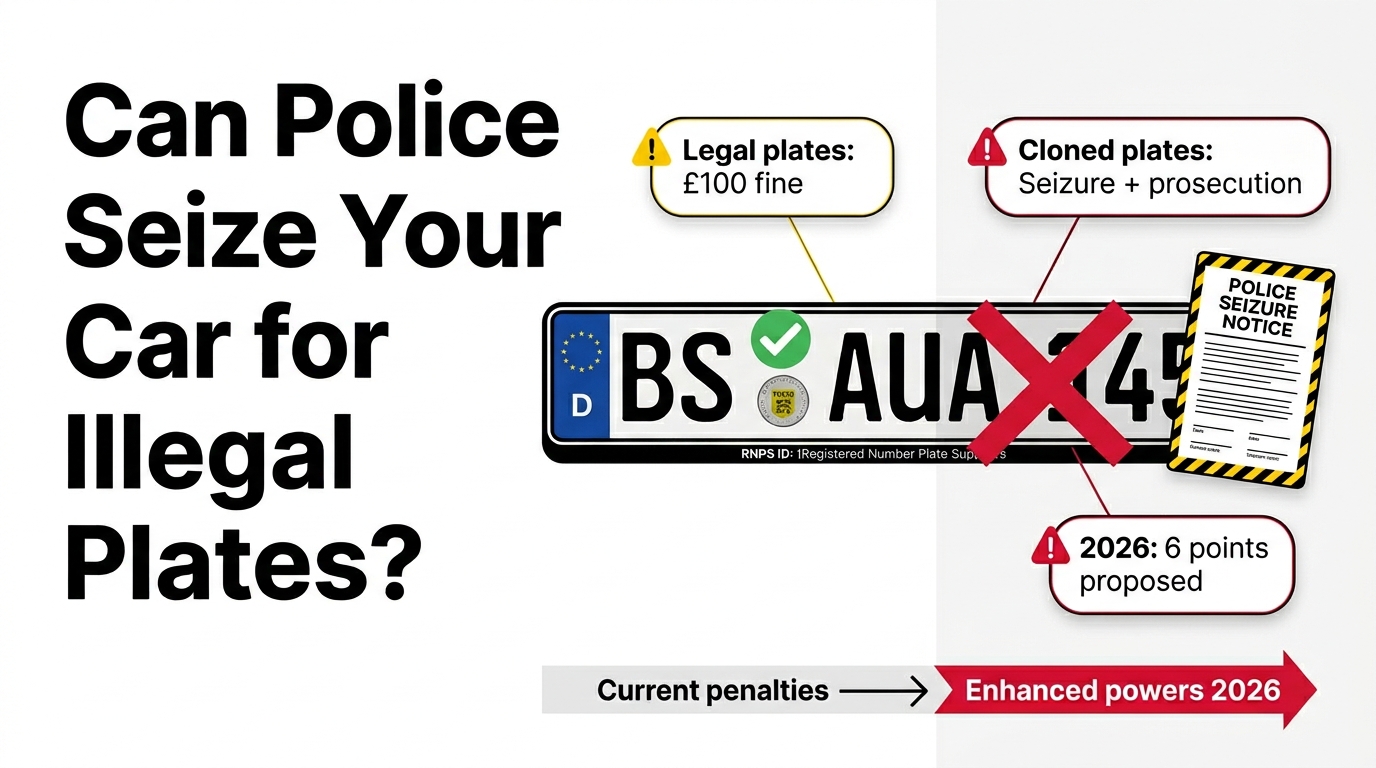
Police can seize vehicles for illegal number plates in specific circumstances, particularly when plates are cloned, falsified, or used to evade enforcement. Under current legislation, standard non-compliant plates typically result in fines up to £1,000 and MOT failure rather than immediate seizure. However, the government’s January 2026 Road Safety Strategy consultation proposes enhanced enforcement powers, including potential vehicle confiscation for serious offences.
Key verdict: While routine non-compliance (incorrect fonts, spacing, or materials) rarely leads to seizure, cloned plates, deliberately obscured registrations, or plates used in criminal activity can result in immediate vehicle impoundment under Section 165A of the Road Traffic Act 1988.
Critical caveat: The distinction between minor technical breaches and serious fraud matters significantly. Plates that fail BS AU 145e standards but display genuine registrations face financial penalties. Plates designed to deceive ANPR cameras or conceal vehicle identity face seizure and potential criminal prosecution.A tPrivate Number Plate Maker Ltd (RNPS ID: 73132), we manufacture every plate to full BS AU 145e:2018 compliance at our Ilford workshop, ensuring our customers avoid both penalties and seizure risks through proper documentation verification and certified manufacturing.
Current Police Powers: What the Law Actually Says
Understanding when police can legally seize your vehicle requires examining the specific legislation governing number plate enforcement. The powers differ significantly between technical non-compliance and deliberate fraud.
Road Traffic Act 1988 Provisions
Section 165A of the Road Traffic Act 1988 grants police powers to seize vehicles driven without a valid licence or insurance. While this section doesn’t explicitly mention number plates, illegal plates can trigger seizure when they indicate:
- The vehicle is untaxed (no visible registration)
- The vehicle identity is concealed (cloned plates)
- The driver cannot be identified (obscured plates)
Police officers must have reasonable grounds to believe an offence has been committed before exercising seizure powers. A plate with slightly incorrect character spacing would not typically meet this threshold, whereas a plate displaying a registration not assigned to that vehicle would. (See our: Road Vehicles Regulations 2001 Guide)
Vehicle Excise and Registration Act 1994
Section 42 of the Vehicle Excise and Registration Act 1994 addresses the display of registration marks. The legislation mandates that vehicles must display number plates conforming to prescribed requirements. Breaches constitute a criminal offence punishable by fines up to level 3 on the standard scale (currently £1,000).
However, Section 42 does not grant automatic seizure powers for non-compliant plates. The DVLA’s enforcement guidance distinguishes between:
- Technical breaches: Incorrect fonts, margins, or materials – handled through fixed penalty notices or prosecution.
- Fraudulent use: Cloned plates, false registrations – may trigger seizure under broader deception offences.
(See: DVLA Document Requirements)
When Seizure Actually Occurs
Police seizure of vehicles for number plate offences typically occurs in these scenarios:
- Cloned plates: When a vehicle displays registration marks assigned to a different vehicle of similar make and model.
- No visible registration: Plates so non-compliant (e.g., reflective spray, removed plates) that ANPR cameras cannot read them.
- Criminal investigation: Plates linked to other offences (theft, evasion, organised crime).
- Repeat offences: Drivers with multiple convictions for plate-related offences.
The College of Policing’s Authorised Professional Practice on vehicle seizure emphasises proportionality. Officers must consider whether seizure is necessary and appropriate given the specific circumstances.
Proposed New Powers Under 2026 Consultation
The government’s January 2026 Road Safety Strategy introduced proposals that could significantly expand police enforcement powers regarding illegal number plates.
Six Penalty Points Proposal
The consultation document proposes introducing 6 penalty points for drivers caught with illegal number plates. Currently, most number plate offences carry financial penalties only, with points rarely applied unless connected to other driving offences.
Under the proposed changes:
- Drivers accumulating 6 points within two years of passing their test would face licence revocation.
- Commercial drivers could face professional consequences.
- Insurance premiums would likely increase substantially.
(See our: Number Plate Fines UK Guide)
Enhanced Seizure Powers Being Considered
While the consultation document does not explicitly mandate automatic seizure for all illegal plate offences, it signals government intent to strengthen enforcement mechanisms. Key proposals under discussion include:
- Automatic seizure for cloned plates: Removing officer discretion in clear cloning cases.
- Immediate impoundment for ANPR-evasion plates: Plates using reflective sprays or films designed to defeat cameras.
- Extended retention periods: Vehicles held for longer during investigations.
The consultation period runs through mid-2026, with implementation expected no earlier than late 2026 or 2027. However, the government’s stated position indicates serious intent to combat number plate fraud.
Industry Response and Concerns
The RNPS (Registered Number Plate Suppliers) scheme has expressed support for stricter enforcement against fraudulent plates while emphasising the importance of distinguishing between:
- Deliberate fraud requiring strong sanctions.
- Unintentional non-compliance from consumers purchasing from non-compliant suppliers.
This distinction matters because many drivers unknowingly purchase illegal number plates from online suppliers who do not verify documents or manufacture to BS AU 145e standards. (See our: BS AU 145e Explained Guide)
What Constitutes an Illegal Number Plate
To understand seizure risk, drivers must recognise what makes a number plate illegal under UK law. The Road Vehicles (Display of Registration Marks) Regulations 2001 set detailed specifications.
BS AU 145e:2018 Requirements
Since September 2021, all replacement number plates must comply with BS AU 145e:2018, which mandates:
- Reflectivity: Background must reflect light for ANPR camera readability in all weather conditions.
- Impact resistance: Plates must withstand stone chips and road debris.
- Weathering resistance: No fading or degradation after UK winter exposure.
- NIR compatibility: Readable by near-infra-red traffic cameras.
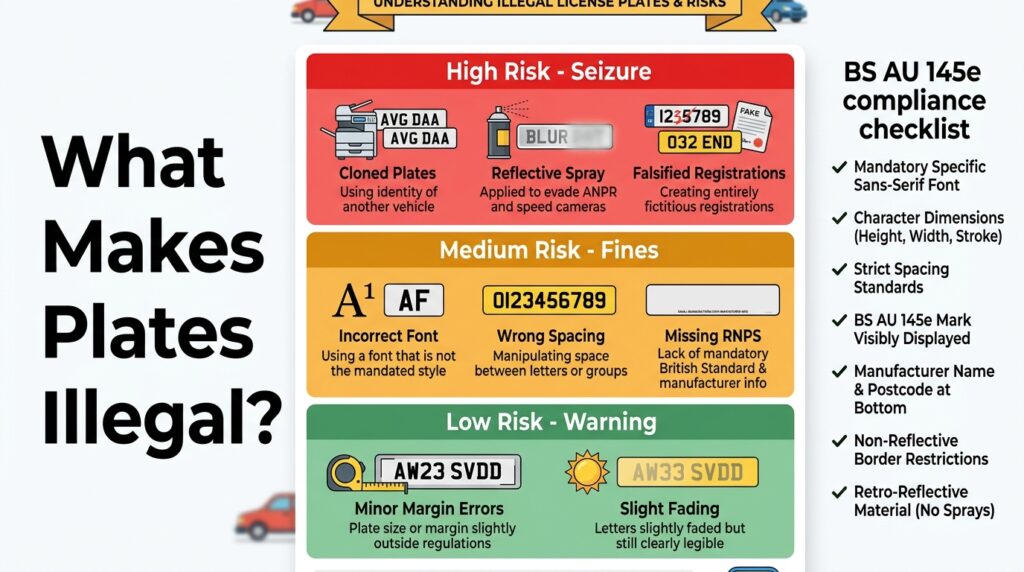
- Charles Wright font: Mandatory typeface with specific character dimensions.
Common Violations by Category
- High-Risk (Seizure Likely): Cloned plates, completely non-reflective plates, and plates with ANPR-evasion sprays.
- Medium-Risk (Fines Likely): Incorrect character spacing, non-Charles Wright fonts, and show plates used on roads.
- Low-Risk (Warnings): Slightly incorrect margins or minor fading on older BS AU 145d plates.
(See our: Are Ghost Plates Legal Guide)
Ghost Plates and Reflective Sprays
“Ghost plates” represent a particular enforcement concern. Legal ghost number plates use subtle gradient effects while maintaining BS AU 145e reflectivity. Illegal versions apply reflective sprays that make plates invisible to ANPR. Police can seize vehicles fitted with these devices under Section 165A.
Actual Enforcement and Penalties in 2026
Understanding the gap between maximum legal penalties and typical enforcement helps drivers assess real-world risk.
Current Penalty Structure
- Fixed Penalty Notices: £100 fixed penalty for minor offences.
- Prosecution: Maximum fine of £1,000.
- MOT Failure: Illegal plates will cause an immediate MOT failure.
Cloned Plate Investigations
When police identify cloned plates, they typically perform a vehicle stop and document verification. Innocent victims of cloning face vehicle seizure while investigations establish which vehicle is genuine. This is why purchasing from DVLA-registered suppliers who maintain records is vital.
How to Avoid Vehicle Seizure: Practical Steps
Drivers can eliminate seizure risk by ensuring their number plates meet all legal requirements and maintaining proper documentation.
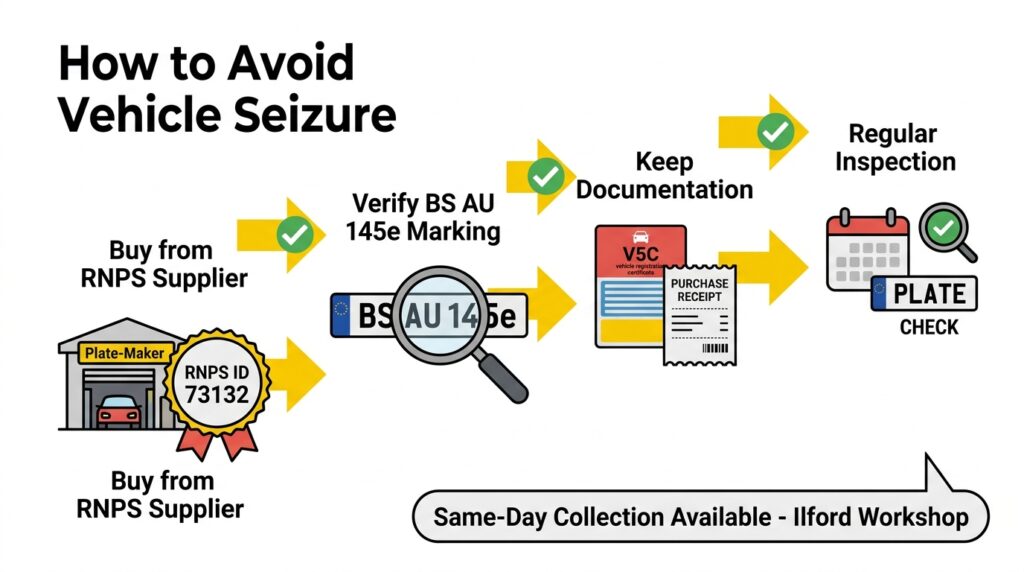
Purchase from DVLA-Registered Suppliers
Private Number Plate Maker Ltd (RNPS ID: 73132) operates a physical workshop in Ilford with on-site document verification. (See our: Same Day Collection Ilford Guide)
Regular Inspection and Maintenance
Inspect plates monthly for fading, damage, or loose fixings. (See our: How to Maintain Number Plates Guide)
Practical Takeaways
- What to Do: Purchase only from registered suppliers, verify the BS AU 145e marking, and keep your V5C accessible.
- What to Avoid: “ANPR-proof” plates, novelty fonts, and suppliers who don’t ask for legal documents.
- How Plate-Maker Ensures Compliance: Every plate undergoes a strict document check and is manufactured using certified 145e materials.
Next Steps: Design your compliant plates using our online Plate Builder, or visit our Eastern Avenue workshop for same-day collection in Ilford.
Frequently Asked Questions
Can police seize my car immediately for illegal number plates?
Police can seize vehicles immediately when plates indicate cloning or deliberate ANPR evasion under Section 165A of the Road Traffic Act 1988. Minor breaches usually result in a £100 fine.
What are the proposed penalties for illegal plates in 2026?
The 2026 Road Safety Strategy proposes 6 penalty points for illegal plate offences, alongside the existing £1,000 maximum fine.
Will my car be seized if my plates aren’t BS AU 145e compliant?
Immediate seizure is rare for simple non-compliance unless it suggests fraud. However, it will result in an MOT failure. You should check if 3D or 4D plates are still legal before purchasing.
How do I prove my plates aren’t cloned if police stop me?
Always carry your V5C document and proof of purchase from an RNPS-registered supplier like Plate-Maker.
Are ghost plates legal and will they result in seizure?
Legal ghost plates maintain reflectivity. Illegal “stealth” plates that use sprays to hide from cameras will likely lead to vehicle seizure. Read the truth about ghost plates here.
Conclusion
Vehicle seizure for illegal number plates is a targeted enforcement tool focusing on fraud and evasion. However, the 2026 consultation signals a much tougher stance for all drivers. The safest approach is to use a registered supplier. Ready to order? Start designing your 2D, 3D, or 4D plates here or visit us for same-day collection.
Leave a Reply