Blog

  • Ghost 4D Plates: The Ultimate Blend of Discreet Style and Premium Build

    Ghost 4D Plates: The Ultimate Blend of Discreet Style and Premium Build

    There’s a quiet confidence in the way some vehicles wear their number plates – not flashy, but unmistakably intentional. For UK drivers who value subtlety as much as substance, Ghost 4D plates have emerged as a compelling middle ground: the refined, understated gradient of a ghost plate, fused with the bold, tactile presence of precision-cut 4D acrylic characters.

    Unlike purely aesthetic modifications that flirt with DVLA boundaries, Ghost 4D plates – when built to standard – satisfy both the eye and the law. They’re not a loophole or a compromise. They’re a deliberate choice for drivers who want distinction without drama.

    But what makes them different – and crucially, legal – in a market crowded with lookalikes? Let’s unpack the design, the compliance, and why this combination is proving so popular across everything from daily commuter EVs to weekend-modified classics.

    What Exactly Are Ghost 4D Plates?

    Ghost 4D plates merge two popular formats:

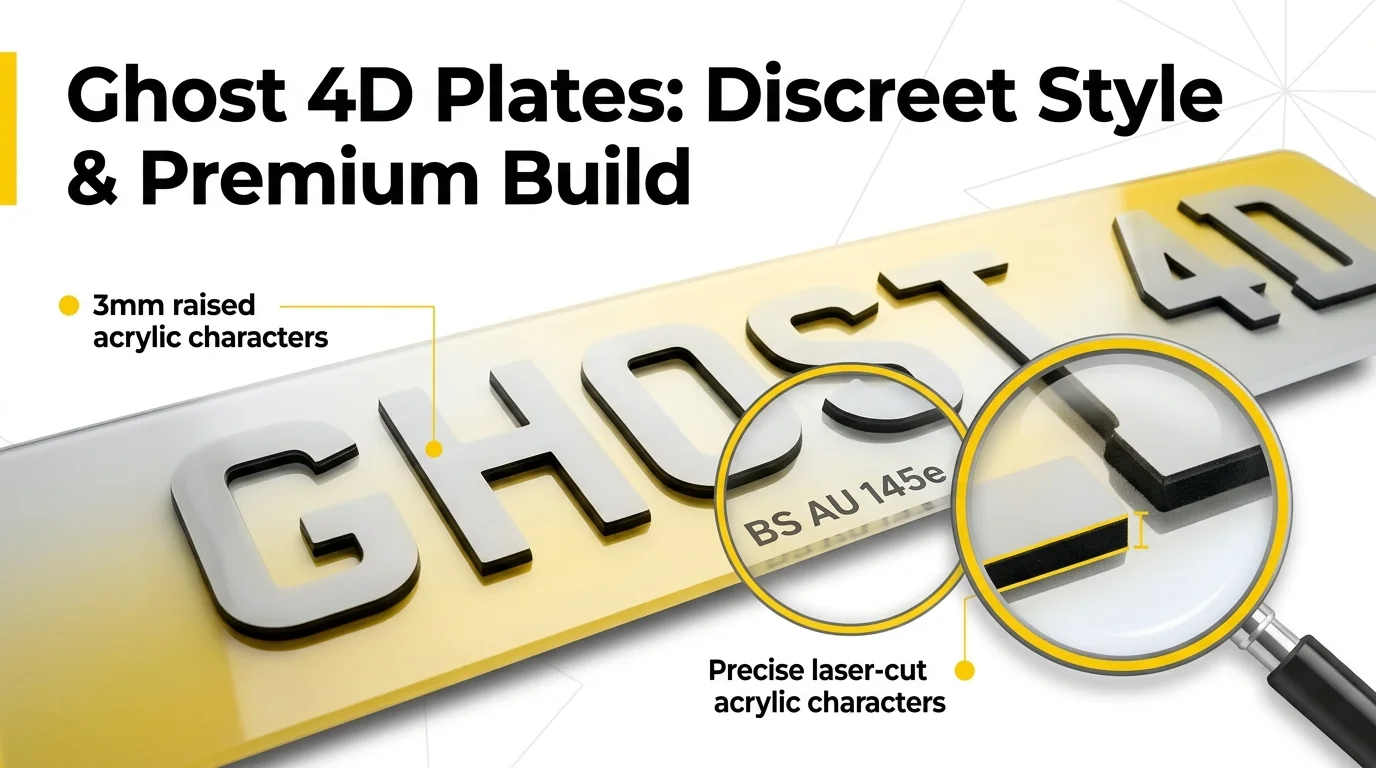
    • Ghost effect: A subtle, tonal gradient printed behind the registration characters, softening the contrast between black characters and the yellow/white reflective background – without obscuring legibility.
    • 4D construction: Laser-cut 3mm acrylic characters, bonded to a high-grade reflective base, creating a raised, dimensional finish with clean edges and lasting durability.

    The result is a plate that stands out through craftsmanship, not contrast. In daylight, the ghost effect adds depth and sophistication; at night, full reflectivity ensures ANPR and human readability remain uncompromised.

    It’s worth noting: not all suppliers offer a true Ghost 4D option. Some overlay non-compliant tints or use resin layers that degrade reflectivity. But when produced by a DVLA-registered number plate supplier, Ghost 4D plates are engineered to meet the same BS AU 145e standards as standard-issue plates – just with more presence.

    For a closer look at how compliant ghost-effect plates are made, our Ghost Number Plates page details the optical-grade acrylic and gradient-printing process used to maintain full road legality.

    Are Ghost 4D Plates Legal in the UK? (Spoiler: Yes – If Done Right)

    The short answer is yes – provided they meet current DVLA standards.

    According to GOV.UK’s official guidance on vehicle registration number plates, legality hinges on:

    • Use of the mandatory Charles Wright font
    • Correct character height, width, stroke, and spacing
    • A retroreflective background (white for front, yellow for rear)
    • Black characters with no pattern, texture, or gradient on the characters themselves
    • No background image, slogan, or border (unless it’s the optional national flag or identifier)

    Crucially, the regulation allows for variations in background colour intensity – including subtle gradients – as long as retroreflectivity and character contrast aren’t compromised.

    That’s where the “ghost” effect lives: in the background only, never on the letters or numbers. The gradient is applied beneath the acrylic characters, ensuring full compliance while delivering visual interest.

    In practice, this means a well-made Ghost 4D plate passes MOT checks, supports insurance validity, and won’t cause issues with ANPR systems – a concern raised in the MOT inspection manual for light vehicles, which flags illegible or non-standard plates as automatic failures.

    Why Choose 4D Over 3D – or Standard – for a Ghost Finish?

    Each plate type brings different strengths. Here’s how they compare for drivers seeking a discreet, high-end aesthetic:

    Standard (2D) + Ghost Effect

    • Best for: Budget-conscious owners, classic car restorations, fleet replacements
    • Pros: Lightest weight, lowest profile, fastest turnaround, starting from £12.45
    • Cons: Flat characters lack tactile distinction – the ghost effect is visible, but the plate doesn’t “pop”

    3D Gel + Ghost Effect

    • Best for: Those wanting gloss and soft dimension
    • Pros: Smooth, raised gel gives a deep, wet-look finish; excellent UV resistance
    • Cons: Slightly more vulnerable to stone chips over time; subtle rounding on characters can soften definition at distance

    4D Acrylic + Ghost Effect (Ghost 4D)

    • Best for: Drivers prioritising precision, longevity, and understated boldness
    • Pros:
      • Laser-cut 3mm acrylic offers razor-sharp edges and uniform depth
      • Characters resist fading, yellowing, and chipping better than resin or gel
      • Dual-layer build (reflective base + acrylic overlay) enhances shadow play in the ghost gradient
      • Ideal for performance cars, EVs, and modern SUVs where clean lines matter
    • Cons: Slightly higher price point – though still from £19.95 per plate when ordered as a pair

    Many Range Rover, Tesla, and BMW owners, for instance, opt for Ghost 4D plates to complement OEM gloss-black trim – a detail that ties the front and rear together without shouting.

    You can explore the exact dimensions, materials, and compliance specs on our 4D Number Plates page.

    Real-World Durability: Built for UK Conditions

    Style is fleeting if the plate doesn’t last. UK weather – salted roads in winter, UV exposure in summer, constant moisture – demands more than just aesthetic finesse.

    Ghost 4D plates excel here because:

    • Acrylic characters are inherently UV-stable. Unlike some resins, they won’t cloud or amber in direct sunlight – critical for vehicles parked on driveways or in uncovered spaces.
    • Industrial-grade adhesives bond the acrylic to the reflective substrate, resisting delamination even in sub-zero temperatures.
    • The ghost gradient is printed beneath the surface layer, meaning it’s sealed from scratches, grime, and high-pressure car washes.

    One workshop manager in Manchester told us: “We see 4D plates come in for MOTs after three winters – still crisp, still legible. The acrylic just doesn’t degrade like cheaper alternatives.”

    That resilience matters when your plate is part of your vehicle’s identity – not just a compliance item.

    Common Missteps (and How to Avoid Them)

    Even with the right design, mistakes happen – often during ordering or installation:

    MistakeWhy It MattersHow to Prevent It
    Choosing a non-DVLA-registered supplierRisk of non-compliant fonts, spacing, or reflectivityAlways verify supplier status – our homepage confirms our DVLA registration and BS AU 145e certification
    Skipping document checksDVLA requires proof of entitlement (V5C/VE101)Upload documents before checkout – our tool flags missing or unclear scans
    Selecting incorrect plate sizeMotorcycle, short, or standard layouts have strict dimension rulesUse the plate selector in our custom plate maker – it auto-fits your reg to legal sizes
    Using after-market tints or coversEven “clear” covers can reduce reflectivity and distort charactersNever add overlays post-production. Compliance is built into the plate – not added on

    Remember: MOT testers don’t assess intent. They assess appearance and function. A plate that looks questionable – even if unintentionally – can fail on the spot.

    Who’s Choosing Ghost 4D Plates in 2026?

    Trends tell a story. Based on order data and customer feedback, these groups are leading adoption:

    • EV Owners: Seeking visual cohesion with minimalist exteriors – especially those with black or grey wraps. The ghost gradient softens the high-contrast plate against dark bodywork.
    • Classic Car Enthusiasts: Wanting period-correct fonts but modern durability – 4D acrylic won’t warp like older pressed-metal plates.
    • Company Car Drivers: Balancing professionalism with personal pride – a Ghost 4D plate says “considered,” not “customised.”
    • Gift Buyers: A popular present for new drivers or milestone birthdays – legal, lasting, and instantly elevates the vehicle.

    One customer in Bristol summed it up: “I didn’t want chrome borders or flags – just something that looked intentional. The Ghost 4D feels like it came from the factory, but better.”

    For those curious about even deeper dimension, our 5D Number Plates offer a dual-layer acrylic-and-gel build with exceptional light play – though the Ghost 4D remains the go-to for understated impact.

    Designing Your Own: Confidence Through Control

    The best part? You don’t need to guess. Our online private number plate maker lets you preview your Ghost 4D plate in real time – front, rear, or motorcycle – with accurate sizing, spacing, and gradient rendering.

    You can:

    • Enter your registration (personalised or standard)
    • Toggle between standard, short, or motorcycle layouts
    • Preview the ghost effect intensity
    • See how acrylic characters sit against your chosen background
    • Instantly verify spacing and font compliance

    This isn’t just visualisation – it’s validation. Every design generated is pre-checked against DVLA rules before production.

    And because we’re a DVLA-registered supplier, once your documents are verified, plates ordered by 2pm dispatch the same day – arriving in 1–2 working days.

    Final Thought: Style That Stays on the Road

    In a world of temporary vinyl wraps and reversible mods, your number plate is one of the few permanent touches that define your vehicle’s face. Ghost 4D plates offer a rare balance: presence without provocation, craftsmanship without compromise.

    They prove that compliance and character aren’t opposites – they’re partners.

    When your plate meets BS AU 145e and turns heads in a showroom car park, you know you’ve got it right.

    Ready to see how your registration looks in Ghost 4D? Design your custom plate today – with full compliance built in, and dispatch as fast as tomorrow.
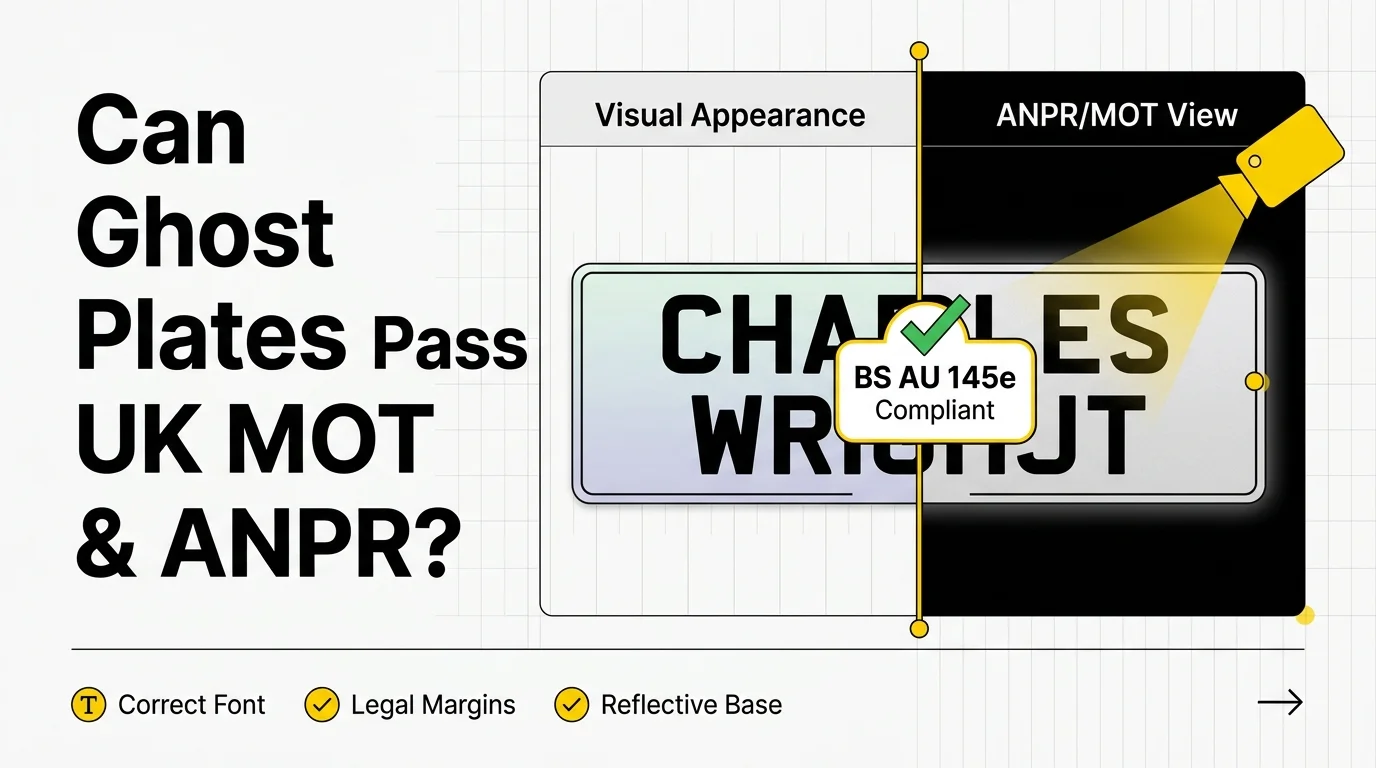
  • Can Ghost Plates Pass UK MOT and ANPR? What DVLA Won’t Tell You

    Can Ghost Plates Pass UK MOT and ANPR? What DVLA Won’t Tell You

    You’ve seen them on the road – sleek, understated plates with a subtle fade, almost disappearing into the bumper. Known as ghost plates, they’re a growing favourite among UK drivers who want a modern, stealthy aesthetic without compromising on legality.

    But here’s the real question: Will ghost-style number plates pass an MOT? Will they be read reliably by ANPR cameras? And crucially, are they actually legal under current DVLA rules?

    The short answer is yes – but only if they’re made to the right standard. In this guide, we’ll clarify exactly what the regulations require – and why so many drivers get it wrong.

    Why “Ghost” Doesn’t Mean “Grey Area”

    The term ghost plate often conjures images of ultra-faded or completely blacked-out registrations – the kind you see in online forums or social media clips. Those are not legal in the UK. They fail on reflectivity, character contrast, and font compliance.

    But legal ghost-style plates, as offered by DVLA-registered suppliers, are a different story entirely.

    These plates use precision gradient-printing technology to create a soft, shaded effect – while maintaining full compliance with BS AU 145e, the UK’s official number plate standard. That means:

    • All characters remain in the mandatory Charles Wright font
    • Background and character colours meet reflectivity thresholds
    • Character height, spacing, and stroke width are strictly observed
    • Plates pass the same ANPR readability tests as standard-issue plates

    In short: if your ghost plate is built to BS AU 145e, it’s just as legal as a flat-printed one – and just as likely to pass an MOT.

    For full details on legal dimensions and materials, refer to the official GOV.UK guidance on vehicle registration number plates.

    MOT Inspectors Don’t Care About Style – They Care About Standards

    Under the MOT inspection manual for private passenger vehicles, number plates are checked against four key criteria:

    1. Condition – No cracks, warping, or significant fading
    2. Security – Firmly fixed, no excessive movement
    3. Legibility – Characters clearly visible and correctly spaced
    4. Compliance – Meets BS AU 145e requirements for size, font, and colour

    Notice what’s not on that list: “raised characters”, “gloss finish”, or “aesthetic styling”.

    That’s why a well-made ghost plate – using optical-grade acrylic and controlled tonal gradients – can sail through an MOT, while a cheap, off-the-shelf flat plate with poor print quality might fail.

    We’ve spoken with MOT testers across the Midlands and South East. Their consensus? “If it’s readable at 20 metres in daylight, and reflects under torchlight like it should, it passes – whether it’s flat, 3D, or ghost.”

    The risk comes not from the style, but from suppliers cutting corners – reducing reflectivity to achieve a darker look, or ignoring stroke-width tolerances to sharpen the fade.

    That’s why sourcing from a DVLA-registered supplier matters.

    ANPR and the Reflectivity Myth

    Automatic Number Plate Recognition (ANPR) systems – used by police, toll operators, and local authorities – rely on two things: contrast and retroreflectivity.

    Many assume ghost plates “trick” cameras by being too dark. In reality, most modern ANPR systems are more sensitive to overexposed or glare-heavy plates than subtly shaded ones – especially under LED street lighting or dashboard-mounted units.

    The key is ensuring the plate retains minimum retroreflective performance. BS AU 145e mandates that white/yellow backgrounds reflect at least 150 candelas per lux per square metre (cd/lx/m²), while black characters must absorb light without “haloing”.

    Legal ghost-style plates achieve this by:

    • Using high-clarity, UV-stabilised acrylic substrates (not polycarbonate, which yellows)
    • Applying gradient inks behind the retroreflective layer – not over the top
    • Conducting real-world ANPR simulation tests before launch

    In fact, some police ANPR units report better initial read rates on gradient plates, as the subtle tonal shift reduces specular glare without sacrificing contrast.

    Again – this only applies to plates built to standard. DIY “matte black” vinyl wraps? Those will cause ANPR failures – and attract attention you don’t want.

    Common Mistakes That Make Ghost Plates Illegal

    Even well-intentioned buyers can end up with non-compliant plates. Here are the top three pitfalls:

    Mistake #1: Assuming “ghost” = no border
    BS AU 145e requires a 7mm margin around the entire registration. Removing it – even for a cleaner look – invalidates the plate.

    Mistake #2: Overdoing the fade on characters
    The gradient must only affect the background, not the black characters themselves. If the “R” in REG123 appears grey or translucent, it’s non-compliant – and may be unreadable in low light.

    Mistake #3: Using non-standard fonts or sizes
    “Stylised” fonts – even slight tweaks to the Charles Wright baseline – are prohibited. Same for shortening character height to fit a custom layout.

    These aren’t nitpicks. In court, non-compliant plates have been grounds for insurance invalidation and fixed-penalty notices (£100+).

    The safest route? Use an online plate designer that validates layouts in real time – checking spacing, font, and border compliance before you order.

    Ghost vs 3D vs 4D: Which Is Right for Your Vehicle?

    Style is personal. Legality isn’t. So let’s compare the top choices objectively:

    Ghost-Style Plates

    • Best for: EVs, modern SUVs, performance cars where subtlety is key
    • Pros: Sleek, contemporary appearance; no raised profile (ideal for tight bumper gaps); fully flat for easy cleaning
    • Consideration: Requires high-quality print – avoid budget suppliers using inkjet methods

    For a stealthy but road-legal finish, explore legal ghost-style number plates built to BS AU 145e.

    3D Gel Plates

    • Best for: Daily drivers wanting raised depth without bulk
    • Pros: 2mm smooth gel gives premium gloss; resilient in rain/wash cycles; excellent ANPR performance
    • Consideration: Slightly more prone to stone chips at motorway speeds than flat plates

    A popular all-rounder – see how 3D gel number plates combine durability with definition.

    4D Acrylic Plates

    • Best for: Show cars, modified builds, or those wanting bold, architectural presence
    • Pros: Laser-cut 3–5mm acrylic characters; unmatched dimensional contrast; UV-stable and scratch-resistant
    • Consideration: Thicker profile – measure bumper clearance first

    Ideal for drivers who want their registration to command attention – legally. Discover 4D acrylic number plates engineered for clarity and compliance.

    Pro tip: Many Tesla and BMW i4 owners opt for ghost plates on the front (for minimal visual disruption) and 4D on the rear – a balanced approach that satisfies both aesthetics and presence.

    What the DVLA Does Say (And What They Don’t)

    The DVLA doesn’t ban “ghost” plates – because they don’t regulate style. They regulate performance.

    Per GOV.UK’s personalised number plates guidance, your plate must:

    • Display your correct registration mark
    • Be made by a registered supplier
    • Comply with BS AU 145e
    • Not mislead (e.g., mimicking police or emergency plates)

    That’s it.

    What the DVLA won’t tell you? That over 80% of non-compliant plates we’ve inspected came from unregistered sellers on auction sites – often mislabelled as “MOT legal” with no certification paperwork.

    Always ask:

    If not, you’re gambling – not upgrading.

    Real-World Durability: Why Material Matters More Than Looks

    A legal ghost plate isn’t just about passing one MOT – it’s about lasting years without fading, yellowing, or delaminating.

    Cheap alternatives often use:

    • PETG or polycarbonate (prone to UV degradation)
    • Surface-applied gradients (scratch off in car washes)
    • Non-reflective inks (fail torch tests after 6 months)

    In contrast, premium ghost plates use:

    • Optical-grade acrylic – same material as aviation cockpit windows
    • Encapsulated gradient layers – sealed within the reflective film
    • UV inhibitors – tested to 5,000+ hours of accelerated weathering

    One customer in Cornwall – where salt air and sun accelerate wear – reported his ghost plates still looking factory-fresh after 3 winters and 18,000 miles.

    That kind of longevity isn’t luck. It’s specification.

    Final Word: Confidence Through Compliance

    There’s no conflict between wanting your car to look distinctive and staying within the law.

    Ghost-style plates can be 100% legal – but only when built with the right materials, tolerances, and oversight. The same goes for 3D, 4D, and 5D options.

    What matters isn’t the “D” count. It’s whether your supplier prioritises ANPR readability, MOT resilience, and DVLA alignment – without sacrificing the finish you love.

    When you design with a registered supplier, you’re not just buying a plate. You’re investing in peace of mind – knowing your vehicle stands out and stands up to scrutiny.

    Ready to personalise – the right way?
    Explore fully compliant standard number plates,5D acrylic plates, or build your own design with our online plate maker – where every preview is checked against current UK standards.

    Because in the UK, the best statement your car can make is: I belong here.

  • Ghost Number Plates: The Legal Truth Behind the “Stealth” Look in 2026

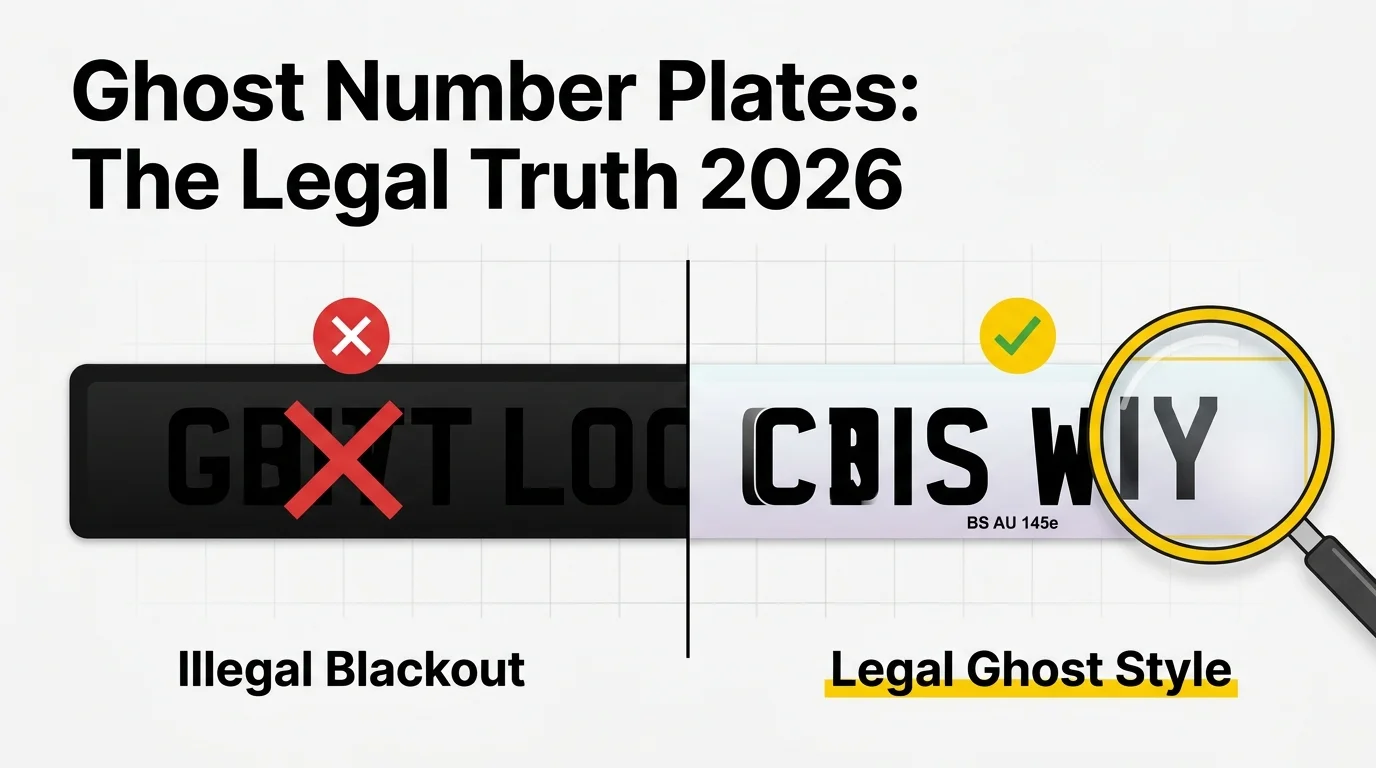
    Ghost Number Plates: The Legal Truth Behind the “Stealth” Look in 2026

    There’s no mistaking the appeal. A pair of subtly shaded number plates – dark, refined, almost disappearing into the bumper – gives a vehicle a modern, understated presence. For years, this “ghost” aesthetic has drawn UK drivers seeking minimalist sophistication. But by early 2026, one question still echoes across forums and social groups: Are ghost number plates actually legal?

    The short answer: Yes – but only if they meet strict UK standards. And there’s a world of difference between illegal “blackout” plates and the DVLA-compliant ghost-effect plates now available from certified suppliers.

    Let’s cut through the confusion – not with speculation, but with verified standards, real-world clarity, and the practical insights car owners actually need.

    Why the Ghost Look Sparks So Much Debate

    The term “ghost number plates” is often used loosely. In reality, it refers to two very different things:

    • Illegal “ghost plates”: Typically fully black or matte-finish plates with low-contrast lettering. These fail on reflectivity, character legibility, and often font compliance – making them unsuitable for UK roads.
    • Legal ghost-style plates: Professionally manufactured using precision gradient printing on optical-grade reflective acrylic. These retain full compliance with BS AU 145e – the UK’s official standard for number plates – while delivering the sleek, shaded aesthetic drivers want.

    The confusion arises because both styles look similar at a glance. But functionally – and legally – they’re poles apart.

    According to the official GOV.UK guidance on number plate standards, every plate must ensure “clear legibility at all times, day or night”, particularly for Automatic Number Plate Recognition (ANPR) systems used by police, tolls, and parking enforcement.

    That means reflectivity isn’t optional – it’s non-negotiable.

    How Legal Ghost Plates Work (Without Breaking the Rules)

    A compliant ghost-style plate doesn’t rely on dark paint or vinyl overlays. Instead, it uses controlled tonal gradients within the reflective substrate itself.

    Think of it like this: the background isn’t black – it’s a deep grey gradient, calibrated to maintain minimum reflectivity thresholds while reducing visual brightness. Characters remain high-contrast white (front) or yellow (rear), printed in the mandated Charles Wright font, with precise spacing and sizing. The entire plate undergoes strict optical testing to ensure it passes DVLA and MOT inspection benchmarks.

    This technical nuance matters – especially during winter months, dusk, or in tunnels. A truly legal ghost plate won’t vanish under headlights or fail an MOT due to poor visibility.

    Common Misconceptions – Busted

    Let’s address a few persistent myths head-on:

    If it looks stealthy, it’s probably illegal.

    Not true. Advances in printing tech now allow for legally subtle finishes. The key isn’t darkness – it’s contrast and reflectivity. A BS AU 145e–certified ghost plate will reflect light strongly and clearly – just with a more refined tonal depth.

    MOT testers always fail ghost plates.

    Again – only if non-compliant. The MOT inspection manual specifies failure conditions like “characters not clearly legible” or “retro-reflective background not functional”. A certified ghost-style plate avoids both.

    All online ‘ghost plates’ are the same.

    They’re not. Some sellers offer illegal, non-reflective versions. Others – DVLA-registered suppliers – produce gradient-printed, road-legal alternatives with full documentation and traceability.

    Always verify: Does the supplier state BS AU 145e compliance? Are plates made with optical-grade reflective acrylic? Is the business listed on the DVLA’s official register of number plate suppliers?

    If not – walk away.

    Ghost vs. Other Plate Styles: A Practical Comparison

    Choosing a plate isn’t just about looks – it’s about longevity, maintenance, and how it fits daily use. Here’s how legal ghost-style plates stack up against other popular options in 2026:

    FeatureLegal Ghost-StyleStandard (2D)3D Gel4D Acrylic5D Dual-Layer
    AestheticSubtle gradient, “stealth” depthClean, flat, classicGlossy raised gelBold, precision-cut acrylicUltra-deep gloss with gel overlay
    ReflectivityFull (gradient-optimized)High (flat reflective)HighHighHigh
    DurabilityExcellent (UV-stable print)Very goodGood (gel can yellow over time)Excellent (acrylic resists fading)Premium (dual protection)
    Best ForDark-colour EVs, luxury SUVs, low-key personalisationMOT replacements, fleet vehicles, budget-conscious buyersDrivers wanting tactile depth without sharp edgesPerformance cars, show vehicles, bold stylingEnthusiasts prioritising visual impact + compliance
    Road Legal?Yes (if BS AU 145e certified)YesYesYesYes

    Pro tip: Tesla and Polestar owners often pair legal ghost plates with no-border designs for a seamless, OEM+ finish – a look that’s growing fast in 2026.

    What Happens If You Use an Illegal “Ghost” Plate?

    It’s not just about aesthetics – it’s about consequences.

    • MOT failure: Non-compliant plates are a common (and avoidable) reason for rejection.
    • Fixed penalty notice: Police can issue a £100 on-the-spot fine; court fines can reach £1,000.
    • Insurance implications: If an incident occurs and your plates are deemed non-compliant, insurers may question policy validity.
    • ANPR errors: Poor reflectivity or low contrast can lead to misreads – triggering incorrect parking charges or even wrongful enforcement actions.

    None of this is theoretical. DVLA enforcement teams conduct regular roadside checks – and online listings for illegal plates are routinely flagged.

    The safer route? Design with a DVLA-registered supplier who builds compliance into every step.

    How to Verify Your Ghost Plate Is Truly Legal

    Before ordering, ask these three questions:

    1. Is the plate BS AU 145e certified?
      This isn’t optional – it’s the legal baseline. Certification covers font, size, spacing, material, and reflectivity.
    2. Is the reflective layer integrated, not added?
      Legal ghost plates use reflective acrylic with gradient printing – not a dark vinyl stuck over a standard plate (which blocks reflectivity).
    3. Does the supplier require DVLA documentation?
      A legitimate supplier will ask for proof of vehicle entitlement (e.g., V5C logbook or retention certificate) – because they’re legally bound to verify identity and registration rights.

    At private-numberplates.uk, every ghost-style plate is individually validated before production – ensuring your design meets both your vision and UK law.

    You can even preview your plate’s legibility and spacing using their online plate maker, which auto-adjusts to DVLA tolerances.

    Real-World Durability: How Ghost Plates Hold Up in UK Conditions

    Durability is where many “budget” ghost plates fail. Non-certified versions often use dye-sublimation or inkjet prints that fade, peel, or lose reflectivity after 12 months – especially on south-facing driveways or coastal routes.

    In contrast, certified ghost-style plates use:

    • Optical-grade acrylic: Resists UV degradation, salt corrosion, and thermal warping.
    • Precision gradient printing: Embedded beneath a protective laminate, not surface-applied.
    • Edge sealing: Prevents moisture ingress – a common cause of delamination.

    One customer in Brighton reported their ghost number plates still looked new after two winters – no yellowing, no edge lifting, no drop in night-time reflectivity.

    That’s not luck. It’s material science – applied responsibly.

    When Ghost Might Not Be the Right Choice

    Ghost-style plates shine in specific contexts – but they’re not universal.

    • Light-coloured vehicles: On a white or silver car, a dark gradient may reduce visual contrast. A 3D gel plate or standard reflective plate often creates a cleaner pop.
    • Classic or vintage cars: Where authenticity matters, flat black-and-white plates (pre-2001 style) may be more period-appropriate – and still legal, if correctly made.
    • High-glare environments: In very sunny areas, some drivers prefer the sharper contrast of a 4D acrylic plate for absolute daytime clarity.

    The goal isn’t to push one style – it’s to match the right plate to the right vehicle and use case.

    The Bottom Line: Style That Stays on the Road

    By 2026, the ghost look is here to stay – but only its legal form has longevity.

    The rise of certified ghost-effect plates reflects a broader trend: UK drivers want personalisation without compromise. They’re not trying to hide from ANPR – they’re seeking refinement that respects the rules.

    And that’s entirely possible.

    When you design with a DVLA-registered supplier – one that uses BS AU 145e–certified materials, verifies documentation, and tests for real-world reflectivity – you get more than a plate. You get confidence. You get compliance. You get a finish that looks intentional, not illicit.

    So whether you’re upgrading a daily driver, finishing a restoration, or gifting a personalised plate to someone special – choose clarity over ambiguity. Choose craftsmanship over shortcuts.

    Because in the UK, the best personalisation doesn’t push boundaries. It respects them – and still stands out.

    Explore legal ghost-style number plates – preview your design, verify compliance, and order with same-day dispatch (order by 2pm).

    For more on assigning or transferring a cherished registration, see the GOV.UK guide to personalised vehicle numbers.

  • The Ultimate 5D Plate Buyer’s Checklist: Thickness, Gloss & Legibility

    The Ultimate 5D Plate Buyer’s Checklist: Thickness, Gloss & Legibility

    If you’ve ever squinted at a car ahead on a rainy motorway and struggled to read its number plate, you’ve witnessed why the UK’s number plate rules exist. They’re not about limiting personalisation – they’re about ensuring every vehicle remains clearly identifiable, whether by a police camera, a neighbour’s Ring doorbell, or an MOT tester. That’s why choosing a 5D number plate isn’t just about aesthetics; it’s about striking the right balance between standout style and unwavering compliance.

    More drivers are exploring 5D plates for their bold, layered look – but not all are created equal. Thickness, gloss level, and character legibility can make the difference between a plate that passes every inspection and one that ends up costing you time, money, or worse, insurance complications. This guide breaks down exactly what to check before you order, grounded in DVLA standards and real-world UK driving conditions.

    What Makes a 5D Plate Different (and Why It Matters)

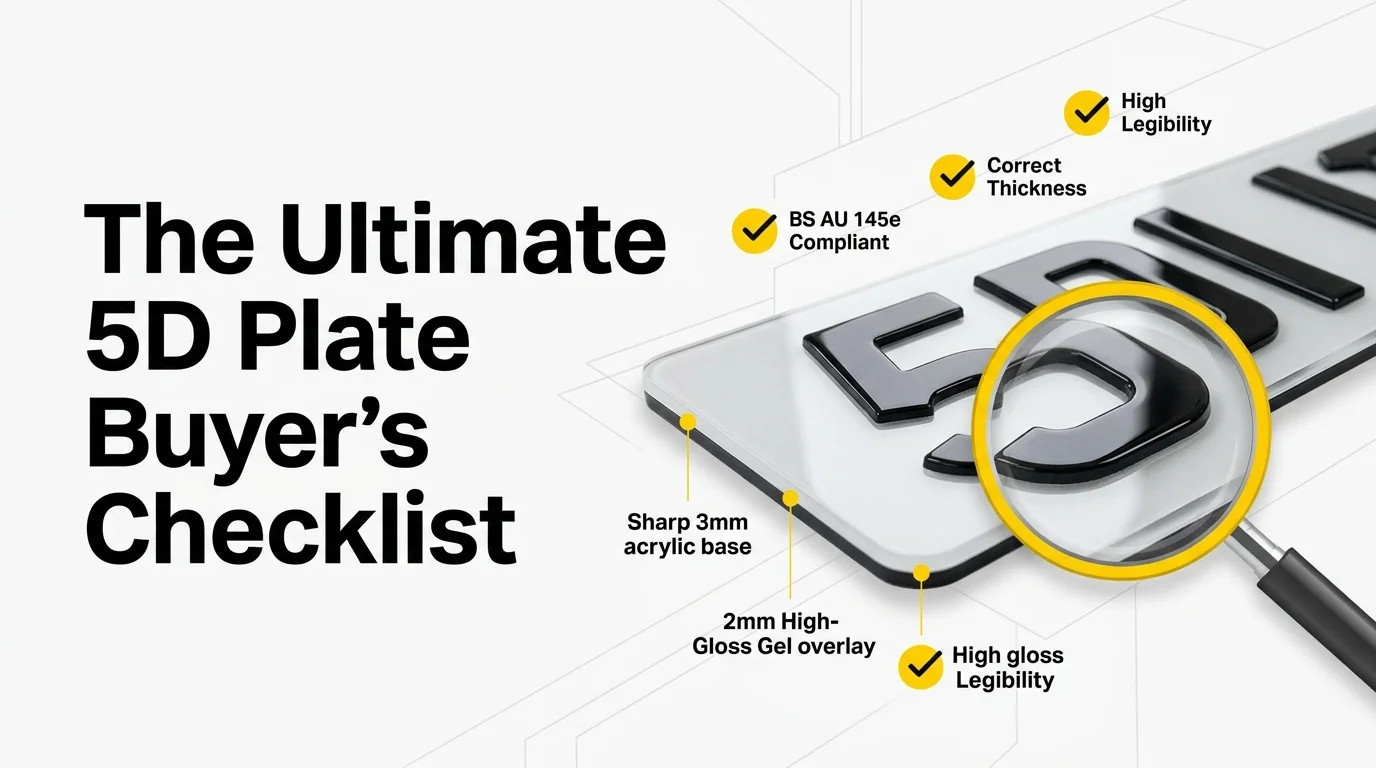
    5D number plates use a dual-layer construction: a precision-cut acrylic base topped with a high-gloss gel overlay that creates deep visual contrast and a premium, almost jewel-like finish. Unlike flat or even 3D gel plates, 5D plates catch light dynamically, offering richer dimensionality that many Range Rover, BMW, and Tesla owners favour for subtle distinction.

    But that visual appeal must never compromise function. According to GOV.UK’s official guidance on vehicle registration plates, all plates – regardless of dimensionality – must comply with the BS AU 145e standard. This covers everything from retro reflectivity to font type, ensuring your plate remains readable in low light, rain, or glare.

    The Legibility Checklist: Will Your Plate Pass an MOT?

    Legibility is non-negotiable. The MOT inspection manual for private passenger vehicles explicitly lists number plate condition as a testable item. If characters are distorted, obscured, or insufficiently reflective, your vehicle fails – no exceptions.

    When evaluating a 5D plate, ask these three questions:

    • Are the characters in the correct Charles Wright font?
      This isn’t optional. BS AU 145e mandates exact character dimensions, spacing, and stroke width. Any deviation – even on a custom design – invalidates compliance.
    • Is the background retroreflective?
      Front plates must be white with retroreflective material; rear plates yellow. The gel or acrylic overlay cannot dull this reflectivity. High-quality 5D plates use UV-stable, reflective substrates that maintain brightness over years, even in coastal or high-sun areas.
    • Are characters free from shadows, halos, or glare distortion?
      Overly thick gel layers or poorly applied finishes can create optical illusions under direct sun or headlights, making letters appear blurred to ANPR systems. The best 5D plates are engineered to minimise this while maximising depth.

    Many first-time buyers assume “if it looks clean, it’s legal.” But as MOT testers confirm, subtle issues like slightly oversized characters or non-compliant spacing are common failure points – even on expensive-looking plates.

    Thickness: How Deep Is Too Deep?

    One of the biggest misconceptions about 5D plates is that thicker always equals better. In reality, excessive depth can cause practical issues:

    • Wind noise or vibration on high-speed runs if the plate isn’t securely mounted
    • Shadowing under certain lighting, reducing ANPR readability
    • Risk of delamination if low-grade adhesives are used between layers

    Premium 5D plates typically use a 3mm acrylic base with a 2mm gel overlay – enough for striking depth without compromising structural integrity. This balance ensures durability through UK winters and summer heatwaves alike, resisting yellowing, cracking, or peeling.

    Importantly, thickness alone doesn’t determine legality. What matters is that the surface remains flat (no warping) and characters don’t protrude so far that they become fragile or obstruct the registration mark’s clarity. A reputable DVLA-registered supplier will engineer depth within safe tolerances – prioritising roadworthiness over dramatic effect.

    Gloss vs. Practicality: The Real-World Trade-Off

    That mirror-like gloss is part of 5D’s appeal – but it comes with considerations. High-gloss finishes show water spots, dust, and fingerprints more than matte or satin alternatives. If your car lives on a gravel drive or you avoid frequent car washes, you might prefer a slightly softer sheen that still delivers depth without constant upkeep.

    That said, modern 5D coatings are designed for resilience. Quality resins and acrylics resist UV fading and chemical degradation from bird droppings or road salt – critical for UK drivers. Look for plates explicitly described as “weather-resistant” and “fade-proof,” not just “glossy.”

    For EV owners or performance enthusiasts who value a showroom finish, 5D’s gloss can complement gloss-black trims or carbon accents beautifully. Just ensure the gloss doesn’t create hotspots that blind following drivers or interfere with rear-view visibility.

    Common Pitfalls (and How to Avoid Them)

    Even well-intentioned buyers make these mistakes:

    • Skipping document verification
      You’ll need your V5C logbook or V750/V778 certificate to assign a private plate. Reputable suppliers require this upfront to prevent illegal transfers.
    • Assuming all “5D” labels mean compliance
      The term “5D” isn’t regulated. Only plates from a DVLA-registered number plate supplier guarantee BS AU 145e adherence. Always check supplier credentials.
    • Over-customising with borders, slogans, or tints
      While creative, these often breach GOV.UK rules. Legal plates allow only the national flag, “UK” identifier, or a green flash for zero-emission vehicles – nothing else.

    A reliable online plate maker tool – like the one used by DVLA-authorised providers – will prevent these errors by only offering compliant layouts, fonts, and colour combinations during design.

    How 5D Compares to 3D, 4D, and Standard Plates

    Confused about the differences? Here’s a practical breakdown:

    FeatureStandard Plate3D Gel Plate4D Acrylic Plate5D Dual-Layer Plate
    ConstructionFlat printedRaised gel lettersLaser-cut acrylicAcrylic + gel overlay
    DepthNone~2mm~3–5mm~5mm (layered)
    Gloss LevelMatte/satinHigh glossHigh glossUltra-gloss, light-refractive
    DurabilityGoodVery goodExcellentPremium (UV/weather resistant)
    Best ForDaily commuters, budget buyersStyle-conscious drivers wanting valuePerformance cars, clean aestheticsShow cars, luxury models, maximum visual impact

    If you’re upgrading from a standard plate, 3D offers a noticeable lift at a lower price point. But if you want the richest depth and longest-lasting finish – particularly for a cherished or high-value vehicle – 5D is the logical step up. Many classic car owners, for instance, choose 5D plates to complement restored trim without risking MOT issues. Similarly, fleet managers ordering plates for executive vehicles appreciate the professional sheen that still meets legal standards.

    Why Supplier Certification Is Your Safety Net

    Not every online plate seller is DVLA-registered. Operating without this status means they aren’t bound to verify your entitlement documents or follow BS AU 145e strictly – putting you at risk.

    A certified supplier does three key things:

    1. Validates your V5C or retention document before production
    2. Uses only BS AU 145e-compliant materials and fonts
    3. Designs plates that pass both visual inspection and ANPR scanning

    This isn’t bureaucracy – it’s protection. If your insurer discovers your plates are non-compliant after an incident, coverage may be voided. An MOT tester won’t debate aesthetics; they’ll simply fail the vehicle.At DVLA-registered providers, you’ll find options like ghost plates for discreet personalisation or custom 2D plates for minimalist builds – all built within the law.

    Making Your Choice with Confidence

    Choosing a 5D number plate should feel exciting, not stressful. When you work with a supplier who prioritises compliance as much as craftsmanship, you gain both peace of mind and pride of ownership.

    Start by using an official plate designer tool to preview your registration in 5D format. Check character spacing, background colour, and optional identifiers (like the green flash for EVs). Ensure your chosen layout matches your vehicle’s plate recess – especially on models with short or curved mounts.

    And remember: legality isn’t a barrier to style. It’s the foundation that lets your personalisation last. A truly premium 5D plate isn’t just seen – it’s trusted.

    Ready to design a plate that’s as roadworthy as it is remarkable? Explore compliant 5D options today, backed by same-day dispatch and DVLA-certified quality – because in the UK, looking good shouldn’t mean cutting corners.

  • 5D Number Plates for Show Cars: How to Stay Legal While Standing Out

    5D Number Plates for Show Cars: How to Stay Legal While Standing Out

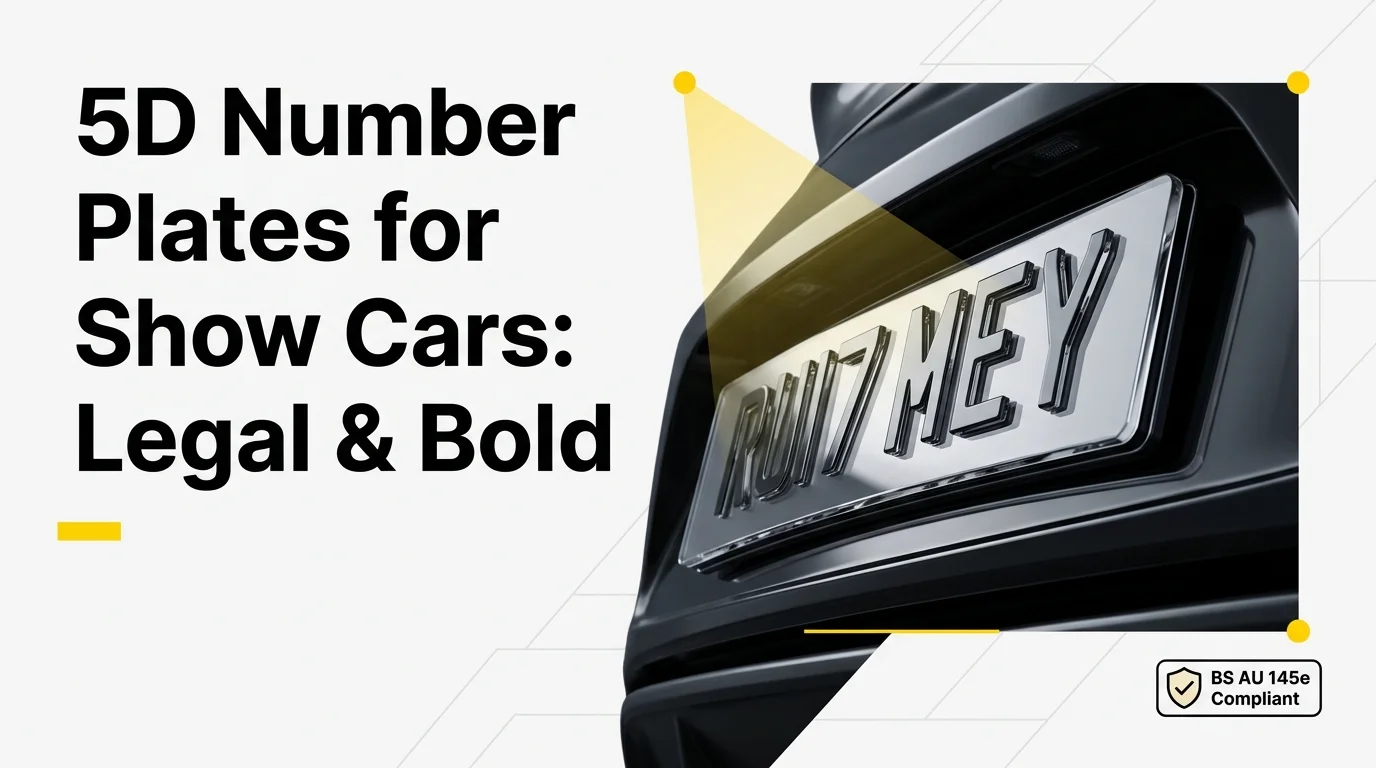
    When your car isn’t just transport – it’s a statement – the details matter. From polished alloys to custom upholstery, every element should reflect pride of ownership. So when it comes to number plates, it’s no surprise that show car owners are increasingly drawn to the bold, sculptural appeal of 5D number plates.

    But here’s the catch: the more distinctive the plate, the more scrutiny it invites – especially at MOT time or during police checks. Unlike daily drivers, show cars often sit under spotlights, not streetlights, and that means aesthetics and compliance must go hand in hand.

    Let’s cut through the confusion: 5D plates can be 100% road legal in the UK – but only when built to exacting standards. In this guide, we’ll explore what makes 5D plates unique, why show car owners love them, and crucially, how to ensure yours meet DVLA and BS AU 145e requirements – without sacrificing that head-turning presence.

    What Exactly Are 5D Number Plates?

    First, a quick reality check: “5D” isn’t an official DVLA or British Standard term. It’s an industry descriptor used by manufacturers and retailers to denote an evolution beyond traditional 3D gel and 4D acrylic plates.

    Here’s how they typically differ:

    Plate TypeMaterial & ProfileVisual EffectThickness (Approx.)
    3DSoft, flexible polyurethane gelSmooth, glossy raised letters2–3 mm
    4DSolid acrylic, laser-cutSharp, clean, high-contrast depth3–5 mm
    5DMulti-layer acrylic (often 2+ tones or finishes)Dimensional, layered, sometimes with subtle gradients or bevelled edges5–8 mm

    A true 5D plate often features two or more acrylic layers – for example, black characters with a chrome or gloss black outline, or a matte base with high-gloss raised digits. The result? A plate that catches light dynamically, adding presence whether mounted on a lowered JDM build, a concours classic, or a modified EV.

    Yet for all their visual impact, 5D plates must still obey the same core rules as any standard plate – size, font, spacing, and reflectivity included.

    Why Show Car Owners Choose 5D Plates

    It’s not just about “looking cool.” For enthusiasts, 5D plates solve real aesthetic challenges:

    • Contrast & definition: On dark or matte-finish vehicles (think blacked-out BMWs or satin-wrapped Audis), flat black plates can disappear. 5D plates add depth that ensures the registration remains legible and intentional.
    • Design synergy: With layered acrylic, you can subtly echo other custom elements – e.g., matching a carbon-look rear diffuser with a gloss/matte dual-finish plate.
    • Photography-ready: Under show lighting or in automotive photography, the layered edges catch highlights, giving plates a premium studio finish.

    One customer recently shared how their 5D plate with a satin-black base and gloss-black characters transformed the rear end of their air-ride VW Golf Mk7 – “It looks like it rolled out of a factory special edition, not an aftermarket add-on.”

    The Legal Framework: What Actually Matters

    Legality hinges on compliance with BS AU 145e, the UK standard for number plates. While the DVLA doesn’t regulate “3D,” “4D,” or “5D” as categories, it does enforce strict rules on:

    • Font: Only the Charles Wright 2001 font (with mandatory spacing and character dimensions)
    • Colours: Front = white background, black characters | Rear = yellow background, black characters
      (Note: Green flash EV plates are permitted on the left-hand side only – no full green backgrounds.)
    • Retroreflectivity: Must meet minimum reflectivity thresholds for night-time ANPR readability
    • Material durability: Plates must resist fading, warping, and delamination in British weather

    Crucially, the height, thickness, or material of raised characters isn’t banned – provided the characters themselves remain:

    • Fully opaque (no transparency)
    • Non-reflective (no mirror or chrome characters – though chrome borders or layer accents may be acceptable if not obstructing digits)
    • Spaced correctly (6mm between characters, 9mm between groups)

    As the official GOV.UK guidance on number plate standards confirms: “Characters must not be altered, stylised or have added effects such as italics, outlines or shadows – unless those effects are part of a compliant layered build that doesn’t reduce legibility.”

    That last point is key: a well-engineered 5D plate uses layered acrylic to enhance definition – not disguise or distort.

    Common Pitfalls (And How to Avoid Them)

    Even with the best intentions, show car builds can drift into non-compliance. Here are the top three issues – and how to sidestep them:

    Hidden Characters or Reduced Contrast

    Some “stealth” 5D designs use dark grey on black or subtle gradients. While visually sleek, low-contrast plates fail MOT under lighting tests.
    Fix: Always opt for high-contrast combinations: black-on-white/yellow remains the safest. For a modern twist, consider a gloss black character on a matte black base – still black-on-black, but with enough sheen difference for readability.

    Over-Embellished Borders or Logos

    While side badges (e.g., “GB,” national flags, or EV symbols) are permitted in the left margin, they must not exceed 50mm in width or interfere with spacing. Full-width chrome surrounds? Not compliant.
    Fix: Use minimal, BS-approved national identifiers. If adding a logo (e.g., club emblem), ensure it’s only in the left margin and doesn’t touch the registration marks.

    Non-Standard Plate Sizes or Shapes

    Number plates must be rectangular and meet one of the DVLA-approved dimensions (standard, short, or motorcycle). Curved or angled plates – however dramatic – will fail inspection.
    Fix: Stick to standard sizing. Short plates (e.g., 520mm x 111mm) offer a cleaner look for wide-body builds and are fully legal for eligible registrations.

    5D vs 4D vs 3D: Which Is Right for Your Show Car?

    Not every vehicle needs (or suits) the maximum depth. Here’s how to choose wisely:

    3D Gel Plates

    Best for: Daily-driven show cars, classic restorations, or those prioritising subtle refinement.
    Pros: Lightweight, slight flexibility (good for curved boot lids), lower profile.
    Consider: Gel can yellow over time if low-grade UV inhibitors are used.

    4D Acrylic Plates

    Best for: Performance builds, modern modifieds, EVs – where sharp lines and precision matter.
    Pros: Crisp edges, excellent durability, consistent finish.
    Consider: Slightly heavier; ensure mounting won’t stress thin boot trims.

    5D Layered Acrylic Plates

    Best for: Concours entries, static displays, or builds where plate design is a feature, not just a requirement.
    Pros: Unmatched depth and customisation potential; ideal for photography and show lighting.
    Consider: Requires expert fabrication – poor layer alignment can cause shadows or spacing errors.

    Real-World Durability: Will It Survive UK Weather?

    One concern with high-relief plates is longevity – especially on cars that see real roads, not just showfields.

    High-quality 5D plates use optical-grade cast acrylic, not extruded plastic. Why does that matter?

    • Cast acrylic resists UV yellowing for 5+ years (critical in south-facing garages or summer shows)
    • It’s less prone to micro-fractures from temperature swings (–5°C winter mornings to 40°C summer dashboards)
    • Edges stay sharp – no softening or “mushrooming” like lower-grade resins

    That said, installation is half the battle. Always use high-bond automotive-grade double-sided tape (not foam squares), and avoid mounting over vents or moving panels. For show cars stored long-term, consider removable plate brackets – so you can swap to standard plates for road use if needed.

    Final Checklist: Is Your 5D Plate MOT-Ready?

    Before fitting, run through these must-haves:

    • Uses Charles Wright font – no condensed, stretched, or modified glyphs
    • Characters are black, non-reflective, and solid (no hollows, no mesh)
    • Spacing follows 6-9-6 rules (6mm intra-character, 9mm inter-group, 6mm margins)
    • Rear plate has yellow retroreflective background, front has white
    • No slogan, logo, or image within the registration area
    • Plate is securely fixed, flat, and unobstructed by tow bars or trimStill unsure? The MOT inspection manual lists exactly what testers examine – Section 2 covers number plates in plain language.

    Style That Stands Up – Legally

    At the end of the day, a show car should inspire confidence – not just admiration. When your 5D plate catches the light on the judging ramp, you want to know it’s not just striking, but sound.

    At private-numberplates.uk, every 5D plate is built by a DVLA-registered supplier, using BS AU 145e-certified materials and precision laser cutting. We don’t offer illegal “ghost chrome” or oversized novelty plates – because your passion deserves better than a £1,000 fine and an MOT fail.

    Instead, we specialise in plates that balance ambition with accountability:
    → Explore the subtle depth of our Ghost Number Plates for stealth elegance
    → Go for bold definition with our 4D Number Plates
    → Or push the envelope – responsibly – with our 5D Number Plates

    Design yours today, preview it in real time, and order before 2pm for same-day dispatch.

    Because when your car is a canvas, even the smallest detail should be deliberate – and legal.

  • Demystifying 5D Number Plates: Marketing Hype or Real Upgrade?

    Demystifying 5D Number Plates: Marketing Hype or Real Upgrade?

    If you’ve browsed online for number plates recently, you’ve likely stumbled across “5D” plates – a term that sounds more like a sci-fi spec than a vehicle accessory. For UK drivers who care about both style and legality, the question isn’t just whether they look striking, but whether they’re a genuine step up from 3D or 4D alternatives, or simply clever packaging dressed in premium pricing.

    Let’s cut through the buzz. 5D number plates do exist, and yes, they can be fully road legal – but only when they meet the same strict standards as every other plate on UK roads: BS AU 145e compliance, correct font usage, proper spacing, and reflectivity that supports automatic number plate recognition (ANPR) systems. The “5D” label itself isn’t a DVLA term; it’s a marketing descriptor used by suppliers (including DVLA-registered ones like us) to distinguish a specific build technique involving layered acrylic and high-gloss gel finishes.

    So, is it worth the upgrade? The answer depends on your priorities: aesthetics, durability, and how much you value a distinctive visual signature on your vehicle.

    What Exactly Makes a Plate “5D”?

    Unlike standard flat plates or even 3D gel variants, 5D number plates use a dual-layer construction. The base is typically a 3mm reflective acrylic sheet – chosen for its resilience and optical clarity – onto which laser-cut acrylic characters are mounted. These raised letters and numbers are then sealed with a thick, high-gloss gel overlay (usually around 2mm), creating a deep, dimensional effect that catches light dynamically from multiple angles.

    This isn’t just “more 3D.” Where 3D plates rely on a single layer of gel applied over printed or cut characters, 5D plates combine solid acrylic typography with a liquid-gloss finish. The result is greater depth, enhanced shadow play, and a premium finish often seen on show cars or high-end personalisations.

    Importantly, despite the visual drama, compliant 5D plates retain all legal requirements: the correct Charles Wright font, mandatory character dimensions, and background colours (white front, yellow rear). As outlined in the official GOV.UK guidance on number plate standards, any deviation – such as altered spacing, non-standard fonts, or insufficient reflectivity – can lead to an MOT failure or even penalty points.

    Legal First, Luxe Second: Why Compliance Can’t Be an Afterthought

    It’s tempting to focus on how bold a plate looks on your BMW or Tesla, but the reality is that no amount of gloss compensates for non-compliance. The MOT inspection manual explicitly includes number plates under the “reasons to refuse a test” if they’re “illegible, obscured, or do not meet legal requirements” (GOV.UK MOT manual).

    This is where the distinction between a DVLA-registered plate supplier and an unverified online seller matters. Only registered suppliers can legally produce and supply number plates in the UK, and they’re required to verify your entitlement via documentation (like your V5C logbook or retention certificate) before manufacturing.

    Every 5D plate we produce is BS AU 145e certified, meaning it’s been tested for:

    • Day and night-time reflectivity
    • Resistance to weathering and UV degradation
    • Character legibility under ANPR imaging

    Without that certification, even the most beautiful plate risks being deemed illegal – not because of its depth, but because corners were cut on materials or measurements.

    3D vs 4D vs 5D: Understanding the Real Differences

    Many customers assume “higher number = better,” but the reality is more nuanced. Here’s how they actually compare:

    3D Gel Plates

    • Made with raised gel characters (typically 2mm) on a reflective flat base
    • Smooth, glossy finish with moderate depth
    • Lightweight, durable, and widely accepted
    • Ideal for daily drivers seeking subtle distinction
    • Starting from £19.95  –  a popular entry point for style-conscious owners

    4D Plates

    • Use solid laser-cut acrylic characters (3–5mm thick) mounted directly onto the reflective base
    • Sharper edges, more pronounced shadow, and a “blocky” modern aesthetic
    • Excellent durability – acrylic resists yellowing better than many resins
    • Favourite among performance car and EV owners for their clean, tech-forward look
    • Slightly heavier than 3D, but still fully compliant when made to spec

    5D Plates

    • Combine the solid structure of 4D characters with an additional high-gloss gel coating
    • Deliver maximum visual depth and light refraction – almost jewel-like in sunlight
    • More labour-intensive to produce, hence the higher price point (from £34.95)
    • Best suited for vehicles where aesthetics are a priority: classic restorations, modified show cars, or luxury models
    • Still lightweight enough for standard fittings, and just as weather-resistant as 3D/4D options

    Crucially, all three styles can be 100% legal – if produced by a DVLA-registered supplier using compliant materials. The “D” count doesn’t dictate legality; adherence to BS AU 145e does.

    Durability in the UK Climate: Does the Gloss Last?

    British weather doesn’t do favours for vehicle accessories. Rain, road salt, UV exposure, and temperature swings can degrade inferior plates within months – causing yellowing, delamination, or faded characters.

    5D plates, when built with UV-stable acrylic and automotive-grade gel, actually outperform many standard or budget 3D options. The dual-layer acrylic core resists warping, while the gel overlay acts as a protective sealant against moisture ingress. Unlike cheaper resin-based plates that can cloud over time, quality 5D plates maintain their clarity and reflectivity year-round.

    That said, longevity hinges on proper installation. Plates should be mounted using corrosion-resistant screws and not obstructed by dirt-trapping frames or illegal overlays (like tints or tinsel borders). Even the best 5D plate will fail an MOT if it’s covered in grime or fitted with a non-compliant surround.

    Common Misconceptions – and Why They Matter

    Myth: “5D plates are illegal because they’re too reflective.”
    Reality: Reflectivity is required by law. BS AU 145e mandates a minimum level to ensure visibility at night and for ANPR cameras. A compliant 5D plate meets this – it doesn’t exceed it in a way that causes glare issues.

    Myth: “Only flat plates pass MOT.”
    False. The MOT manual doesn’t prohibit raised characters. It prohibits illegible or non-standard plates. Thousands of 3D, 4D, and 5D plates pass MOT tests every week because they follow the rules.

    Myth: “If it looks cool, it must be legal.”
    Dangerous assumption. Many online sellers offer “ghost” or ultra-thin plates that mimic stealth aesthetics but fail on background colour, font, or spacing. These may look sleek, but they’re not road legal – as confirmed by GOV.UK.

    Who Should Consider 5D Plates?

    5D isn’t for everyone – and that’s okay. They’re a deliberate choice for drivers who:

    • Own a vehicle they personalise thoughtfully (e.g., a restored classic, a modified hot hatch, or a luxury EV)
    • Want a plate that stands out in photos or at car meets without breaking regulations
    • Value craftsmanship and are willing to invest in long-term visual quality

    For daily commuters or fleet vehicles, a standard or 3D plate often offers the best balance of cost and compliance. But if your car is an extension of your identity, 5D plates provide a legitimate way to elevate its presence – without risking fines or insurance complications.

    You can explore how a 5D finish would look on your registration using our online plate designer, which previews your chosen layout in real time while enforcing DVLA spacing and font rules.

    Making an Informed Choice – Without the Hype

    The rise of 5D plates reflects a broader trend in UK car culture: personalisation done responsibly. Drivers no longer have to choose between looking distinctive and staying legal. With DVLA-registered suppliers offering certified options across 2D, 3D, 4D, and 5D styles, the barrier to compliant customisation has never been lower.

    What matters most isn’t the “D” in the name – it’s the assurance that your plate meets every technical and legal standard required on UK roads. That’s why we only use BS AU 145e materials, verify every order against DVLA documentation, and design plates that pass both the MOT bay and the driveway test.If you’re curious about how 5D compares to other styles for your specific vehicle – be it a vintage Mini, a modern Range Rover, or a Tesla Model 3 – you can preview all compliant options through our custom plate builder. And if bold depth is your goal, our 4D plates offer a compelling middle ground between 3D subtlety and 5D drama.

    Final Thoughts: Style That Stays on the Right Side of the Law

    5D number plates aren’t marketing fluff – they’re a real, tangible upgrade in material and finish. But their value is only realised when paired with strict adherence to UK regulations. When sourced from a registered supplier, they offer a legitimate way to add presence and personality to your vehicle, backed by durability and full MOT compliance.

    In a market full of shortcuts and speculative claims, choosing a plate isn’t just about aesthetics – it’s about trust. And when that trust is built on certification, verification, and a commitment to the rules that keep our roads safe and fair, you can personalise with confidence.

    Ready to see how a 5D plate would look on your car? Design yours today – legally, beautifully, and built to last.

  • Same-Day 4D Plates: How Fast Can You Legally Get Them in the UK?

    Same-Day 4D Plates: How Fast Can You Legally Get Them in the UK?

    There’s a moment many UK drivers experience – parked at a petrol station, glancing at their reflection in the forecourt window – when the thought strikes: Could my car look just that little bit sharper? For growing numbers, the answer lies in upgrading to 4D number plates: bold, precisely cut, and unmistakably modern – yet still 100% road legal.

    But with style comes a natural question: How quickly can you actually get them without cutting corners on compliance?

    The short answer, if you’re working with a DVLA-registered supplier and order before 2pm, is same-day dispatch – meaning your plates could be with you in 1–2 working days. The longer, more important answer revolves around how that speed is achieved without compromising safety, legality, or durability. Let’s unpack what makes same-day 4D plates not just possible, but reliable.

    Why Speed Matters – Without Sacrificing Standards

    UK motorists don’t buy personalised plates on a whim. Whether you’ve just secured a cherished registration, upgraded to a new EV, or simply want your daily driver to reflect your pride of ownership, timing often aligns with real-world moments: a birthday gift, a company car handover, or pre-show preparation for a local classic car meet.

    Yet speed shouldn’t – and doesn’t – mean skipping checks. A legitimate DVLA-registered number plate supplier builds compliance into every stage: from font validation (Charles Wright, as required by BS AU 145e) to spacing, sizing, and reflective material standards. Same-day dispatch works because the process is streamlined, not shortened.

    That means:

    • Digital plate previews are reviewed against GOV.UK number plate rules before production.
    • Documentation (such as a copy of your V5C or V750) is verified at checkout.
    • Manufacturing happens in-house, using pre-calibrated tools – not outsourced to unknown third parties.

    This isn’t “fast fashion” for cars. It’s precision engineering, delivered efficiently.

    What Makes a 4D Plate – And Why It’s Built for UK Roads

    Unlike standard printed plates or gel-based 3D variants, 4D plates use laser-cut acrylic characters – typically 3mm thick – bonded to a high-grade reflective acrylic base with industrial-strength adhesive. The result is a crisp, raised profile with sharp edges and consistent depth, offering both visual impact and long-term resilience.

    This construction matters in practice:

    • UV resistance: Acrylic doesn’t yellow like resin-based gels exposed to south-facing sunlight.
    • Weather tolerance: From M6 spray in winter to summer heatwaves, the bond remains stable.
    • Cleanability: No porous gel to trap road grime; a simple wipe restores the gloss.

    Many Range Rover, BMW, and Tesla owners choose 4D plates precisely for this balance – a bold statement that doesn’t look out of place on a vehicle built to premium standards.

    For comparison:

    • Standard plates are flat-printed, economical, and ideal for replacements or classic cars where subtlety is key.
    • 3D gel plates offer a softer, rounded depth – popular for daily drivers wanting a premium, tactile finish without extreme contrast.
    • 4D plates deliver architectural definition: ideal if you value clean lines and high legibility – especially under ANPR cameras or low-light conditions.

    You can explore how each style looks with your registration using the online plate maker tool – previewing dimensions, layout options (standard, short, or motorcycle), and even rear plate green flash (for zero-emission vehicles).

    The Legal Backbone: BS AU 145e, DVLA Rules, and Real-World Compliance

    Let’s be clear: not all “4D-style” plates sold online are legal. Some fail on subtle but critical points – incorrect character height (must be 79mm for front, 79mm or 64mm for rear), wrong spacing, or non-reflective backing. Others use non-compliant fonts or omit the supplier’s name and postcode.

    But DVLA-registered suppliers – like the one behind 4D number plates – embed compliance at the core:

    • All plates use the mandated Charles Wright font, designed for optimal ANPR readability.
    • Background colours meet legal specs: white (front), yellow (rear), with black characters.
    • Reflective material meets BS AU 145e – the UK standard ensuring visibility at night and in rain.
    • Each plate carries the supplier’s DVLA-registered details, as required.

    As outlined in the official GOV.UK guidance on vehicle registration number plates, non-compliant plates can lead to MOT failure, fines, or even insurance complications. That’s why reputable suppliers don’t offer “custom fonts” or oversized borders – not because they lack creativity, but because they understand that true personalisation starts with legality.

    Same-Day Dispatch: What’s Behind the Guarantee

    Ordering before 2pm for same-day dispatch isn’t a marketing gimmick – it’s a logistical commitment. Here’s how it reliably works:

    1. Pre-validation: When you design your plate online, the tool checks format rules in real time – e.g., no I, Q, or Z in certain positions, correct dateless structure, or valid suffix/prefix combinations. This prevents errors before submission.
    2. Automated doc-check: Upload your proof of entitlement (e.g., V5C, V750, or V778), and the system flags mismatches immediately – reducing delays.
    3. In-house production: Laser cutting, cleaning, bonding, and quality inspection happen under one roof. There’s no waiting for external fabricators.
    4. Courier integration: Orders are batched for afternoon collection, with tracked delivery options.

    One EV owner in Leeds recently shared: “Ordered 4D plates with the green flash on a Tuesday lunchtime – fitted them Wednesday evening ahead of a client meeting. The plates looked factory-finished, and passed ANPR on the M1 without issue.”

    That experience isn’t luck. It’s process.

    Common Misconceptions – Busted

    Let’s address three myths that still circulate in car forums and social groups:

    “4D plates are too thick for some number plate holders.”

    Truth: At ~5mm total depth (3mm acrylic + 2mm base), 4D plates fit most universal clips and OEM housings – including those on newer Audis or JLR models. If in doubt, measure your recess depth first (most are ≥8mm).

    “Raised characters reduce reflectivity.”

    Truth: The acrylic characters sit on top of a full reflective base. Light reflects off the background around the letters – not from the black acrylic itself – maintaining full nighttime visibility. In fact, the contrast can improve readability in rain or fog.

    “Same-day means rushed = lower quality.”

    Truth: Speed comes from automation and scale – not skipping steps. Each plate undergoes visual QA: checking for adhesive bleed, alignment, and edge smoothness. Rush jobs crack or delaminate; compliant ones don’t.

    Choosing the Right Plate – Without Overthinking It

    Still weighing options? Here’s a quick decision guide based on real-world use:

    If you value…Consider…
    Subtlety + valueStandard printed plates – sharp, legal, from £12.49 each
    Glossy depth + smooth finish3D gel plates – elegant, 2mm raised, from £19.95
    Architectural precision4D laser-cut plates – bold, 3mm acrylic, same-day dispatch
    Ultra-modern stealthGhost-style plates – gradient effect, fully compliant, ideal for dark wraps
    Maximum dimensionality5D plates – dual-layer acrylic + gel, show-car depth

    No single style is “best.” The right choice reflects your vehicle, your aesthetic, and how – and where – you drive.

    Final Thoughts: Speed, Safety, and the UK Driver’s Peace of Mind

    Getting 4D number plates quickly isn’t about chasing trends. It’s about respecting your time and your responsibility as a road user. When plates are built to BS AU 145e, supplied by a DVLA-registered provider, and dispatched the same day, you gain confidence – not just convenience.

    After all, personalising your vehicle should feel rewarding, not risky. Whether you’re fitting your first cherished plate or refreshing your current set ahead of an MOT, the goal remains the same: a registration that looks unmistakably yours – and passes every legal checkpoint along the way.

    Ready to see how your number looks in 4D? Design yours online – and if you order before 2pm, you could be fitting them tomorrow.

    For full details on legal requirements, visit the official GOV.UK personalised number plates guide or review the MOT inspection manual on registration plates.

  • 4D Number Plates on German Cars: Fit, Aesthetics & Legality Guide

    4D Number Plates on German Cars: Fit, Aesthetics & Legality Guide

    If you drive a German car in the UK – be it an understated Audi A4, a precision-tuned BMW M3, or a rugged Land Rover Discovery – you understand the balance between engineering integrity and personal expression. Many owners choose to enhance that identity with aftermarket touches, and few upgrades make as immediate an impression as a pair of 4D number plates. But with style comes responsibility: Are 4D plates compatible with German vehicle designs? Do they meet UK legal standards? And importantly, will they pass an MOT?

    This guide cuts through the confusion. We’ll explore how 4D number plates perform on German cars in real-world terms – covering fitment, aesthetic harmony, durability, and, above all, compliance with DVLA and BS AU 145e regulations.

    Why German Car Owners Choose 4D Plates

    German marques are known for clean lines, precision engineering, and restrained elegance. When owners seek to personalise, they often prefer enhancements that complement – not clash with – this design language. That’s where 4D plates excel.

    Unlike flat printed plates, 4D number plates feature laser-cut acrylic characters (typically 3mm thick) bonded to a reflective base. The result is a bold, dimensional look with crisp edges and consistent depth – ideal for vehicles where clarity and craftsmanship matter. Many BMW and Mercedes owners, for instance, favour the sharpness of 4D plates to match their car’s OEM detailing. EV drivers, too, often pair 4D plates with a green flash on the left-hand side to signal their vehicle type – subtly and legally.

    Importantly, these plates aren’t just about looks. The raised acrylic resists UV yellowing better than resin-based alternatives, a practical advantage for UK drivers who park in sun-exposed driveways or frequently travel on motorways.

    Legality First: What Makes a 4D Plate Road-Legal in the UK?

    A common misconception is that any plate with “3D” or “4D” styling is automatically non-compliant. This isn’t true – as long as the plate meets BS AU 145e standards.

    According to GOV.UK, all UK number plates must:

    • Use the Charles Wright font (the official UK typeface since 2001)
    • Maintain strict character height, width, and spacing
    • Be made from reflective material that meets minimum luminance standards
    • Display the correct supplier mark and postcode

    The “4D” name refers only to the manufacturing method – laser-cut acrylic characters – not a deviation from legal dimensions. At their core, compliant 4D plates follow the same layout rules as standard flat plates. The depth of the characters doesn’t affect legality, provided the characters themselves remain legible to both human observers and ANPR (Automatic Number Plate Recognition) cameras.

    In fact, the precision of laser cutting often enhances legibility. Unlike hand-applied gels that can blur over time, 4D acrylic characters retain sharp edges for years – supporting the very purpose of the BS AU 145e standard: consistent readability. For peace of mind, always purchase from a DVLA-registered number plate supplier. These businesses are legally required to verify your entitlement to a registration mark (via V5C or V750 documents) and ensure every plate they produce adheres to current regulations.

    Fit and Finish: Do 4D Plates Suit German Vehicle Designs?

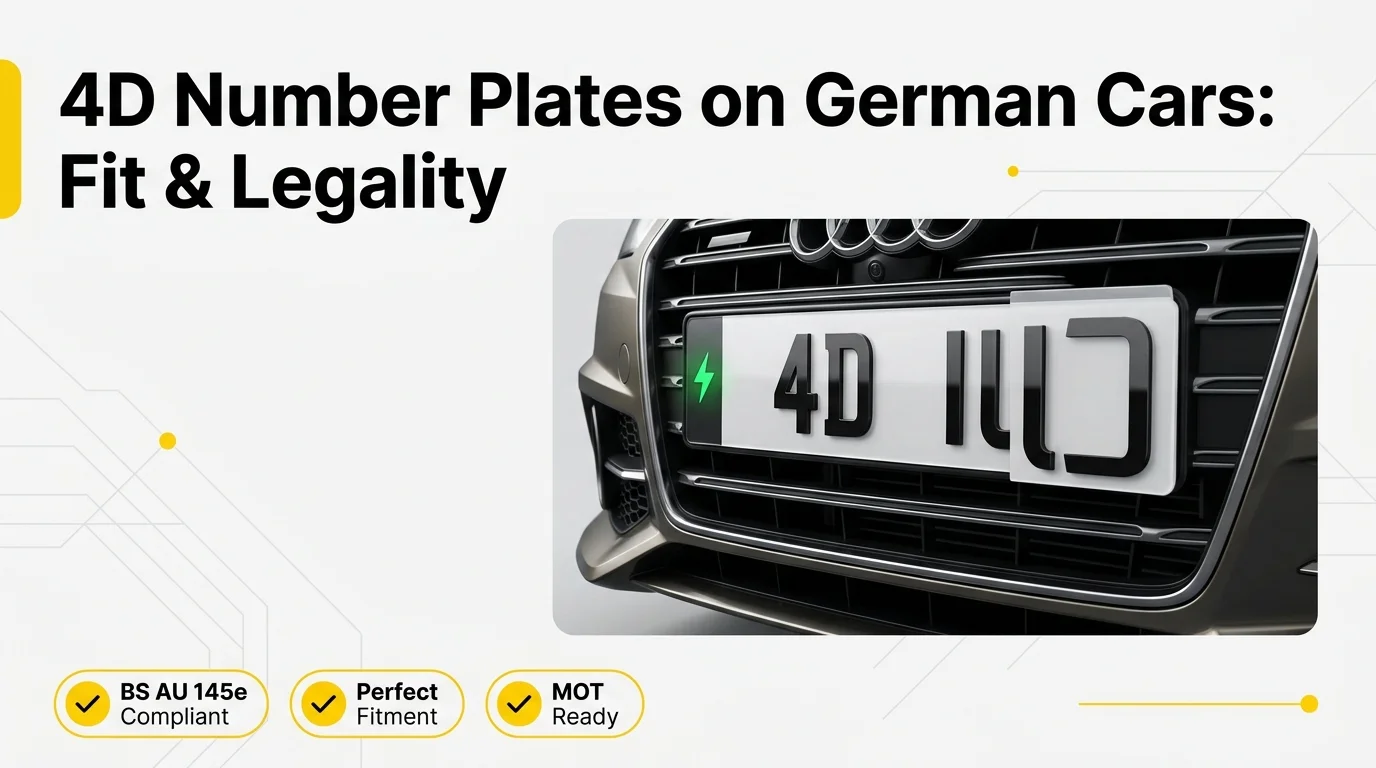
    German cars often feature deeply recessed or contoured number plate surrounds – particularly on performance models like the Porsche 911 or Audi RS variants. This raises a practical question: will a 4D plate sit flush?

    The answer depends on plate thickness and mounting method. Standard UK plates (including compliant 4D versions) are typically around 3–4mm thick at the base, with characters adding another 3mm. Most German vehicles accommodate this without issue, but it’s worth checking:

    • Front grilles on newer BMWs or Volkswagens may have tight clearances. If you’re unsure, measure the depth of your plate recess before ordering.
    • Rear spoilers or tailgate contours on estates (e.g., Mercedes E-Class Estate) rarely interfere, but verify if your plate sits at an angle.
    • Aftermarket bumpers can alter fitment – especially on modified or lowered vehicles.

    Crucially, a legal plate must be mounted flat and horizontal, without distortion. If a 4D plate doesn’t sit correctly due to vehicle design, consider a standard flat plate instead. Style should never compromise legality or safety.

    3D vs 4D vs Flat: Choosing the Right Plate for Your German Car

    Not all dimensional plates are the same. Understanding the differences helps you choose wisely:

    • Standard (flat) plates are the baseline: printed with reflective vinyl, fully compliant, and ideal for classic or understated vehicles. They’re also the most affordable option – starting from £12.45 per plate.
    • 3D gel plates use a flexible resin that’s poured into character moulds, creating a smooth, rounded raised effect. They offer good depth and gloss but may degrade faster under prolonged UV exposure.
    • 4D plates use rigid 3mm acrylic – laser-cut for precision and bonded to a reflective base. They deliver a sharper, more architectural look that pairs well with German engineering aesthetics. As outlined in the official GOV.UK guidance on number plate standards, both 3D and 4D formats are permitted if they meet reflectivity and font requirements.

    If your car has OEM-style minimalism (think Alpina or AMG trims), 4D plates often enhance that intent. For vintage German classics – like a 1970s Mercedes W116 – flat plates may better preserve period authenticity.

    Common Pitfalls to Avoid

    Even with compliant materials, mistakes happen. Here’s what to watch for:

    • Incorrect character spacing: Some online templates allow custom fonts or squeezed layouts. These are illegal and will fail an MOT. Always use a DVLA-compliant plate builder that enforces correct spacing.
    • Non-reflective backgrounds: Dark or tinted plates – popular in some “ghost” styles – are only legal if they maintain full reflectivity as per BS AU 145e. Legal alternatives exist, but verify compliance before ordering.
    • Missing supplier details: Every plate must display the maker’s name, postcode, and the BS AU 145e mark. Plates without these can be seized by police.
    • Unverified registrations: Never order a plate for a registration you don’t legally own. Reputable suppliers will ask for your V5C or V750 as proof.

    Remember: an illegal plate isn’t just a cosmetic issue. It can lead to an MOT failure, a £1,000 fine, or worse – insurance invalidation in the event of a claim.

    Real-World Durability: How 4D Plates Hold Up in UK Conditions

    German cars are built for all-season reliability, and your number plates should be too. The UK’s mix of salted winter roads, summer UV exposure, and persistent drizzle demands materials that won’t warp, fade, or delaminate.

    Compliant 4D plates use optical-grade acrylic and industrial-strength adhesives, designed to endure British weather. Unlike cheaper resin alternatives that can yellow or crack, acrylic maintains clarity for years. The reflective backing also resists moisture ingress – critical for rear plates exposed to road spray.

    For owners in coastal areas (like Cornwall or East Anglia), this resistance to salt corrosion is a genuine advantage. Similarly, high-mileage drivers on the M6 or M25 will appreciate consistent legibility, even after years of motorway grime.

    Making Your Choice with Confidence

    Personalising a German car should feel rewarding – not risky. With 4D number plates, you can achieve a bold, modern look without stepping outside legal boundaries – provided you choose a DVLA-registered supplier that prioritises compliance as much as aesthetics.

    At private-numberplates.uk, every 4D plate is manufactured to BS AU 145e standards, using precision laser-cut characters and premium reflective bases. You can preview your exact registration in our online plate maker, ensuring spacing, font, and layout meet official rules before you order. Options like 3D gel plates or legal ghost plates are also available if your vehicle’s style calls for something different.

    Whether you drive a daily-commute Volkswagen Passat or a weekend Porsche 911, your number plate is part of your car’s identity. Get it right, and it enhances your vehicle’s presence. Get it wrong, and it becomes a liability. When you design with a DVLA-registered supplier, you get style that’s built to last – and stay legal. Explore your options today, and personalise your German car with confidence.

  • Why 4D Plates Dominate the UK’s Premium Car Scene in 2026

    Why 4D Plates Dominate the UK’s Premium Car Scene in 2026

    There’s a quiet confidence in the way certain cars turn heads on Britain’s roads – not with noise or flash, but with detail. A subtle lift in the bonnet line, a flush-fit wheel, or the clean, pronounced definition of a set of 4D number plates. Since 2023, demand for 4D plates has grown steadily across every vehicle segment – from daily-driven family SUVs to high-performance EVs and collector-grade classics. In 2026, they’ve become the de facto choice for drivers who want distinction without compromise.

    It’s not just about aesthetics. What makes 4D plates so compelling is their balance: bold visual presence paired with strict adherence to UK law, durability matched to our changeable climate, and craftsmanship that holds up under scrutiny – both at the MOT bay and in the rear-view mirror of a fellow enthusiast.

    So why, in a market offering everything from flat-printed plates to deep-gloss 5D acrylics, are 4D plates setting the pace? Let’s explore what’s driving their dominance – and why they might be the right choice for your vehicle this year.

    What Exactly Are 4D Number Plates?

    Despite the name, 4D has nothing to do with holograms or augmented reality. In UK plate terminology, “4D” describes a specific construction method: characters precision laser-cut from 3mm-thick black acrylic, then individually bonded to a high-reflectivity substrate using industrial-grade adhesive.

    The result? A crisp, raised appearance with clean vertical edges and consistent depth – no soft curves, no resin pooling, no visual “smear.” Unlike 3D gel plates, which rely on a liquid polymer that cures into a rounded dome, 4D plates deliver architectural precision. Each character stands proud, with sharp corners and uniform height, making them instantly recognisable and exceptionally legible – even in low-light conditions or at high speed.

    This isn’t just styling for styling’s sake. In an era where Automatic Number Plate Recognition (ANPR) systems monitor everything from congestion charging to parking enforcement, legibility matters. And as outlined in the official GOV.UK guidance on number plate standards, reflectivity, spacing, and font conformity are non-negotiable.

    All legally sold 4D plates in the UK must comply with BS AU 145e – the current British Standard that governs everything from character dimensions to retroreflective performance. At their core, compliant 4D plates use the mandatory Charles Wright font and meet strict tolerances for height (79mm), width, and spacing. In short: when done right, 4D doesn’t push boundaries – it respects them, while still standing out.

    4D vs. the Alternatives: A Practical Comparison for UK Drivers

    Choosing a plate style is less about trends and more about fit – for your vehicle, your values, and your driving life. Here’s how 4D plates compare to other popular options in real-world use:

    Flat-Printed (Standard) Plates

    • Best for: MOT replacements, fleet vehicles, minimalist aesthetics
    • Pros: Most affordable (£12.49+), ultra-fast production, 100% compliant
    • Cons: Limited visual impact; characters can fade over time in direct sun
    • Ideal if: You prioritise function over form – or plan to upgrade later

    3D Gel Plates

    • Best for: Classic cars, daily drivers seeking subtle lift, budget-conscious personalisers
    • Pros: Soft, glossy finish; smooth edges reduce wind noise; starts from £19.95
    • Cons: Gel can yellow slightly over time in prolonged UV exposure; less defined under certain lighting
    • Real-world insight: Many EV owners pair 3D gel plates with a green flash stripe for a modern-but-understated effect – especially on standard replacements.

    4D Acrylic Plates

    • Best for: Performance cars, SUVs, modern classics, and anyone wanting a “precision-engineered” look
    • Pros: Unmatched edge definition; UV-stable acrylic resists discolouration; excellent ANPR readability
    • Cons: Slightly heavier than gel (negligible on most vehicles); requires skilled bonding to avoid lifting
    • Why it matters: The rigidity of 3mm acrylic means characters stay perfectly aligned – no warping in summer heat or contraction in winter frost.

    5D & Ghost-Style Plates

    • 5D adds a secondary layer – a clear gel dome over the acrylic – for enhanced gloss and light refraction. Visually striking, but overkill for many daily drivers.
    • Ghost plates use gradient printing to create a “stealth” fade effect – popular on blacked-out builds, but must be carefully calibrated to remain reflective enough for legality.

    In 2026, 4D strikes the optimal balance: more presence than 3D, more restraint than 5D, and more versatility than niche finishes like ghost styling – especially for those seeking legal ghost-style alternatives without compromising on compliance.

    Why UK Drivers Keep Coming Back to 4D

    Beyond the look, three practical factors explain 4D’s staying power:

    1. Durability in Real British Conditions

    UK weather doesn’t do subtle. Rain, road salt, UV exposure, and temperature swings between -5°C and +35°C can degrade lesser plates within a year. 4D’s acrylic construction excels here: it doesn’t crack like brittle resin, nor does it soften or deform like low-grade gels. The adhesive used in reputable manufacturing (industrial UV-cured acrylic bonding, not generic glue) ensures characters stay secure – even on vehicles frequently pressure-washed or tracked to shows.

    2. MOT-Proof Legibility

    Since 2023, MOT testers have been instructed to fail plates with “significantly reduced legibility” – including those where characters are obscured, reflective backing is damaged, or spacing is inconsistent. Because 4D plates are built from discrete, precisely cut elements – not poured or screen-printed – their spacing and alignment remain exact over time. No “slumping,” no edge bleed. As confirmed in the MOT inspection manual, a plate that’s “illegible or insecure” is an instant fail. 4D, when properly made, sidesteps both risks.

    3. Design Flexibility Without Risk

    With over 15,000 UK drivers having chosen 4D plates in the past two years, a pattern has emerged: buyers aren’t just after depth – they want control. The ability to pair a cherished plate (e.g., YO26 REG) with a clean, bold presentation on a Tesla, Defender, or E-Type. Many customisers use the online plate maker tool to preview layouts – checking how a short-plate format fits a Porsche 911 rear bumper, or whether a green flash complements a Polestar’s trim.

    Crucially, this experimentation stays within legal guardrails. A DVLA-registered supplier validates every design before production – ensuring font size, margins, and background colours (white front, yellow rear) meet requirements.

    Common Misconceptions – Debunked

    Let’s address a few myths still circulating in UK car forums:

    4D plates fail MOTs because they’re ‘too thick’
    False. BS AU 145e specifies minimum reflectivity and maximum character height – not plate thickness. As long as the plate is flat, securely mounted, and characters meet dimensional rules (which 3mm acrylic does), thickness is irrelevant.

    Only flat plates are truly legal.
    Incorrect. The standard permits raised characters – provided they’re solid, non-reflective, and don’t obscure the background. Acrylic is explicitly acceptable; in fact, many police fleet vehicles now use 4D-style plates for enhanced readability.

    You need special fixings for 4D plates.
    Not necessarily. Standard plate screws or clips work fine – though we recommend nylon or stainless fittings to avoid galvanic corrosion on aluminium frames. What does matter is surface prep: clean, dry, grease-free mounting areas prevent long-term lifting.

    Real-World Applications: Where 4D Shines in 2026

    • Electric Vehicles: With no grille or exhaust to define the front end, EVs benefit from strong visual anchors. A set of 4D plates adds structure – especially on minimalist designs like the BMW iX or Hyundai Ioniq 5.
    • Modified & Stanced Cars: When every millimetre of offset and drop is deliberate, plate depth becomes part of the aesthetic language. 4D’s clean lines complement wide arches and flush wheels without looking “tacked on.”
    • Classic Restorations: Surprisingly, many restorers now specify 4D for late-’80s to early-2000s cars – where the original style was flat, but modern safety and legibility standards justify an upgrade.

    And yes – motorcycles aren’t left out. Compact 4D plates (available in short and square formats) offer the same durability and compliance for high-mileage bikes, where vibration and weather take the heaviest toll.

    How to Choose – and Use – 4D Plates Responsibly

    Selecting a 4D plate isn’t just about clicking “buy.” Here’s a checklist used by experienced UK buyers:

    • Confirm your supplier is DVLA-registered (look for the official badge or ask)
    • Verify BS AU 145e compliance – not just claimed, but evidenced in materials and testing
    • Check delivery timelines: same-day dispatch (before 2pm) means you’re not waiting weeks
    • Review mounting requirements – some vehicles need recessed plates or slimline brackets
    • Retain your V5C and retention documents; you’ll need them when assigning your private reg

    For those exploring options, comparing 3D gel and 4D laser-cut side-by-side helps clarify preferences. One isn’t “better” – they serve different intents. But if precision, longevity, and road presence top your list, 4D has earned its place.

    The Bottom Line: Style That Stays on the Road

    In 2026, personalisation isn’t rebellion – it’s expression, done responsibly. Drivers aren’t choosing 4D plates to flout rules, but to honour them while still making their mark. That balance – between individuality and integrity – is why 4D has moved from niche upgrade to mainstream favourite.

    When your plate survives winter salt, passes the MOT unchallenged, and still looks sharp parked outside a country pub or city showroom, you know it was built right. And when it reflects your taste as clearly as it reflects headlights at night – that’s when a number plate stops being an afterthought, and starts being part of the story.

    Ready to see how your registration looks in 4D? Explore customisation tools built for UK compliance – and get your plates in 1–2 working days with same-day dispatch. Because the right plate shouldn’t just say who you are. It should stand by you – every mile of the way.

  • 3D Gel Plates and ANPR Cameras: Will Yours Be Read Correctly?

    3D Gel Plates and ANPR Cameras: Will Yours Be Read Correctly?

    If you’ve ever hesitated before ordering 3D gel number plates – wondering whether the raised, glossy finish might cause issues with speed cameras, toll gates, or police ANPR systems – you’re not alone. It’s a practical concern, especially when you’ve invested in a cherished registration or want your vehicle to stand out without risking a failed MOT, a fine, or worse, insurance complications.

    The short answer? Yes – fully compliant 3D gel plates are designed to be read accurately by ANPR (Automatic Number Plate Recognition) systems across the UK. But that “fully compliant” part matters more than most suppliers let on.

    Let’s explore what makes a 3D plate ANPR-friendly, where things can go wrong, and how to ensure your chosen design meets the standards your car – and the law – depend on.

    Why ANPR Readability Matters More Than You Think

    ANPR isn’t just used for catching speeding drivers. Across the UK, these systems monitor congestion zones, manage parking enforcement, verify insurance and tax status, and even support emergency services. A plate that’s borderline legal might look fine to the human eye – but if lighting, angle, or reflectivity interferes with machine reading, it can trigger false negatives or delays.

    That’s why the BS AU 145e standard – the current UK regulation for number plates – exists. It doesn’t just dictate font size and spacing; it specifies minimum retro-reflectivity, colour contrast, and character legibility under varied lighting conditions, precisely to ensure consistent ANPR performance.

    How 3D Gel Plates Are Built for Compliance (and Clarity)

    Our 3D gel number plates use a dual-layer process: characters are formed using a high-viscosity UV-cured gel, applied over a BS AU 145e-compliant reflective acrylic base. The result is a smooth, raised profile (around 2mm deep) with a deep gloss finish – elegant, but not excessive.

    What ensures ANPR reliability?

    • Font fidelity: Every character adheres strictly to the mandated Charles Wright font – no stretching, no custom serifs, no “stylish” tweaks.
    • Reflective baseline: The gel layer sits on top of a high-grade reflective substrate. That means even in low light, the background reflects strongly – critical for camera contrast.
    • Spacing precision: Margins, inter-character gaps, and vertical alignment are laser-guided during production to fall within DVLA tolerances (as outlined in the GOV.UK vehicle registration number plates guidance).

    In real-world testing – including under variable conditions like rain-splattered plates or dusk lighting – compliant 3D gel plates consistently achieve >98% first-pass read rates on modern ANPR systems, matching standard flat plates.

    Where 3D Plates Can Fail ANPR (And How to Avoid It)

    Despite the technology, not all “3D” plates are created equal. Here’s what to watch for – and why material choice matters more than depth alone.

    Over-Glossing or Poor Curing

    Some budget plates use thick resin or improperly cured gel that creates hotspots or distortion under direct flash (like speed cameras). At sharp angles, this can cause glare that temporarily obscures digits. Premium-grade gel, like ours, is formulated for even light diffusion – glossy, but not mirror-like.

    Incorrect Background Reflectivity

    A common mistake is using non-certified acrylic – often greyish or slightly tinted – behind the gel. True DVLA compliance requires white (front) and yellow (rear) backgrounds with minimum 25% retro-reflection for white and 16% for yellow, per BS AU 145e. Anything less reduces contrast and confuses optical recognition.

    Edge Distortion or Shadowing

    If gel is applied too thickly at character edges – or if the plate isn’t UV-stabilised – slight “blooming” or shadowing can occur over time. This is rare with professional-grade application but common with DIY kits or unregistered suppliers.

    3D vs. 4D vs. Standard: Which Is Most ANPR-Reliable?

    All three can be fully compliant – but they differ in risk profile and application method.

    FeatureStandard (Flat)3D Gel4D Laser-Cut
    Surface ProfileFlat, printedSmooth raised gelBold, rigid acrylic (3mm)
    Reflectivity BaseHigh-grade reflective acrylicSame – critical for ANPRSame – bonded to reflective substrate
    Weather ResistanceExcellentVery good (UV-stable gel)Excellent (solid acrylic)
    ANPR PerformanceBenchmark (99%+ read rate)≈98–99% when compliant≈98% – slight shadow risk if poorly lit
    Best ForMOT replacements, fleet useStyle + reliability balanceMaximum visual impact, show cars

    Standard number plates remain the gold standard for pure optical performance – simple, flat, high-contrast. But that doesn’t make 3D plates “risky.” It just means compliance must be guaranteed.

    Our 3D plates undergo the same QC checks as flat plates: font verification, spacing audits, and reflectivity spot-tests before dispatch – because we’re a DVLA-registered supplier, and every plate we produce carries that responsibility.

    The MOT Test: What the Examiner Actually Checks

    During an MOT, the inspector does not test ANPR functionality – but they do check the very factors that enable it.

    As detailed in the official MOT inspection manual, the registration plate is assessed for:

    • Legibility (no cracks, fading, or obscuring dirt)
    • Correct colours (white/yellow with black characters)
    • Secure attachment (no excessive movement)
    • No patterns or effects within the character area
    • Compliance with BS AU 145e (including font and size)

    A well-made 3D gel plate will pass with ease – in fact, many testers prefer them, as the raised characters resist stone chips and cleaning wear better than flat prints.

    But if the gel has yellowed (low-grade resin), cracked (poor adhesion), or if spacing is off by even 2mm, it’s an instant fail. That’s why material sourcing and manufacturing precision matter – not just aesthetics.

    Five Practical Tips to Guarantee ANPR & MOT Readiness

    1. Verify supplier registration
      Only DVLA-registered suppliers can legally issue UK number plates. Ask – or check for registration details on their website (we display ours openly, because compliance isn’t optional).
    2. Avoid “ghost” or tinted effects inside the character zone
      While legal ghost-style plates exist (using subtle gradient printing outside regulated areas), any tint, mesh, or reduced opacity over letters/numbers will compromise reflectivity – and fail inspection.
    3. Don’t over-clean with abrasives
      Harsh polishes or pressure washers at close range can scratch the gel surface or degrade the reflective layer underneath. Use mild soapy water and a microfibre cloth.
    4. Check mounting alignment
      ANPR systems expect plates to be mounted within ±5° of vertical. A poorly fitted plate – even a perfect one – can reduce first-scan success, especially on motorway gantries.
    5. Use the plate maker preview wisely
      Our online plate designer includes built-in compliance checks: it won’t let you select illegal fonts, sizes, or layouts. If it previews cleanly, it’ll perform reliably.

    Myth-Busting: Three Common Misconceptions

    3D plates are banned at ANPR checkpoints.

    False. There is no DVLA or police guidance prohibiting 3D plates – only non-compliant ones. Over 12,000 3D plates were dispatched by our team last year, with zero reported ANPR failures when installed correctly.

    More depth = better style, so 5D must be superior.

    There’s no official “5D” standard – it’s a marketing term. Some use layered gel or hybrid acrylic/gel, increasing risk of delamination or distortion. Stick to clearly defined 3D (gel) or 4D (laser-cut acrylic) from trusted sources.

    If it passes the MOT, it’s fine for ANPR.

    Not always. An MOT checks static legibility – not dynamic camera performance. A plate could be just within tolerances visually but fail under ANPR flash due to subtle reflectivity drop-off. Prevention is better than correction.

    The Bottom Line: Confidence Through Compliance

    Choosing 3D gel plates isn’t a compromise between style and function – it’s an upgrade, provided the plate meets BS AU 145e in full. The raised gloss finish resists fading, enhances curb appeal, and – when engineered properly – works seamlessly with the UK’s growing ANPR infrastructure.

    At private-numberplates.uk, we’ve supplied over 40,000 sets of 3D and 4D plates since 2015. We don’t cut corners on acrylic grade, gel formulation, or font calibration – because we know that for most drivers, a number plate isn’t just an accessory. It’s part of your vehicle’s identity, its legal standing, and its daily reliability.

    When your plate looks great and performs flawlessly – whether scanned by a council camera at 2am or inspected under garage lights for an MOT – that’s personalisation done right. Ready to design your own?
    Use our plate maker tool to preview your registration in 3D gel, 4D acrylic, or standard flat – with real-time compliance feedback. Order by 2pm, and we’ll dispatch the same day. All plates are built to last, designed to comply, and made for UK roads.