Category: Blog

  • Ghost Plates Crackdown 2026: What the New Penalty Points Mean for UK Drivers

    Ghost Plates Crackdown 2026: What the New Penalty Points Mean for UK Drivers

    Executive Summary

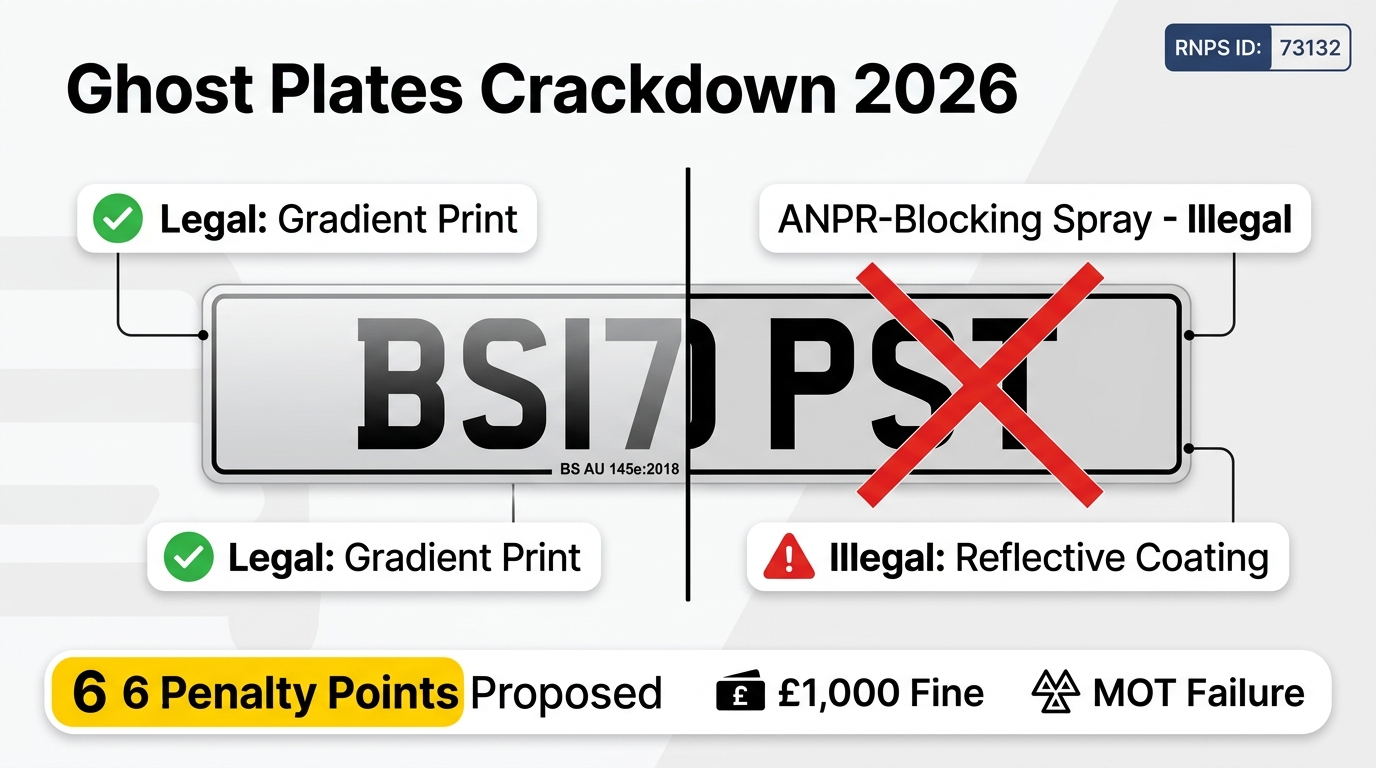
    Ghost plates that use reflective sprays or films to evade ANPR cameras are facing stricter enforcement in 2026, with proposed penalties of up to 6 penalty points for drivers caught with illegal number plates. Under the Road Vehicles (Display of Registration Marks) Regulations 2001, number plates must maintain specific reflectivity standards to be readable by automatic number plate recognition systems, and any modification that compromises this is illegal. While subtle gradient effects that maintain BS AU 145e compliance remain legal, plates treated with ANPR-blocking coatings can result in fines up to £1,000, MOT failure, and potential penalty points. At Private Number Plate Maker Ltd (RNPS ID: 73132), we manufacture only fully compliant ghost plates that use legal gradient effects without reflective coatings, ensuring you stay within the law while achieving the aesthetic you want. This guide explains what constitutes an illegal ghost plate, the enforcement landscape in 2026, and how to ensure your plates remain compliant.

    What Are Ghost Plates and Why Are They Under Scrutiny?

    Ghost plates have become increasingly popular among car enthusiasts seeking a subtle, modern aesthetic for their vehicles. The term refers to number plates that create a visual effect where the characters appear to fade or blend into the background, typically using grey, silver, or gradient colour schemes rather than the traditional black-on-white or black-on-yellow.

    However, not all ghost plates are created equal, and understanding the distinction between legal and illegal versions is critical for UK drivers in 2026.

    Legal Ghost Plates: Gradient Effects Within BS AU 145e

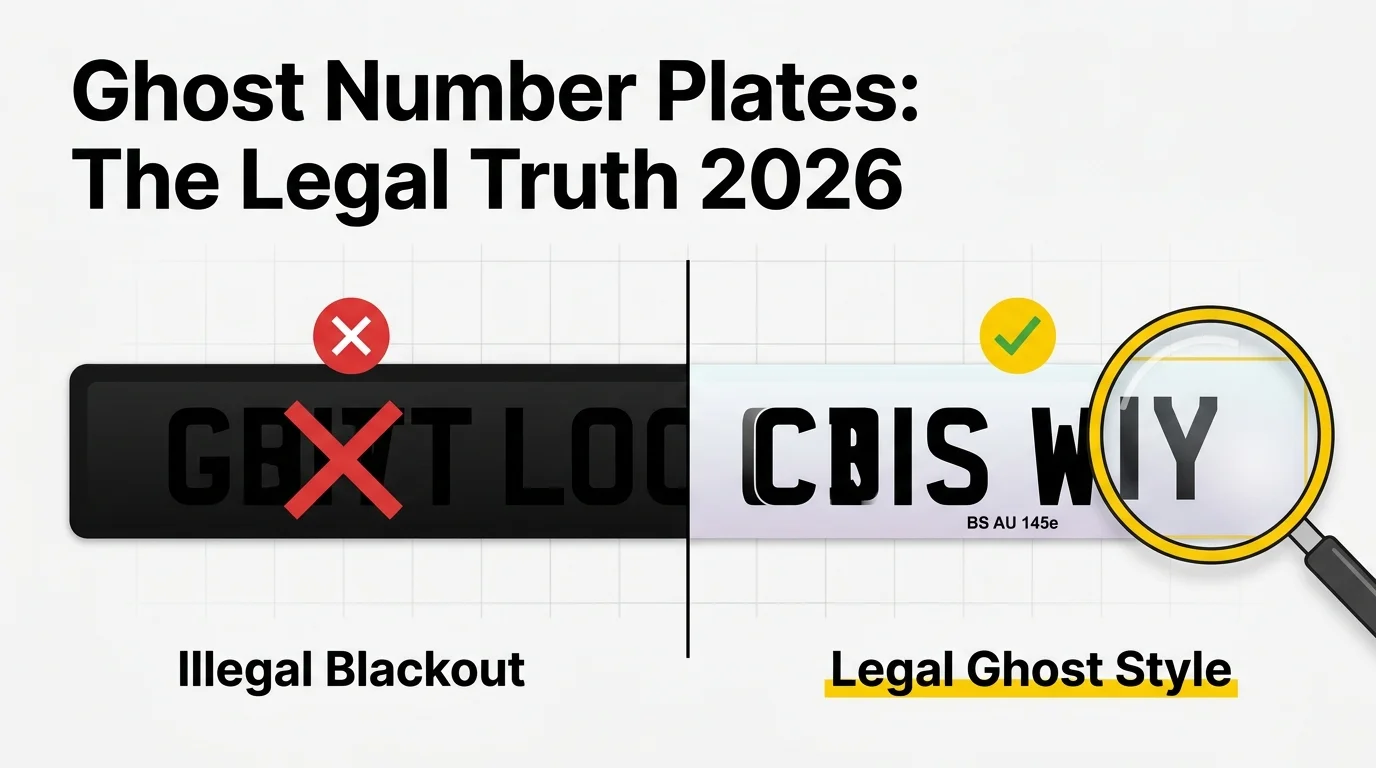
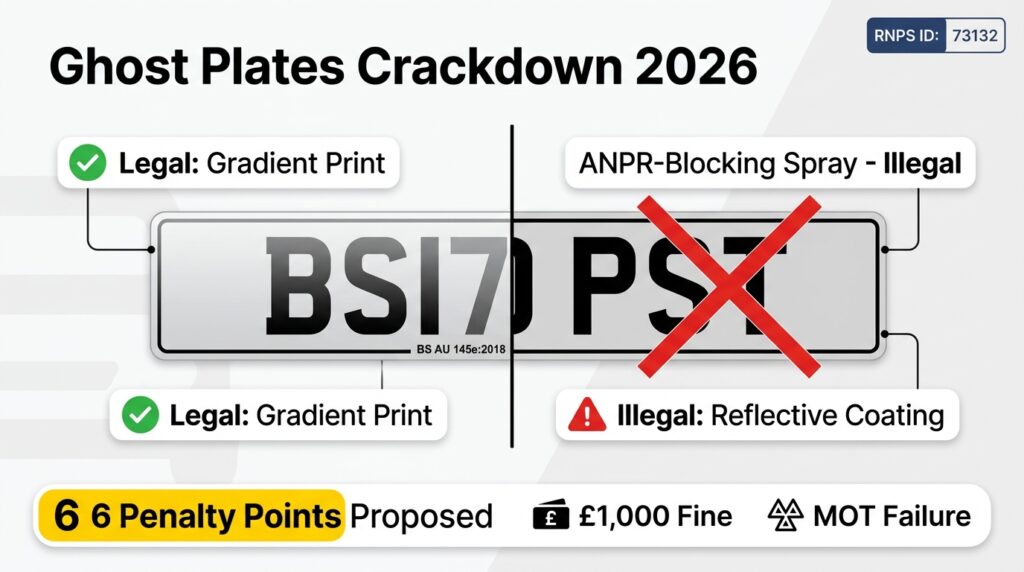
    Legal ghost plates achieve their distinctive appearance through subtle gradient effects printed directly onto the reflective substrate. These plates maintain full compliance with BS AU 145e:2018, the British Standard that governs number plate reflectivity, impact resistance, and ANPR camera readability. (Read our Ghost Plates Guide here)

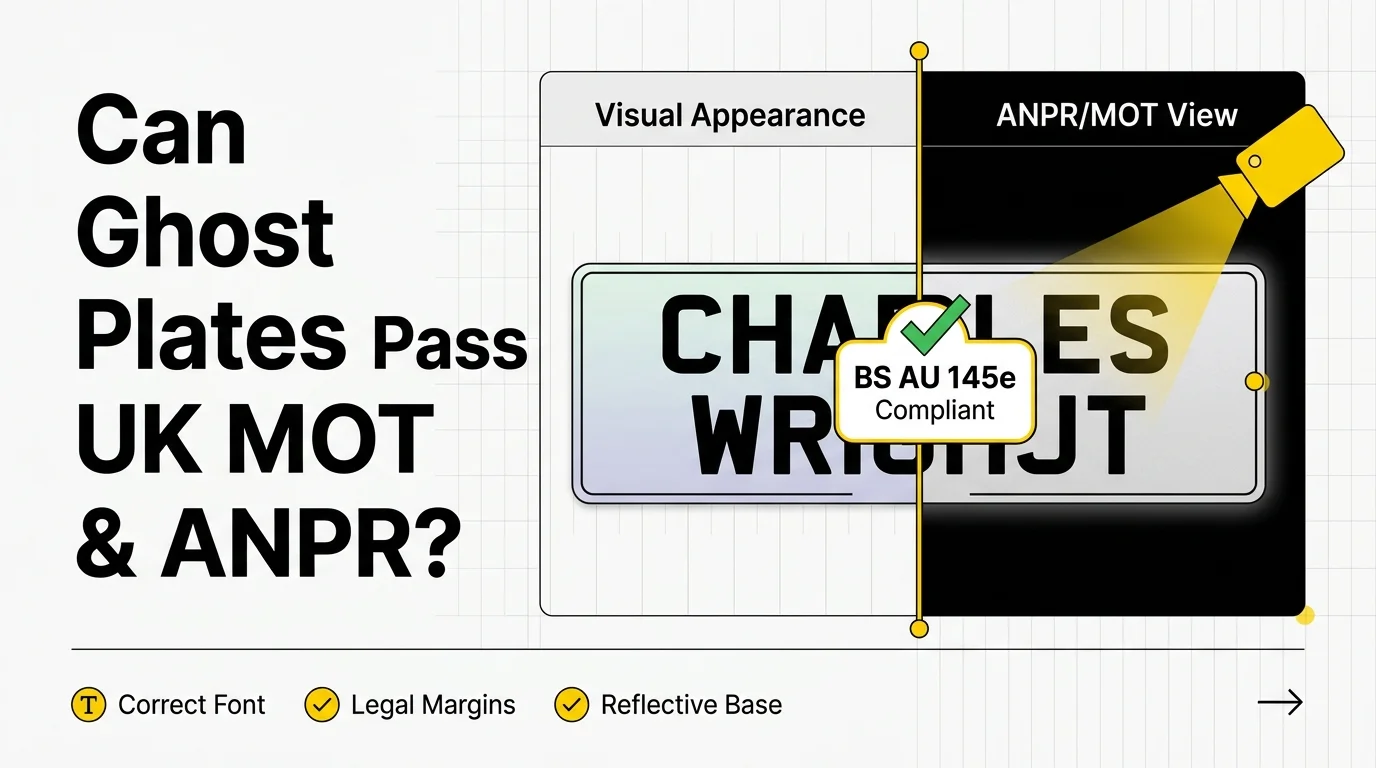
    The key requirement is that the plate must remain fully readable by both human observers and automatic number plate recognition systems in all lighting and weather conditions. The gradient effect is purely aesthetic and does not compromise the plate’s reflective properties or NIR (near-infrared) compatibility.

    (Are Ghost Plates Legal? Read our Guide)

    Illegal Ghost Plates: ANPR Evasion Technologies

    Illegal ghost plates use reflective sprays, films, or coatings specifically designed to interfere with ANPR camera functionality. These products claim to make plates “ANPR-proof” or “camera-proof” by either:

    • Blocking infrared wavelengths used by traffic cameras
    • Creating excessive glare that obscures characters
    • Reducing reflectivity below legal minimums

    (Learn more about ANPR Evasion Rules)

    Under Regulation 16 of the Road Vehicles (Display of Registration Marks) Regulations 2001, number plates must be made from reflective material and display characters in the prescribed manner. Any modification that affects reflectivity or readability constitutes an offence.
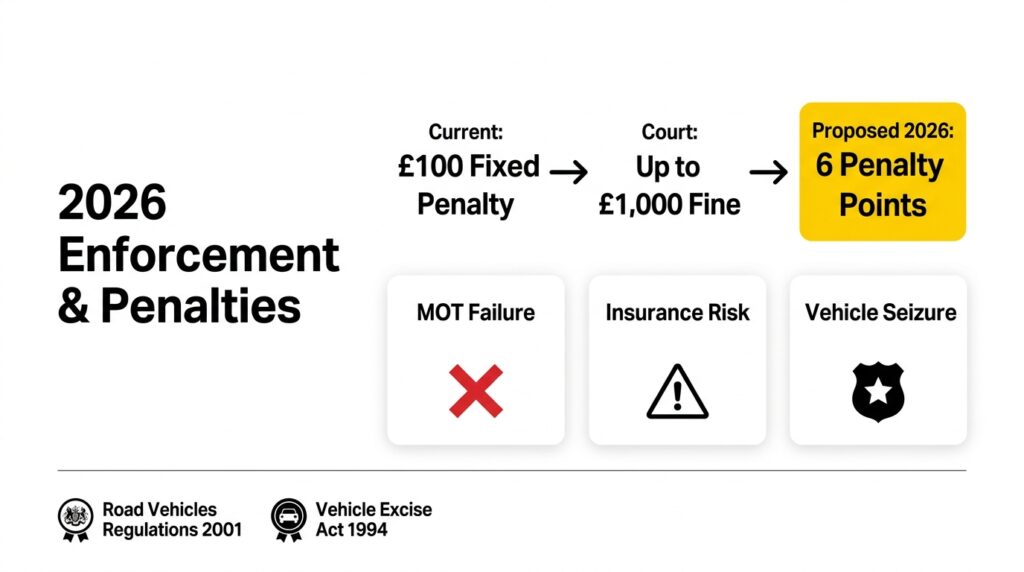
    The 2026 Enforcement Landscape: Proposed Penalty Points

    January 2026 Road Safety Strategy Announcement

    In January 2026, the UK government published its Road Safety Strategy, which included proposals to strengthen enforcement against illegal number plate modifications. The strategy specifically addresses the growing use of ANPR evasion technologies and proposes introducing 6 penalty points for drivers caught with non-compliant plates. (Check the DVLA Ghost Plates Crackdown details)

    (View Illegal Number Plate Fines 2026)

    Important Note: This proposal represents a significant increase from current enforcement practices. While we reference this announcement, readers should verify the current status of this legislation through official government sources at gov.uk, as parliamentary approval and implementation timelines may vary.

    Current Penalties Under Existing Legislation

    Even without the proposed penalty points, drivers with illegal ghost plates face substantial consequences under current law:

    MOT Failure: Vehicles presenting with non-compliant number plates will fail their MOT test under the Road Vehicles Regulations. This means you cannot legally drive the vehicle away until compliant plates are fitted.

    Fixed Penalty Notices: Police officers and Traffic Officers can issue fixed penalty notices for number plate offences. While the standard fixed penalty is £100, this can escalate if the case proceeds to court.

    Court Prosecution: Under Section 42 of the Vehicle Excise and Registration Act 1994, offences related to registration marks can result in fines up to level 3 on the standard scale, currently £1,000.

    (View more on Number Plate Fines UK)

    Why ANPR Evasion Is Taken Seriously

    The government’s focus on ANPR-blocking plates stems from the critical role these systems play in:

    • Road Safety: Identifying uninsured, untaxed, or stolen vehicles
    • Traffic Management: Enforcing congestion charges, ULEZ, and low emission zones
    • Criminal Investigation: Tracking vehicles involved in serious offences
    • Parking Enforcement: Managing parking violations and trespass

    Any technology designed to circumvent these systems undermines public safety infrastructure and is treated accordingly by enforcement agencies.

    How to Identify Legal vs Illegal Ghost Plates

    The Reflectivity Test

    The fundamental difference between legal and illegal ghost plates lies in their reflective properties. BS AU 145e:2018 mandates specific reflectivity standards to ensure plates remain readable by ANPR cameras in all conditions.

    Legal ghost plates:

    • Use gradient printing on certified reflective substrate
    • Maintain NIR compatibility for camera readability
    • Display the BS AU 145e:2018 marking on the plate
    • Show the manufacturer’s name, trademark, or RNPS ID number

    (BS AU 145e Standards Explained)

    Illegal ghost plates:

    • Feature reflective sprays or films applied after manufacture
    • Claim to be “ANPR-proof” or “camera-blocking”
    • Lack proper BS AU 145e certification marking
    • Often sold by non-RNPS registered suppliers

    Visual Indicators of Compliance

    When examining ghost plates, look for these compliance markers:

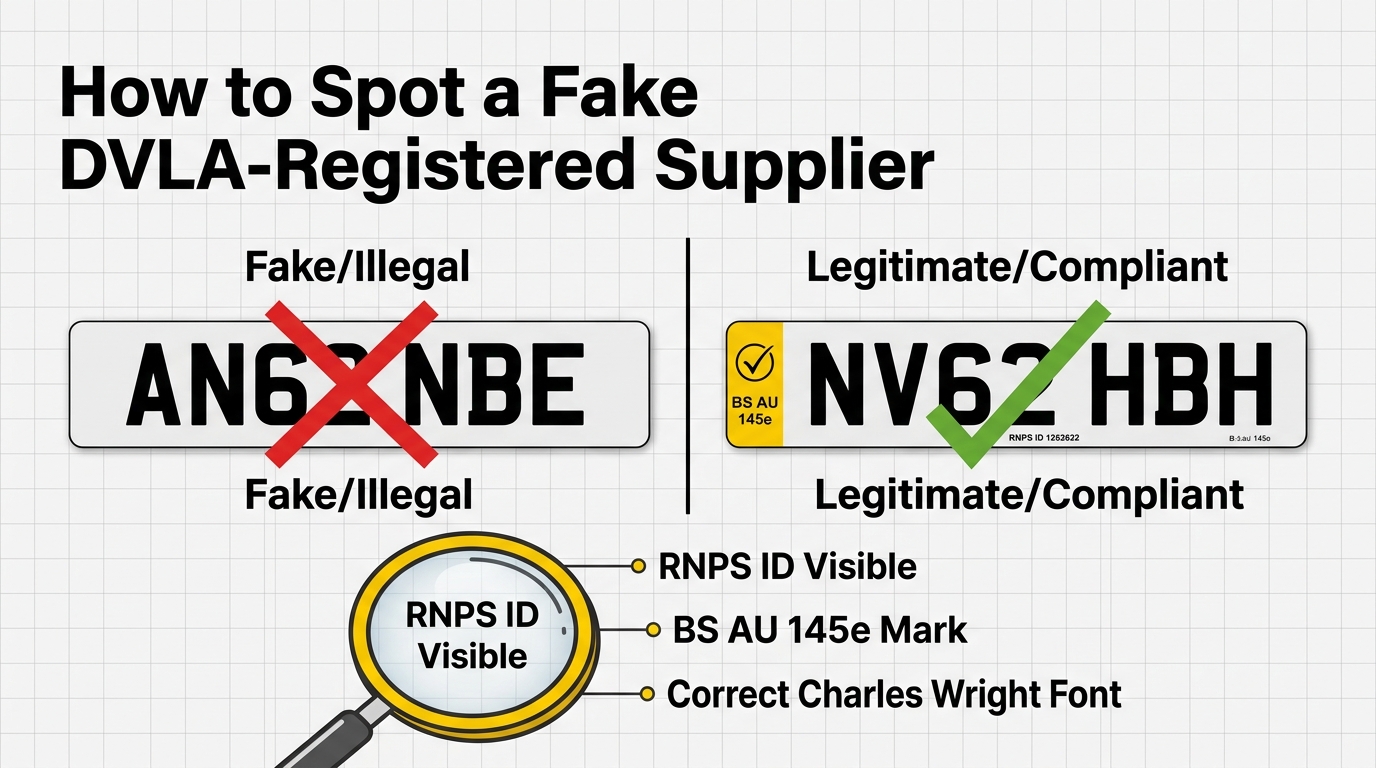
    1. BS AU 145e:2018 Marking: This should be clearly visible on the bottom left or right of the plate. Plates marked only “BS AU 145e” without the 2018 date may not meet current standards.
    2. RNPS ID Number: DVLA-registered suppliers must display their RNPS identification number. Our plates show RNPS ID: 73132.
    3. Supplier Details: The manufacturer’s name or trademark should be present on the plate.
    4. Character Specifications: Even with gradient effects, characters must use the mandatory Charles Wright font with correct spacing (79mm height, 50mm width, 14mm stroke thickness for cars). (Charles Wright Font Guide)
    Practical Implications for UK Drivers

    What This Means for Existing Ghost Plates

    If you currently have ghost plates fitted to your vehicle, you should verify their compliance status immediately:

    Check for BS AU 145e:2018 marking – If your plates lack this marking or show an older standard, they may not be compliant.

    Verify the supplier – Plates purchased from non-RNPS registered suppliers, online marketplaces without verification, or social media sellers carry higher risk of non-compliance.

    Assess the finish – If your plates have been treated with aftermarket sprays, films, or coatings, they are almost certainly illegal regardless of the base plate’s original compliance.

    Enforcement in Practice

    Police officers and DVSA enforcement officers use several methods to identify illegal plates:

    • Visual inspection during routine stops or traffic checks
    • ANPR system alerts when plates fail to read properly
    • MOT testing where plates are checked for compliance
    • Targeted operations focusing on car meets and enthusiast gatherings

    In East London and across the UK, enforcement has intensified as ANPR evasion technologies have become more widespread. The proposed 6 penalty points would make this offence endorsable on your driving licence, potentially affecting insurance premiums and, for new drivers, risking licence revocation under the new driver rules.

    Impact on Insurance and Vehicle Legality

    Driving with illegal number plates can have consequences beyond fines and penalty points:

    Insurance Validity: Some insurance policies may be invalidated if you’re driving with illegal modifications, including non-compliant number plates. This could leave you personally liable for all damages in an accident.

    Vehicle Seizure: In serious cases, particularly where ANPR evasion is deliberate and systematic, police have powers to seize vehicles.

    Criminal Record: Court prosecution for number plate offences can result in a criminal conviction.

    How Plate-Maker Ensures Full Compliance

    Our Manufacturing Process

    At Private Number Plate Maker Ltd, we manufacture every plate on-site at our Eastern Avenue workshop in Ilford. Unlike resellers or drop-shippers, we control every aspect of production to ensure full compliance with UK regulations.

    Document Verification: Under Schedule 2 of the Road Vehicles Regulations 2001, we verify your identity and entitlement to the registration number before manufacturing any plate. We accept driving licences, passports, utility bills, council tax bills, V5C registration certificates, V750 certificates of entitlement, V778 retention documents, and V948 authorisation letters. (DVLA Document Requirements)

    BS AU 145e:2018 Materials: We use only certified reflective substrates that meet the 2018 British Standard requirements for reflectivity, impact resistance, weathering, and NIR compatibility.

    Quality Control: Every plate undergoes inspection to ensure correct character spacing, font compliance, and proper marking before leaving our workshop.

    Our Ghost Plate Range

    Our ghost plates use legal gradient printing techniques that create the desired aesthetic while maintaining full BS AU 145e:2018 compliance. The gradient effect is printed directly onto the reflective substrate during manufacture – no sprays, films, or coatings are applied.

    (Shop our Ghost Number Plates here)

    Each plate displays:

    • BS AU 145e:2018 marking
    • RNPS ID: 73132
    • Our company details
    • Correct Charles Wright font characters
    • Proper spacing and dimensions

    Same-Day Collection in Ilford

    For customers in East London and surrounding areas, we offer same-day collection from our Ilford workshop at 242 Eastern Ave, IG4 5AB. This allows you to verify your plates in person and ensure complete satisfaction before fitting. (Learn about Same Day Collection)

    We also provide next-day UK delivery for customers who cannot visit our workshop. (View Delivery Times)

    Practical Takeaways

    What You Should Do Now

    If you’re considering ghost plates:

    • Choose only DVLA-registered suppliers with verifiable RNPS IDs
    • Ensure plates are marked BS AU 145e:2018 (not just BS AU 145e)
    • Avoid any supplier offering “ANPR-proof” or “camera-blocking” features
    • Request proof of compliance before purchasing

    If you have existing ghost plates:

    • Verify they carry BS AU 145e:2018 marking
    • Check they were supplied by an RNPS-registered manufacturer
    • Ensure no aftermarket sprays or films have been applied
    • If in doubt, replace them with certified compliant plates

    If you’re buying used plates:

    • Exercise extreme caution – used plates may not be compliant
    • Verify the RNPS ID and BS AU 145e:2018 marking
    • When uncertain, order new plates from a registered supplier

    What to Avoid

    • Aftermarket reflective sprays: Any product claiming to modify plate reflectivity is illegal
    • Social media sellers: Unverified sellers on Facebook, Instagram, or WhatsApp often supply non-compliant plates
    • “Too good to be true” pricing: Legitimate BS AU 145e:2018 plates have material and manufacturing costs – extremely cheap plates often cut corners
    • International suppliers: Plates manufactured outside the UK may not meet British Standards

    How Plate-Maker Ensures Compliance

    Every plate we manufacture includes:

    • BS AU 145e:2018 certified materials
    • Proper document verification per Schedule 2 requirements
    • RNPS ID: 73132 clearly displayed
    • On-site manufacturing at our Ilford workshop
    • Quality inspection before dispatch

    Ready to order compliant ghost plates? Start designing your plates using our online builder, or visit our Ilford workshop for same-day collection (Learn about Same Day Collection).

    Frequently Asked Questions

    Are ghost plates legal in the UK in 2026?

    Yes, ghost plates are legal when manufactured correctly with BS AU 145e:2018 certified materials and proper gradient printing that maintains reflectivity. However, plates with reflective sprays, films, or ANPR-blocking coatings are illegal under the Road Vehicles Regulations 2001 and can result in fines up to £1,000. Always verify your supplier is DVLA-registered with a valid RNPS ID.

    What are the proposed penalty points for illegal number plates in 2026?

    The January 2026 Road Safety Strategy proposed introducing 6 penalty points for drivers caught with illegal number plates, representing a significant increase from current enforcement. However, this proposal requires parliamentary approval before implementation. Current penalties include fines up to £1,000 and MOT failure. Verify the current status at gov.uk before relying on this information.

    How can I tell if my ghost plates are legal?

    Legal ghost plates must display the BS AU 145e:2018 marking, show the manufacturer’s RNPS ID number, use Charles Wright font with correct spacing, and maintain full reflectivity for ANPR cameras. Plates lacking these markings, treated with aftermarket sprays, or purchased from non-registered suppliers are likely illegal. Our compliant ghost plates (Learn how to identify legal ghost plates) include all required certifications.

    What happens if I’m caught with illegal ghost plates?

    Drivers with illegal plates face MOT failure, fixed penalty notices of £100, potential court prosecution with fines up to £1,000 under the Vehicle Excise and Registration Act 1994, and possible penalty points if proposed legislation passes. Insurance validity may also be affected. Police can seize vehicles in serious cases of deliberate ANPR evasion.

    Can I use grey or silver characters on my number plate?

    Yes, grey or silver gradient characters are legal when printed onto BS AU 145e:2018 certified reflective substrate without affecting readability. The characters must still use the mandatory Charles Wright font with correct dimensions (79mm height for cars) and spacing. The gradient effect must not compromise the plate’s reflectivity or NIR compatibility for ANPR cameras.

    Where can I buy legal ghost plates in East London?

    Private Number Plate Maker Ltd (RNPS ID: 73132) manufactures compliant ghost plates at our Ilford workshop on Eastern Avenue. We offer same-day collection from IG4 5AB and next-day UK delivery. All our plates use BS AU 145e:2018 materials, undergo document verification, and include proper certification markings. Visit our Ilford workshop for same-day collection or start designing your plates using our online builder.
  • Why Your Private Reg Needs a Legal Plate-And Not Just a Show Plate

    Why Your Private Reg Needs a Legal Plate-And Not Just a Show Plate

    You’ve just bought a cherished number – maybe it’s your initials, a meaningful year, or something that simply fits your car’s character. The next step feels obvious: get it made into a pair of plates. But here’s where many UK drivers pause – and rightly so.

    Because not all number plates are created equal. A “show plate” might look striking in your garage or on a social post, but take it onto the road unverified, and you’re risking more than a fine. You’re risking your MOT, your insurance, and – in the worst case – your ability to drive that vehicle at all.

    This isn’t about bureaucracy. It’s about design that serves both pride and responsibility. Let’s break down why a DVLA-compliant legal plate is the only sensible choice for your private registration – and how to get it right, without compromising on style.

    The Real Difference: Legal Plates vs. Show Plates

    First, definitions matter.

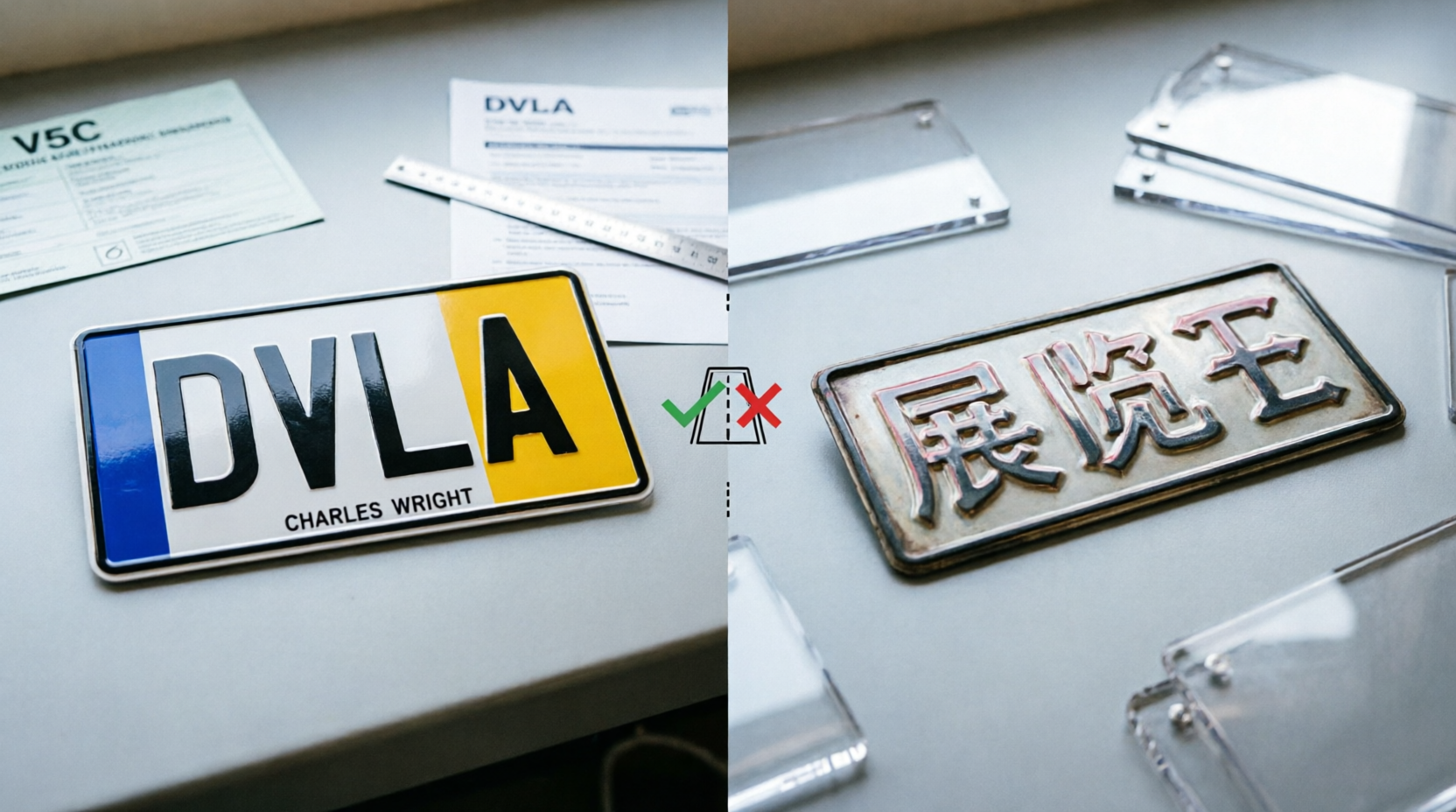
    A show plate is typically made for display only – often seen at car shows, in photoshoots, or mounted in a home office. These may use non-standard fonts, colours, spacing, or materials. Some skip reflectivity entirely. They’re not intended for road use – and if used on the road, they’re illegal.

    A legal number plate, by contrast, meets every requirement set out in the UK’s Road Vehicles (Display of Registration Marks) Regulations 2001 – and, in practice, the updated BS AU 145e standard. That means:

    • Mandatory use of the Charles Wright font (not ‘3D-style’ approximations)
    • Precise character height (79mm), width (50mm), and spacing
    • Reflective backing material with minimum retro-reflectivity values
    • Correct colour scheme: black characters on white (front) and black on yellow (rear)
    • Manufacturer ID and postcode permanently marked on the plate

    As outlined in the official GOV.UK guidance on number plate standards, non-compliance can lead to an MOT failure, a fixed penalty notice, or – if an insurer deems your vehicle illegally modified – a voided claim.

    In short: if it’s not road-legal, it’s not fit for daily driving. Full stop.

    Why So Many Get This Wrong (And Pay the Price)

    Every year, thousands of UK drivers learn this the hard way – often during an MOT or a routine traffic stop.

    Common pitfalls include:

    • Assuming ‘3D’ or ‘4D’ means illegal – it doesn’t, if the construction adheres to BS AU 145e. Raised characters are permitted, provided they’re solid, securely bonded, and don’t distort the font.
    • Using unregistered suppliers – anyone can print a plate. But only DVLA-registered number plate suppliers can legally issue plates tied to your V5C or V750 documentation.
    • Skipping documentation checks – your plate maker must verify your entitlement to the registration (via V5C, V750, or V778). No exceptions.

    The MOT inspection manual is explicit: any plate with “incorrect lettering, spacing, or non-reflective surface” fails automatically – no discretion, no warnings. That £80 test? Wasted. That road trip? Postponed.

    3D, 4D, 5D – Are They Legal? Yes, When Done Right

    Let’s settle the biggest misconception head-on: 3D, 4D, and 5D number plates can be 100% road-legal – and many UK drivers are already using them.

    Here’s how each works within the rules:

    3D Gel Plates

    These use a UV-cured polyurethane gel to create a smooth, raised character – typically around 2mm high. When applied over a BS AU 145e–compliant reflective base and formed in the correct font, they pass both visual and ANPR (Automatic Number Plate Recognition) checks with ease.
    They’re especially popular among EV and performance car owners who want subtlety with depth – no harsh edges, just a refined gloss lift. Learn more about how they’re engineered for compliance and durability in our guide to premium 3D gel number plates.

    4D Laser-Cut Acrylic

    These feature precision-cut 3mm black acrylic characters, bonded with industrial adhesive to a reflective substrate. The result? Strong definition, crisp edges, and excellent longevity – even under high-pressure car washes or coastal salt spray.
    Because the characters are solid (not hollow or mesh), spaced correctly, and fixed flush to the base, they satisfy the ‘no shadowing or distortion’ rule. Over 15,000 UK customers have chosen this style – many on daily-driven SUVs and fleet vehicles. See how they’re made to meet DVLA standards in our 4D laser-cut plates overview.

    5D Dual-Layer Acrylic + Gel

    The newest evolution: a layered approach combining 3mm acrylic backing with a 2mm high-gloss gel overlay on top of the characters. This creates dramatic depth and light refraction – almost jewel-like – without altering dimensions.
    Crucially, the underlying structure remains fully compliant: correct font, spacing, and reflectivity. It’s a show-stopper that still clears ANPR at 60mph. For those seeking maximum visual impact without compromise, our 5D acrylic plates are engineered to lead, not follow.

    Note: “Ghost plates” (tinted or lightly shaded backgrounds) require extra caution. While some subtle tints exist in legal form, most grey or smoked variants fail retro-reflectivity tests. Always verify compliance – we detail the limits in our ghost number plates guide.

    The Hidden Costs of Cutting Corners

    Going for the cheapest, fastest plate option might save £10 today – but consider the ripple effects:

    • MOT failure → Re-test fees, lost time, potential roadside prohibition
    • Insurance invalidation → A claim denied after an incident, even if unrelated to the plates
    • ANPR misreads → False parking fines, congestion charge errors, or police stops
    • Resale impact → Buyers (and dealers) check compliance. A non-standard plate can delay or devalue a sale

    Conversely, a legal plate from a DVLA-registered supplier like ours includes:

    • Built-in verification of your entitlement
    • BS AU 145e–certified materials (tested for UV resistance, impact, and reflectivity)
    • Manufacturer ID and postcode etched discreetly – as required by law
    • Same-day dispatch when ordered by 2pm, so you’re back on the road fast

    And yes – starting from just £12.49 for standard plates, and £19.95 for 3D or 4D, premium compliance doesn’t mean premium pricing.

    How to Spot a Legal Plate (Before You Buy)

    You don’t need a ruler or spectrometer – just a few quick checks:

    1. Look for the supplier ID
      Every legal plate must display the name or postcode of the registered supplier – usually near the bottom edge. No ID? Red flag.
    2. Check the font
      Charles Wright has distinct features: the ‘7’ has a serif, the ‘0’ is subtly oval, and spacing between characters is uniform. Avoid anything that looks ‘bolded’, stretched, or italicised.
    3. Test reflectivity
      Shine a torch at the plate in low light. A legal plate should bounce light directly back to the source – not scatter it. Non-reflective or matte finishes fail here.
    4. Verify documentation process
      A legitimate supplier will always ask for proof of entitlement – either photo ID + V5C logbook, or your V750/V778 certificate. If they don’t? Walk away.

    For peace of mind, use a tool that previews your plate in real-time – with spacing, font, and layout pre-validated. Our online plate maker does exactly that, flagging issues before you even check out.

    Real-World Scenarios: Getting It Right

    Let’s ground this in practice.

    • The Tesla Owner wants a clean, modern look – but knows his Model 3’s sleek rear could highlight poor plate fit. He opts for 4D plates with precise acrylic cuts and a flush mount. Legal, bold, and complementary.
    • The Classic Mini Restorer needs period-correct appearance – but his car isn’t ‘historic’ exempt (pre-1980). So he chooses standard printed plates with correct retro-reflective backing – MOT-safe, but timeless in style.
    • The Gift Buyer surprises a friend with their initials as a private reg – and pairs it with a set of 3D gel plates. Because the supplier handled all DVLA checks, the recipient just fits them – no paperwork stress.

    These aren’t hypotheticals. They’re daily realities for thousands of UK drivers who personalise responsibly.

    Final Thought: Personalisation That Lasts – On and Off the Road

    A private registration is more than a string of letters and numbers. It’s identity. Legacy. Sometimes, a little bit of wit.

    But none of that matters if your plates can’t withstand an MOT bay – or a rainy M6 service station at dusk.

    The good news? You don’t have to choose between expression and compliance. With the right materials, the right supplier, and the right standards, your private reg can look exactly how you want – and still pass every legal checkpoint.

    When you design with a DVLA-registered supplier, you’re not just buying acrylic and adhesive. You’re investing in confidence: that your car looks its best, drives legally, and stands up to whatever the UK weather – or the DVSA inspector – throws at it.Ready to create a plate that’s unmistakably yours, and unmistakably legal?
    Start with our custom plate builder – where every design is previewed, validated, and built to last.

  • Beyond the Font: 3 Overlooked BS AU 145e Rules That Make or Break Plate Legality

    Beyond the Font: 3 Overlooked BS AU 145e Rules That Make or Break Plate Legality

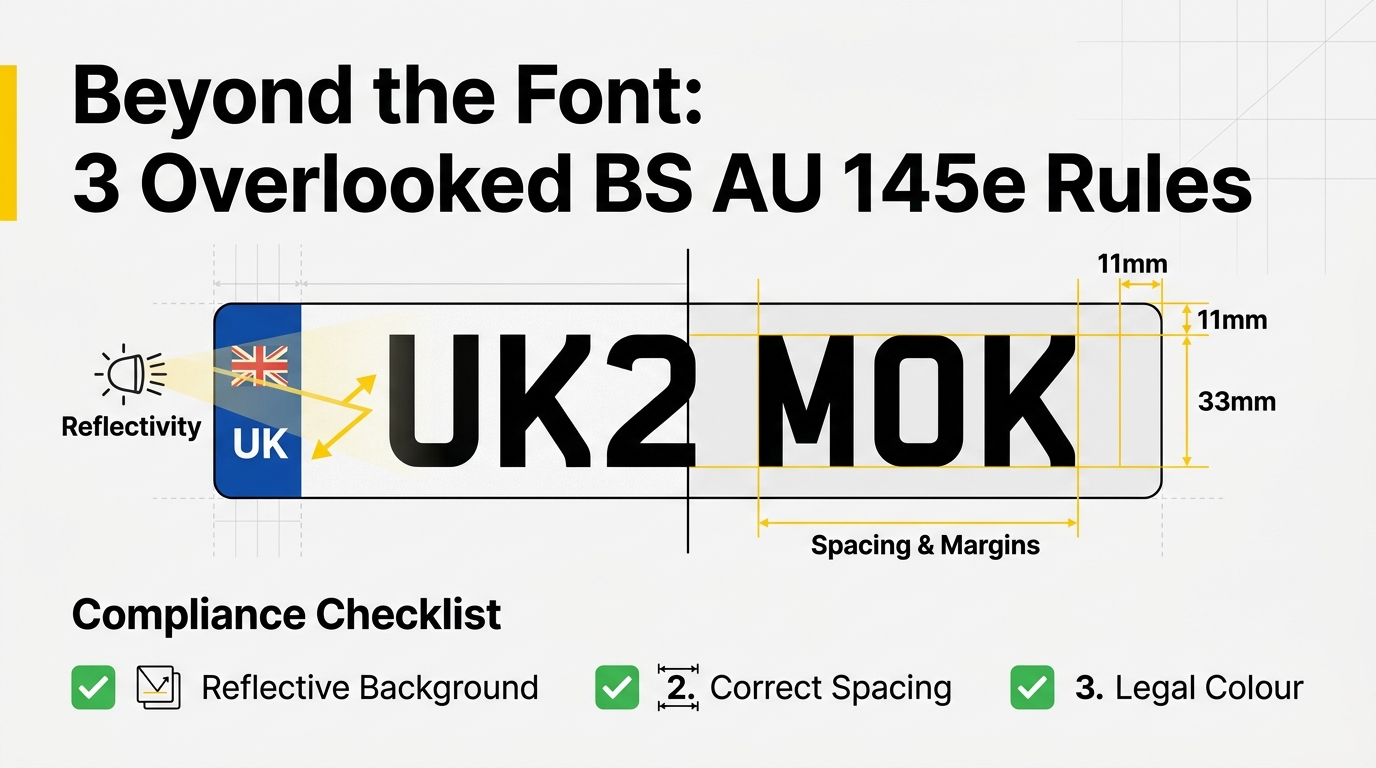
    If you’ve ever admired a sleek set of raised-letter plates on a Range Rover or a glossy finish on a classic Mini, you’ll know UK drivers take pride in how their registration looks. But personalisation comes with responsibility. While most buyers know about the Charles Wright font requirement, three lesser-known BS AU 145e rules quietly determine whether your number plate passes an MOT – or earns a refusal notice.

    These aren’t bureaucratic footnotes. They directly impact reflectivity, character spacing, and background colour adherence – factors that affect everything from ANPR readability to insurance validity. Get them wrong, and even the most stylish plate becomes a liability. Get them right, and you combine confidence with compliance.

    Here’s what every UK driver should understand before ordering 3D, 4D, or any custom plate – especially in 2025, when MOT testers are increasingly trained to spot subtle non-compliances.

    The Reflectivity Rule: It’s Not Just About “Shiny”

    Many assume a reflective number plate simply means it glows under headlights. In reality, BS AU 145e specifies precise photometric performance standards for the retroreflective background – a requirement designed to ensure legibility at night, in rain, or under motorway gantries.

    Non-compliant plates often use cheap reflective sheeting that fades within months, especially on south-facing driveways where UV exposure is intense. Worse, some aftermarket plates apply gloss coatings or overlays that reduce reflectivity rather than enhance it. According to the official MOT inspection manual, any plate that “does not reflect light sufficiently” will fail inspection.

    Premium suppliers use optical-grade reflective acrylic engineered to maintain performance across temperature extremes and prolonged exposure. Acrylic characters – such as those used in 4D laser-cut plates – are bonded without obstructing the reflective layer underneath. This ensures consistent compliance year-round, not just on day one.

    Crucially, reflectivity isn’t optional for front plates alone. Both front (white background) and rear (yellow background) must meet the same standard. A common oversight? Using a non-reflective matte finish on rear plates for a “stealth” look – illegal under current rules.

    Character Spacing and Margins: The Invisible Grid

    Drivers often focus on font shape, but BS AU 145e includes strict dimensional rules for spacing between characters, as well as margins around the plate edge. These aren’t arbitrary – they ensure automated systems like ANPR cameras can parse registrations accurately, even at speed.

    The standard defines:

    • Minimum 11mm space between each character
    • 33mm side margin on standard plates
    • 13mm top and bottom margins
    • Fixed character width and height (50mm high for standard vehicles)

    Deviations can be subtle. A plate with oversized characters might crowd the margins. A custom layout for a short plate – popular on performance cars – could compress spacing if not designed to regulation. Even mounting a plate with excessive overlap from a bracket can obscure required margins, risking an MOT advisory or fail.

    This is where a DVLA-registered supplier’s design tool proves invaluable. Platforms like the private number plate maker preview registrations within legal dimensions, automatically adjusting for plate size (standard, short-run, or motorcycle). You see compliance in real time – not after delivery.

    Many EV owners, for instance, opt for short 4D plates to complement minimalist front fascias. But without precise spacing validation, that sleek look could invalidate insurance if an accident occurs and plates are deemed non-compliant.

    Background Colour and the “Ghost Plate” Trap

    One of the fastest-growing trends – especially among urban drivers – is the “ghost” or “smoked” plate effect. Done legally, it uses gradient printing within BS AU 145e’s reflectivity and contrast thresholds. Done illegally, it employs translucent overlays or darkened backgrounds that reduce legibility below legal minimums.

    The rule is clear: front plates must have a white retroreflective background; rear plates must be yellow. Any tint, fade, or pattern that alters this base colour violates regulation – even if characters remain visible to the human eye.

    Legal ghost-style plates, like the compliant ghost number plates offered by certified suppliers, use precision-gradient printing on certified reflective substrates. They maintain full contrast between black characters and background, passing both visual checks and machine readability tests.

    By contrast, non-certified “stealth” plates often use non-reflective vinyl or dark acrylic bases. These may look dramatic in showroom lighting but fail under real-world conditions – and under MOT scrutiny. The consequence? More than just a replacement cost: if involved in an incident, your insurer could argue negligence due to non-standard plates.

    3D, 4D, or 5D? Style Within the Lines

    Raised-character plates remain hugely popular, but style doesn’t override compliance. The good news? 3D gel, 4D acrylic, and even 5D dual-layer plates can all be fully BS AU 145e compliant – provided they meet the three overlooked rules above.

    • 3D gel plates use a 2mm raised resin that’s UV-stable and non-obstructive to reflectivity when applied correctly. They’re a durable, cost-effective choice for daily drivers, starting from £19.95.
    • 4D plates feature 3mm laser-cut acrylic characters, offering sharper definition and better resistance to yellowing – ideal for owners who keep cars long-term or in high-sun areas.
    • 5D plates layer gel over acrylic for extra depth but require careful manufacturing to avoid reducing background reflectivity. Only certified processes guarantee legality.

    The key differentiator isn’t the “D” count – it’s the supplier’s registration with the DVLA and adherence to material standards. As outlined in GOV.UK guidance, only approved suppliers may produce number plates, and they must verify your identity and vehicle entitlement (via V5C or retention document) before production.

    Real-World Scenarios: Where Compliance Saves You

    Consider these common situations:

    • MOT Day: Your cherished plate looks flawless, but the tester notes insufficient side margins due to a custom bracket. Result: fail, and a return visit.
    • Traffic Stop: ANPR fails to read your plate due to low reflectivity from aged materials. You’re not fined on the spot – but if linked to an unresolved penalty, it complicates resolution.
    • Insurance Claim: After a minor collision, the insurer reviews dashcam footage and notes your rear plate’s darkened background. They classify it as a modification not disclosed – and reduce your payout.

    None of these involve “obvious” offences like fake registrations. They stem from subtle, overlooked deviations that a compliant plate avoids by design.

    Design Confidently, Drive Legally

    Personalising your vehicle shouldn’t mean navigating legal grey zones. The best number plates do two things well: express your style and meet every DVLA standard without compromise.

    Whether you’re fitting a classic Mini with standard plates or upgrading your Range Rover to bold 4D acrylic, compliance starts with the supplier’s process – not just the product. Same-day dispatch (on orders before 2pm), UK-weather-resistant materials, and built-in design validation all contribute to a plate that looks great today and passes inspection years from now.

    You don’t need to memorise BS AU 145e. But you do need a supplier who does.

    At a time when personalisation is more accessible than ever – thanks to online plate builders and fast production – it’s reassuring to know that style and legality aren’t mutually exclusive. In fact, the most admired plates on UK roads are the ones that get both right.

    When you design with a DVLA-registered supplier, you get more than aesthetics. You get peace of mind that your registration mark meets the same standards as your vehicle’s safety systems: tested, verified, and built to last.

    Ready to create a plate that’s as compliant as it is captivating? Start your design with confidence – knowing every character, margin, and millimetre reflects UK road law.

  • How to Spot a Fake DVLA-Approved Number Plate Supplier in 2026

    How to Spot a Fake DVLA-Approved Number Plate Supplier in 2026

    A number plate does more than display your registration – it’s a legal requirement, a safety feature, and often, the first visual statement your vehicle makes. Yet in 2026, as custom plates grow in popularity, an increasing number of online suppliers are blurring the line between style and compliance. Some plates look impressive but fail under scrutiny – at MOT, by ANPR cameras, or worse, during a traffic stop.

    The truth is, not every glossy 3D or 4D plate you see online is road legal. And not every site claiming “DVLA-approved” status actually holds the necessary accreditation. Spotting the difference isn’t about technical jargon – it’s about knowing what to look for, where to check, and which red flags should instantly raise concern.

    This guide is written for UK drivers who care about personalisation and responsibility: those who want their car to stand out, without risking fines, invalid insurance, or an MOT failure.

    Why Legitimacy Matters More Than Ever in 2026

    Recent updates to the MOT inspection manual reinforce how strictly number plates are assessed. As outlined in the official MOT guidance for private passenger vehicles, even subtle deviations – from incorrect character spacing to low reflectivity – can result in an automatic failure.

    More critically, using non-compliant plates may invalidate your insurance if involved in a claim. Insurers routinely check vehicle documentation, and a mismatched or illegal plate can be interpreted as misrepresentation.

    That’s why choosing a genuinely DVLA-registered supplier isn’t optional – it’s essential. But how do you verify one?

    Red Flag #1: Vague or Missing Compliance Claims

    Legitimate UK number plate suppliers don’t hide their credentials – they highlight them.

    If a website states their plates are “DVLA-style,” “DVLA-inspired,” or simply “legal,” that’s a warning sign. The correct phrasing is “DVLA-registered supplier” and “BS AU 145e compliant.” These aren’t marketing buzzwords – they’re legal benchmarks.

    BS AU 145e is the British Standard that governs everything from font height (79mm for standard plates) to material reflectivity and durability. It mandates the use of the Charles Wright font, proper spacing between characters (11mm), and minimum margins around the plate edge (11mm top and bottom, 33mm left and right for rear plates).

    A trustworthy supplier will explicitly confirm compliance – not assume you’ll take their word for it.

    Look for: Clear statements like “Manufactured to BS AU 145e:2021” or “Produced by a DVLA-registered number plate supplier.”
    Avoid: Phrases like “Meets all UK standards” with no supporting detail.

    Red Flag #2: Prices That Seem Too Good to Be True

    Premium materials cost money. High-grade reflective acrylic, UV-stable resins, and precision laser-cut characters aren’t cheap – especially when built to withstand UK winters and intense summer sun.

    While standard printed plates start from under £25 for a front-and-rear set, deeply discounted “4D” or “5D” plates priced under £20 for a pair should raise eyebrows. At that price, corners are being cut: thinner substrates, non-reflective backing, or non-standard fonts.

    For context, genuine 3D gel plates – with 2mm raised characters on certified reflective bases – typically start from £19.95, as offered by accredited suppliers who batch-manufacture without sacrificing compliance.

    Remember: you’re not just paying for aesthetics. You’re paying for materials that retain reflectivity over time – a critical safety factor for night visibility and ANPR recognition.

    Red Flag #3: No Proof of DVLA Registration

    Every legitimate number plate supplier in the UK must be registered with the DVLA. This isn’t optional – it’s a legal requirement under the Road Vehicles (Display of Registration Marks) Regulations 2001. Registered suppliers are issued a unique supplier code, which must appear on invoices and documentation.

    So how do you check? Reputable sites will:

    • Display their DVLA supplier number openly (often in the footer or FAQ)
    • Require proof of identity and vehicle entitlement (e.g., V5C logbook or retention certificate) before manufacturing
    • Issue itemised invoices showing the supplier code, plate details, and certification

    A site that doesn’t ask for documentation, skips verification, or hides its registration status is operating outside the law – and passing that risk onto you.

    According to GOV.UK’s guidance on personalised registrations, you must use a registered supplier to assign a cherished mark to a vehicle. Cutting this step invalidates the transfer.

    Red Flag #4: Overpromising on “Custom” Fonts or Colours

    This is where many drivers get misled.

    You might see listings for “Gothic,” “Stencil,” or “Italic” number plates – or plates with red, blue, or chrome characters on black backgrounds. These are not legal for road use in the UK.

    The law is clear:

    • Front plates must be white with black characters
    • Rear plates must be yellow with black characters
    • Only the Charles Wright font (standard or the updated 2021 variant) is permitted
    • No logos, patterns, or decorative borders inside the character area

    That includes “ghost” effects – unless they’re implemented within the reflectivity and contrast tolerances of BS AU 145e. Some suppliers now offer legally compliant ghost-style plates using gradient-printing technology that maintains full readability.

    But if a site shows examples with coloured backgrounds, slanted letters, or embedded images (flags, club emblems, etc.), it’s selling show plates – not road-legal ones. There’s nothing wrong with show plates for static displays, but they cannot be used on public roads.

    Red Flag #5: No Physical Address or Contact Details

    A DVLA-registered supplier must operate from a verifiable UK business address. If a website only offers a contact form – no phone number, no registered office, no VAT registration (if applicable) – proceed with caution.

    Scam operations often use generic stock photos, fake customer reviews, and offshore domains. Check the site’s Whois record or look for a Companies House registration number. Cross-reference the address with Google Street View.

    Legitimate UK plate makers invest in local infrastructure: climate-controlled workshops, calibrated cutting tools, and quality assurance processes. You can’t achieve consistent BS AU 145e compliance from a garage operation using hobby-grade equipment.

    Real-World Warning Signs: What Buyers Actually Encounter

    Here are three common scenarios reported by UK drivers in early 2026 – and how to avoid them:

    My 4D Plates Failed MOT – But They Looked Fine

    A Bristol-based Audi owner ordered “premium 4D acrylic plates” from a marketplace seller. The plates had thick, shiny characters – but the spacing between ‘O’ and ‘1’ was compressed to fit a shorter bumper. Result? Major MOT defect for incorrect character dimensions.

    Lesson: Always preview your plate using a custom plate builder that enforces legal margins – not just visual appeal.

    The Reflectivity Washed Off After Two Months

    A delivery driver in Glasgow bought £14.99 “3D gel plates” online. After winter rains and car washes, the reflective layer peeled, leaving dull grey patches – especially around the edges. ANPR cameras couldn’t read the plate at toll booths.

    Lesson: True reflectivity comes from embedded microprismatic sheeting – not a surface coating. Ask how the reflectivity is achieved. Premium 3D gel plates use high-grade retroreflective acrylic that resists delamination.

    I Was Fined £100 for a ‘Personalised’ Rear Plate in Blue

    A classic Mini owner fitted a “vintage-style” rear plate with black-on-blue characters – a nod to pre-1973 designs. While historically accurate, it’s illegal today. Police issued a £100 fixed penalty and demanded immediate replacement.

    Lesson: Historical accuracy ≠ current legality. If you own a pre-’73 vehicle and want period-correct plates, seek advice on legal exemptions – but for most vehicles, modern standards apply.

    How to Verify a Supplier in Under 2 Minutes

    Follow this quick checklist before ordering:

    1. Search for “DVLA registered number plate supplier” + the company name.
      Genuine suppliers are often listed in DVLA directories or industry associations.
    2. Check their plate examples for BS AU 145e markers:
      • Correct font (blocky, sans-serif, uniform stroke width)
      • Standard plate sizes (520mm x 111mm for most cars)
      • No slogans, graphics, or non-permitted borders
    3. Look for documentation requirements:
      Legitimate suppliers must ask for:
      • Proof of identity (driving licence or passport)
      • Proof of entitlement (V5C, V750, or V778)
    4. Test their customer service:
      Ask: “Are your plates certified to BS AU 145e:2021, and can you provide your DVLA supplier code?”
      A hesitant or evasive reply says everything.

    The Bottom Line: Style and Safety Aren’t Mutually Exclusive

    You don’t have to choose between a standout look and full compliance. In 2026, UK drivers are increasingly opting for plates that combine depth, gloss, and durability – without breaking the rules.

    Whether it’s the subtle dimensionality of 3D gel plates, the bold precision of true 4D acrylic, or the stealth sophistication of legally certified ghost finishes, the right supplier delivers both aesthetics and assurance.

    Because personalisation shouldn’t come with compromise. It should come with confidence – knowing your plate will pass MOT, survive British weather, and reflect your pride in ownership, every day.

    When you design with a DVLA-registered supplier, you’re not just buying a plate. You’re investing in peace of mind – and a registration mark that’s built to last, legally and visually.

    Ready to create a plate that’s as responsible as it is remarkable? Start with a preview – and finish with the assurance that every detail meets the standard UK law requires.

  • 4D vs 5D vs Ghost: Which Premium Plate Lasts Longest in UK Coastal Areas?

    4D vs 5D vs Ghost: Which Premium Plate Lasts Longest in UK Coastal Areas?

    If you live near the UK coast – from Brighton seafronts to the salt-sprayed lanes of Orkney – you already know your car endures more than most. Constant sea spray, high humidity, and relentless wind don’t just age paintwork – they test every external component, including your number plates. For drivers who’ve invested in a personalised registration or simply want their vehicle to look sharp year-round, choosing the right plate style isn’t just about aesthetics. It’s about resilience.

    With 4D, 5D, and Ghost-style plates all promising premium finishes, how do they truly hold up in Britain’s harshest coastal climates? And more importantly – do they stay legal, visible, and MOT-ready when exposed to salt, moisture, and UV glare day after day? Let’s cut through the marketing and examine what actually lasts on the road’s edge.

    Why Coastal Conditions Demand More from Your Number Plates

    UK coastal environments combine three key stressors:

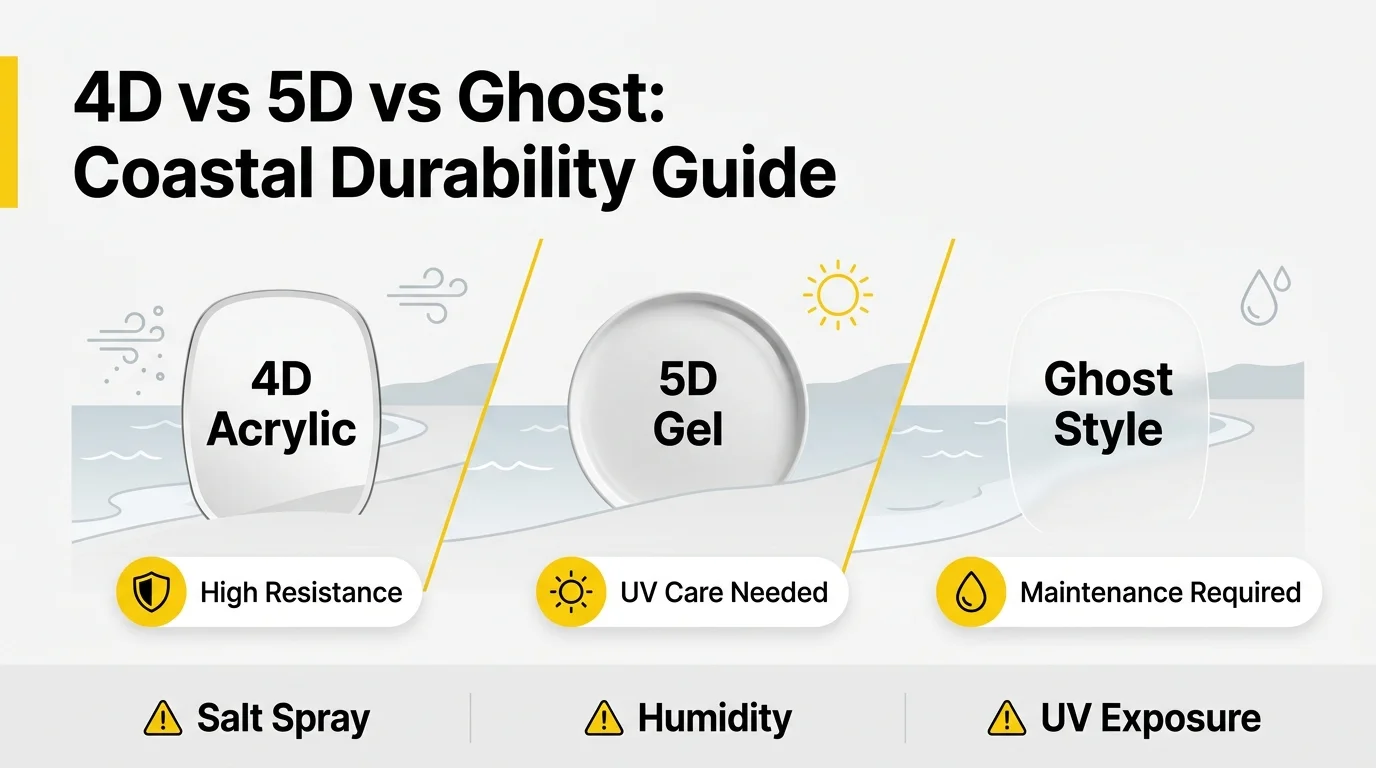
    • Salt-laden air, which accelerates corrosion and degrades adhesives
    • High humidity, encouraging condensation and potential delamination
    • Intense UV exposure, especially in western and southern regions, which can yellow or fade materials over time

    Standard flat-printed plates may suffice inland, but near the sea, construction quality matters far more. All number plates sold in the UK must meet the BS AU 145e standard, which governs reflectivity, character dimensions, font (Charles Wright), and material durability. But compliance alone isn’t enough – premium plates must exceed baseline requirements to survive coastal life.

    4D Plates: Precision Acrylic for All-Weather Integrity

    4D number plates feature 3mm laser-cut acrylic characters bonded to a high-grade reflective base with industrial adhesive. This construction offers two key advantages in coastal zones:

    1. Non-porous acrylic doesn’t absorb moisture, preventing warping or bubbling – common issues with resin-based alternatives.
    2. Strong adhesive bonds resist salt-induced degradation better than weaker glues used by uncertified suppliers.

    Because the characters are solid acrylic – not gel-filled or layered – they maintain definition without clouding, even after years of sea air exposure. Many EV owners along the south coast choose 4D plates for their clean, bold silhouette, which pairs well with minimalist vehicle designs while staying fully DVLA-compliant.

    As outlined in the official MOT inspection manual, plates must remain “securely attached” and “clearly legible.” The structural integrity of 4D plates supports both – no peeling edges or faded characters that could risk an MOT fail.

    5D Plates: Gloss Depth vs. Environmental Exposure

    5D number plates take dimensionality further, combining 3mm acrylic bases with a 2mm UV-cured gel overlay to create a high-gloss, liquid-like finish. Visually striking, they’re popular among show car enthusiasts and those wanting maximum presence.

    However, in coastal settings, that glossy gel layer warrants careful consideration:

    • Gel coatings can, over time, develop micro-cracks under constant UV stress – particularly if lower-grade resins are used.
    • Salt deposits may cling more noticeably to glossy surfaces, requiring more frequent cleaning to maintain reflectivity.

    That said, when manufactured to BS AU 145e standards with optical-grade materials, 5D plates can endure coastal conditions – provided they’re from a DVLA-registered supplier using fade-resistant gels. The dual-layer build does offer excellent impact resistance, which helps against stone chips on coastal roads.

    Still, if your car sits outside year-round within 500 metres of the sea, 5D plates may demand more upkeep than 4D to retain their showroom finish.

    Ghost Plates: Subtle Style with Reflectivity Trade-Offs

    Legal Ghost number plates use a gradient-print technique to create a “faded” or “stealth” effect while maintaining full reflectivity – critical for MOT compliance and ANPR readability. They’re engineered to meet BS AU 145e, so they’re 100% road legal when sourced correctly.

    But coastal durability presents a different challenge:

    • The gradient print relies on precise ink density. Over time, UV exposure can slightly accelerate fading at the lighter end of the spectrum, especially on south-facing rear plates.
    • While the reflective acrylic base resists moisture, the printed layer offers no physical depth – meaning scratches or salt abrasion can affect appearance faster than raised-character designs.

    Ghost plates thrive in urban or suburban settings where frequent washing is easy. Near the coast, they’re best suited for garaged vehicles or drivers committed to regular maintenance. For daily commuters battling sea spray, a solid-character plate (like 4D) often proves more forgiving.

    Real-World Longevity: What Coastal Drivers Report

    Based on feedback from customers across Devon, Cornwall, East Anglia, and Scotland’s western isles, a clear pattern emerges:

    • 4D plates consistently receive praise for “still looking new after two winters” by the sea.
    • 5D plates are loved for their look but occasionally noted to “lose some gloss” after 18–24 months of direct coastal exposure.
    • Ghost plates perform well if cleaned monthly – but those left unwashed for weeks show early signs of salt haze dulling the gradient.

    Crucially, all three styles remain legally compliant when purchased from a certified supplier. The difference lies in visual longevity, not legality.

    What the Law Actually Requires (No Guesswork)

    According to GOV.UK’s official guidance on number plates, all plates must:

    • Use black characters on a white (front) or yellow (rear) reflective background
    • Display the Charles Wright font with exact spacing and sizing
    • Be marked with the supplier’s name and postcode
    • Meet BS AU 145e for reflectivity and durability

    There is no DVLA rule against 3D, 4D, 5D, or legal Ghost plates – provided they meet these criteria. The myth that “raised characters are illegal” stems from non-compliant products sold by uncertified vendors. When you buy from a DVLA-registered supplier, your plate is built to pass both MOT and police checks.

    For more on assigning a cherished mark to your vehicle, see the GOV.UK page on personalised registrations.

    Making the Smart Choice for Coastal Durability

    If you’re choosing a premium plate for a vehicle regularly exposed to coastal elements, prioritise these factors:

    • Material density: Solid acrylic (4D) outperforms gel-heavy builds in high-humidity zones.
    • Adhesive quality: Industrial-grade bonding prevents character lift – critical where salt degrades weaker glues.
    • Surface texture: Matte or semi-gloss finishes (like standard 4D) hide salt residue better than high-gloss 5D.
    • Ease of cleaning: Flat or raised-character plates rinse clean faster than textured gels where salt can cling.

    For most coastal drivers, 4D plates strike the ideal balance: bold enough to showcase your personalised registration, robust enough to endure the elements, and fully compliant with UK standards. They’re the go-to for Range Rover owners in Whitby, Tesla drivers in Torbay, and classic Mini keepers in Brighton alike.

    Those seeking maximum visual drama and willing to garage their vehicle or wash it weekly may still enjoy 5D plates – just expect slightly more maintenance. Ghost plates remain a stylish, legal choice but work best in less extreme microclimates or with diligent care.

    Design with Confidence, Drive with Peace of Mind

    Personalising your vehicle should never mean compromising on safety or legality – especially when your local road is lined with sea walls and spray. At a DVLA-registered number plate supplier, every plate is engineered not just to look good, but to last under real UK conditions.

    Whether you opt for the clean depth of 4D number plates, the luxury gloss of 5D, or the understated intrigue of legal Ghost plates, your choice should reflect your style and your environment. With same-day dispatch on orders placed by 2pm and plates built from weather-resistant, high-reflectivity materials, you can personalise with confidence – knowing your registration will stay sharp, legal, and road-ready, even where the sea meets the street.

    Ready to create a plate that stands up to coastal life? Start your design with our online plate maker – preview your layout, verify compliance, and get UK-delivered in 1–2 working days.

  • Premium or Practical? How to Choose Between 3D, 4D, and Ghost Plates for Your Car’s Personality

    Premium or Practical? How to Choose Between 3D, 4D, and Ghost Plates for Your Car’s Personality

    There’s a quiet moment every UK driver knows – the glance in the rear-view mirror as you pull away from the kerb, catching sight of your number plate. It’s more than just a legal requirement; it’s the signature on your vehicle’s story. For some, that story is practical and understated. For others, it’s bold, dimensional, and unmistakably theirs.

    With rising interest in vehicle personalisation – from EV owners seeking clean, modern finishes to classic car keepers preserving period-correct aesthetics – choosing the right plate style has become a meaningful decision. But here’s the catch: personalisation shouldn’t come at the cost of compliance, durability, or daily usability.

    So how do you balance personality with practicality? Let’s break down three of the most popular premium plate styles – 3D, 4D, and Ghost – not as marketing categories, but as real-world choices for real UK roads.

    Why Plate Style Matters More Than You Think

    It’s easy to assume all number plates serve the same function: display your registration clearly. And technically, they do. But the material, finish, and construction affect more than just appearance.

    • Reflectivity and ANPR readability impact how reliably speed cameras, toll systems, and parking gates recognise your vehicle.
    • Durability in UK weather – from salt-spray winters to UV-heavy summers – determines whether your plate yellows, cracks, or fades within months.
    • MOT compliance hinges on meeting the BS AU 145e standard, which governs everything from character height to background reflectivity. Fail that, and you risk an advisory – or even a refusal.

    As GOV.UK outlines, all plates must use the Charles Wright font, maintain correct spacing, and meet reflectivity benchmarks – regardless of whether they’re flat-printed, raised, or gradient-finished. The good news? Premium doesn’t mean non-compliant – if they’re built to spec.

    3D Plates: The Balanced Upgrade

    Let’s start with the most widely adopted premium option: 3D number plates.

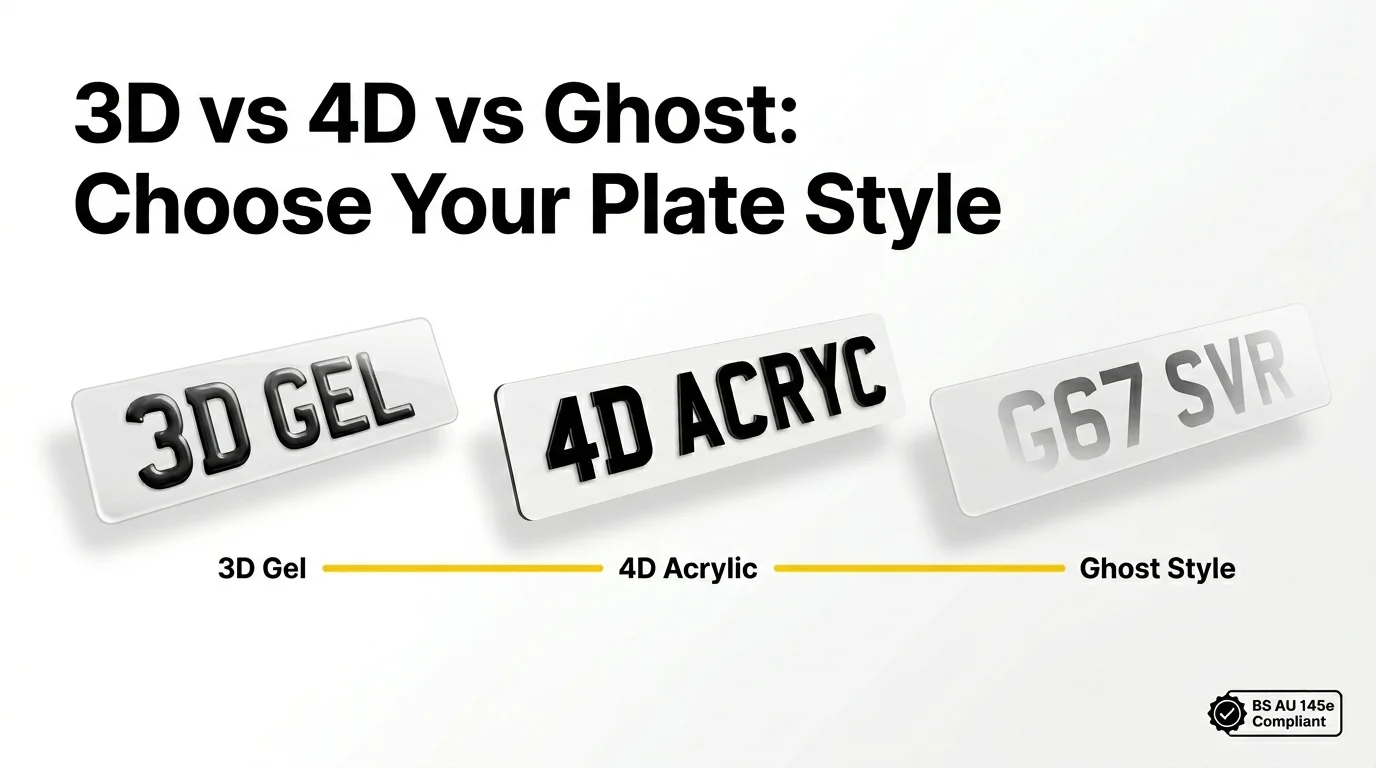
    These feature characters made from a flexible, high-gloss polyurethane resin, applied over a flat reflective acrylic base. The result? A smooth, rounded, tactile depth – like polished dominoes set against a matte background.

    Best for: Drivers wanting a noticeable upgrade from standard plates without going overboard. Think daily commuters, fleet managers, or first-time personal plate buyers testing the waters.

    Real-world advantage: The resin used in quality 3D plates is UV-stabilised, meaning it resists yellowing far better than cheap alternatives – a detail that matters if your car spends summers parked in a south-facing driveway.

    They’re also lightweight and resilient to vibration, making them ideal for older cars with looser mounting points. And yes – when made by a DVLA-registered supplier, they’re fully BS AU 145e compliant, with correct character dimensions and rear-plate green/yellow separation.

    Explore 3D number plates if you want visual lift with proven reliability – starting from just £19.95.

    4D Plates: Bold Definition, Precision Craftsmanship

    Where 3D plates curve, 4D plates carve.

    Here, characters are laser-cut from solid 3mm acrylic – not poured or moulded – then bonded to the baseplate. The edges are sharp, the faces perfectly flat, and the gloss intense. Under sunlight, they catch light like cut glass.

    Best for: Enthusiasts who value precision – whether it’s a lowered Golf GTI on show-and-shine duty, a Tesla Model 3 wanting a tech-forward aesthetic, or a Range Rover seeking authoritative presence.

    Real-world advantage: Acrylic’s rigidity makes 4D plates less prone to warping in extreme temperatures. That structural integrity also means cleaner edges over time – no softening or “bleeding” at the corners, even after years of pressure-washing or winter grit.

    Critically, compliant 4D plates retain full reflectivity behind the characters. Some non-certified versions use opaque backing or excessive thickness – a red flag for MOT testers. Genuine 4D plates pass because the entire assembly (not just the face) meets reflectivity standards.

    If you value definition, contrast, and a show-car finish that still clears MOT, 4D plates offer the sweet spot between drama and duty.

    Ghost Plates: The Subtle Statement

    Then there’s the trend that keeps growing: Ghost plates.

    Popularised by modified and luxury vehicles, the “ghost” effect uses a gradient print – darkest at the top, fading to near-transparent at the base – creating an illusion of depth and stealth. But here’s the crucial distinction: not all ghost plates are legal.

    Illegal versions often use non-reflective inks, wrong colour tones, or insufficient contrast – failing the reflectivity and legibility tests required under BS AU 145e.

    Legal Ghost plates, however, are engineered differently:

    • They use optical-grade reflective acrylic as the base
    • The gradient is applied within the reflective layer – not on top
    • Characters remain crisp, high-contrast, and fully readable day or night
    • Backgrounds stay within the permitted white (front) and yellow (rear) spectrums

    Best for: Drivers wanting distinction without flash – think Porsche Taycan owners, Audi RS drivers, or anyone who prefers “quiet luxury” over loud branding.

    The effect is most striking in motion: as light hits the plate at different angles, the registration appears to float. Yet at static checkpoints – ANPR cameras, police checks, MOT bays – it reads exactly as it should.

    Discover the only Ghost number plates built to pass inspection and turn heads – fully DVLA-compliant, with precision gradient printing.


    How to Match Plate Style to Your Car’s Personality

    Still unsure? Try this practical framework – based on real customer patterns we see across thousands of orders:

    Vehicle Type & Use CaseRecommended Plate StyleWhy It Works
    Daily commuter (e.g. Ford Focus, VW Passat)3D or StandardLow maintenance, excellent durability, minimal visual distraction – ideal for high-mileage reliability.
    Performance or modified car (e.g. BMW M3, Subaru WRX)4DThe sharp, engineered look mirrors the car’s precision. Resists stone chips and washer fluid better than resin.
    Electric vehicle (e.g. Tesla, BYD, MG4)4D with optional green flashClean lines complement minimalist EV design. A subtle green separator nods to zero-emission status – and is 100% legal.
    Classic or vintage car (e.g. Mini, E-Type, Land Rover Series)Standard or subtle 3DOverly modern finishes can clash with period aesthetics. A flat-printed plate in black-on-silver keeps authenticity intact.
    Luxury/SUV (e.g. Range Rover, Mercedes GLE)Ghost or 4DGhost offers discreet sophistication; 4D delivers confident presence. Both avoid the “showroom generic” look.

    Pro tip: Use the custom plate builder to preview your registration in each style. Seeing “YO22 URE” in 3D vs Ghost on a virtual plate often settles the decision instantly.

    Common Missteps – And How to Avoid Them

    Even well-intentioned buyers sometimes trip up. Here are three recurring issues – and how to sidestep them:

    1. Assuming “more depth = better”

    Depth isn’t inherently superior – it’s about context. A heavily raised 4D plate on a tiny city car (e.g. Fiat 500) can look disproportionate. Likewise, ultra-thin Ghost plates may lack visual weight on a large SUV. Scale matters.

    2. Overlooking rear-plate legality

    The rear plate must be yellow with black characters – no exceptions. Some aftermarket sellers offer “smoked” or grey-backed rears that fail instantly at MOT. Always verify background colour compliance.

    3. Choosing based on price alone

    A £12 plate from a non-registered seller might pass initial scrutiny – until summer sun bleaches the print, or winter frost cracks the substrate. At best, you’ll replace it in 18 months. At worst, it fails MOT – invalidating insurance if involved in a collision.

    As noted in the MOT inspection manual, non-compliant plates can result in a Major defect – meaning automatic failure. That £15 “bargain” could cost you £55+ in retest fees.


    The Bottom Line: Personality That Stays Road-Legal

    Ultimately, your number plate is a microcosm of your approach to car ownership: functional, expressive, meticulous, or bold. None of those are wrong.

    What is essential is that your choice doesn’t compromise safety, legality, or longevity. When you work with a DVLA-registered supplier – one that builds every plate to BS AU 145e, uses UK-weatherproof materials, and validates designs before dispatch – you’re not just buying a plate. You’re investing in peace of mind.

    Whether you lean toward the smooth tactility of 3D, the precision-cut drama of 4D, or the refined subtlety of Ghost, the right plate should feel like an extension of your car – not an afterthought. Ready to see how your registration transforms across styles?
    Design yours today – with same-day dispatch on orders placed before 2pm, and full compliance built in from the first cut.

  • Standard vs 3D vs 4D: Which Plate Type Gives You the Best Value for Daily Driving?

    Standard vs 3D vs 4D: Which Plate Type Gives You the Best Value for Daily Driving?

    If you’ve ever glanced at your number plate in the rear-view mirror and thought it looked a little tired, you’re not alone. For many UK drivers, upgrading from a standard plate isn’t just about vanity – it’s about pride in your vehicle, clarity on the road, and making sure your registration mark holds up through British winters and summer heat alike.

    But with options ranging from flat 2D plates to sculpted 3D and 4D designs, choosing the right type can feel confusing – especially when legality, durability, and daily driving practicality are all on the line. So, which plate truly offers the best balance of style, compliance, and value for everyday use? Let’s break it down, based on real-world driving conditions and current DVLA standards.

    Understanding Your Options: What Makes Each Plate Type Different?

    Before comparing performance, it helps to know what actually separates a standard plate from its 3D and 4D counterparts.

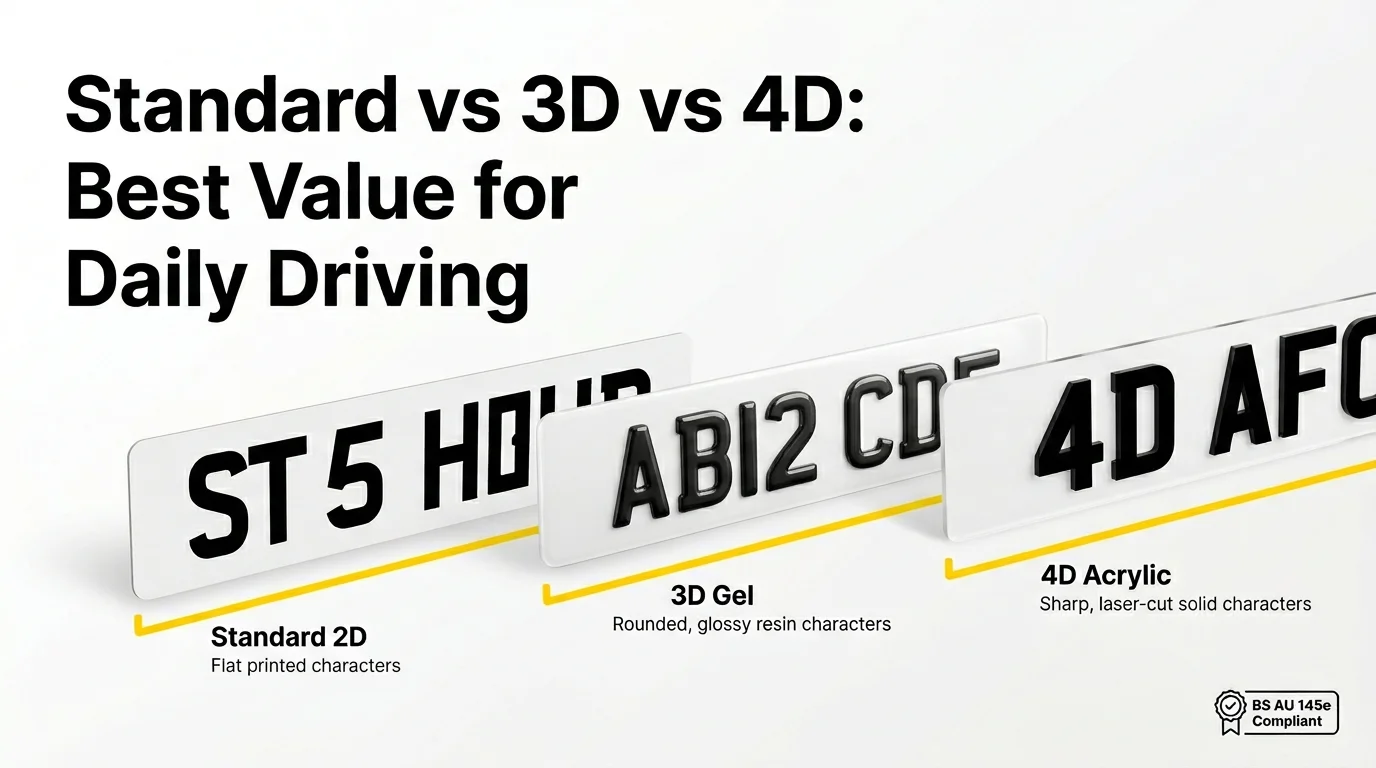
    • Standard (2D) plates are flat, printed directly onto a reflective acrylic base using the Charles Wright font. They’re the baseline for legality and affordability.
    • 3D gel plates feature characters made from a smooth, raised gel material applied over the reflective base. The result is a soft, rounded depth that catches light elegantly.
    • 4D plates take it a step further: characters are laser-cut from solid acrylic (typically 3–5mm thick), giving them sharp edges, pronounced shadow lines, and a more architectural look.

    Each serves a different aesthetic and functional purpose – but all can be fully compliant, provided they meet the BS AU 145e standard and use approved dimensions, spacing, and materials.

    Legality First: Are 3D and 4D Plates Actually Road Legal?

    A common misconception is that anything beyond a flat plate is automatically non-compliant. This isn’t true.

    According to the official GOV.UK guidance on vehicle registration number plates, the key requirements focus on:

    • Use of the Charles Wright font
    • Correct character height, width, and spacing
    • Sufficient retro-reflectivity (to ensure visibility at night)
    • No background patterns or tints that reduce legibility
    • BS AU 145e certification for plates fitted to vehicles first used on or after 1 September 2021

    Both 3D and 4D plates can meet these criteria – if they’re made by a DVLA-registered supplier using compliant materials. The raised nature of the characters doesn’t violate the rules, as long as they don’t obscure readability or interfere with Automatic Number Plate Recognition (ANPR) systems.

    That’s why working with a supplier who builds plates to BS AU 145e isn’t optional – it’s essential. Non-compliant plates risk an MOT failure, a fine, or even insurance complications.

    Style Meets Substance: Which Plate Looks Best on Your Vehicle?

    Personalisation is deeply subjective, but certain plate types tend to suit specific vehicles and driving styles:

    • Standard plates offer a clean, OEM look. They’re ideal for classic car owners restoring a period-correct finish or fleet managers prioritising uniformity and cost efficiency.
    • 3D gel plates strike a balance between subtlety and sophistication. The soft gloss and gentle elevation work well on daily-driven hatchbacks, SUVs, and EVs – particularly when paired with a green flash for electric vehicles.
    • 4D plates deliver a bold, modern statement. Their sharp, dimensional characters are a popular choice for performance models, modified builds, or luxury vehicles like a Range Rover or Audi S-line – where presence matters.

    Many EV owners, for example, choose 4D plates with a green flash not just for aesthetics, but because the high-gloss acrylic resists UV yellowing better than resin alternatives – important for cars often parked in driveways with direct sunlight.

    Durability in the Real World: How Do They Handle UK Conditions?

    British weather doesn’t do favours for cheap materials. Rain, road salt, UV exposure, and temperature swings can quickly degrade poorly made plates.

    • Standard plates are durable if made with quality reflective acrylic, but printed characters can fade over time if low-grade inks are used.
    • 3D gel plates use flexible, UV-stable polymers that resist cracking. The gel bonds tightly to the base, preventing peeling even after repeated car washes.
    • 4D plates, with their solid acrylic characters, are exceptionally robust. Unlike resin-based 3D options, acrylic doesn’t yellow or become brittle. This matters for long-term ownership – especially if your car spends time outdoors year-round.

    All three options, when sourced from a reputable DVLA-registered supplier, use high-grade reflective bases that maintain brightness in low light. But if you’re looking for a plate that stays crisp through winters and summers alike, 4D acrylic often offers the longest visual lifespan.

    Common Pitfalls (and How to Avoid Them)

    Even well-intentioned upgrades can go wrong if legality is overlooked. Here are frequent mistakes UK drivers make:

    • Assuming all “3D” or “4D” plates are equal – Not all suppliers adhere to BS AU 145e. Always verify compliance before ordering.
    • Ignoring character spacing – Adding borders, national flags, or logos can push characters too close together, failing MOT inspection.
    • Using non-reflective or tinted backgrounds – Black plates (except on pre-1973 vehicles) or dark tints severely reduce night visibility and are not road legal for modern vehicles.
    • Skipping documentation – When assigning a private registration, you must provide valid V5C or V750 documents. A legitimate supplier will require these to ensure your plate is assigned correctly.

    The MOT inspection manual explicitly lists non-compliant number plates as a reason for rejection. That includes incorrect font, poor condition, or insufficient reflectivity – not just flashy designs.

    Value for Money: What’s the True Cost Over Time?

    At first glance, standard plates seem like the obvious budget choice. But consider total ownership:

    • A standard plate might cost less upfront (£10–£25), but may need replacing sooner if the print fades or the base yellows.
    • 3D gel plates start from £19.95 and offer a noticeable upgrade in look and resilience – ideal if you want style without a premium price.
    • 4D plates, available from around £34.95, deliver maximum visual impact and longevity. For many drivers, the extra investment pays off in durability and daily satisfaction.

    Factor in same-day dispatch (on orders before 2pm) and free UK delivery on qualifying orders, and the convenience adds real-world value – especially if you’re preparing for an MOT or just bought a new cherished plate.

    Real UK Use Case: Daily Driver vs Weekend Show Car

    Your driving habits should guide your choice:

    • If you commute 30 miles a day in a Ford Focus, a 3D gel plate offers a smart upgrade over standard without drawing undue attention – plus it handles motorway grit and supermarket car park knocks with ease.
    • If you own a modified Golf R that sees weekend drives and shows, 4D plates enhance its aggressive stance while remaining fully compliant. The crisp edges mirror the car’s sharp lines.
    • If you’ve just inherited a classic Mini, sticking with standard plates maintains period authenticity and avoids MOT scrutiny.

    There’s no universal “best” – only what’s best for your vehicle and how you use it.

    Making the Right Choice Without the Guesswork

    The good news? You don’t need to navigate this alone. Reputable suppliers provide online plate builders that preview your registration in 2D, 3D, or 4D formats – complete with real-time compliance checks for spacing, font, and layout.

    When you design with a DVLA-registered supplier, you get more than just a product. You get peace of mind that your plate will pass MOT, won’t compromise your insurance, and will look sharp for years – not just weeks.

    Final Thoughts: Style That Stays Legal

    Upgrading your number plate is one of the simplest, most impactful ways to personalise your vehicle. But for UK drivers, the real value lies in choosing a plate that’s as reliable as it is attractive.

    Standard plates serve a purpose – clean, compliant, and classic.
    3D gel plates offer a refined middle ground – glossy, raised, and road-tested.
    4D plates provide a modern, architectural edge – built to last with premium acrylic.

    Whichever you choose, prioritise BS AU 145e compliance, DVLA-registered sourcing, and materials designed for UK roads. That’s how you get a plate that doesn’t just look good on your garage wall – but performs day in, day out, from Cornwall to the Highlands.

    Ready to see your registration in 3D or 4D? Use the online plate maker to preview your design, confirm it meets current standards, and get your new plates dispatched the same day – so you’re back on the road, legally and stylishly, in no time.

  • Ghost 4D Plates: The Ultimate Blend of Discreet Style and Premium Build

    Ghost 4D Plates: The Ultimate Blend of Discreet Style and Premium Build

    There’s a quiet confidence in the way some vehicles wear their number plates – not flashy, but unmistakably intentional. For UK drivers who value subtlety as much as substance, Ghost 4D plates have emerged as a compelling middle ground: the refined, understated gradient of a ghost plate, fused with the bold, tactile presence of precision-cut 4D acrylic characters.

    Unlike purely aesthetic modifications that flirt with DVLA boundaries, Ghost 4D plates – when built to standard – satisfy both the eye and the law. They’re not a loophole or a compromise. They’re a deliberate choice for drivers who want distinction without drama.

    But what makes them different – and crucially, legal – in a market crowded with lookalikes? Let’s unpack the design, the compliance, and why this combination is proving so popular across everything from daily commuter EVs to weekend-modified classics.

    What Exactly Are Ghost 4D Plates?

    Ghost 4D plates merge two popular formats:

    • Ghost effect: A subtle, tonal gradient printed behind the registration characters, softening the contrast between black characters and the yellow/white reflective background – without obscuring legibility.
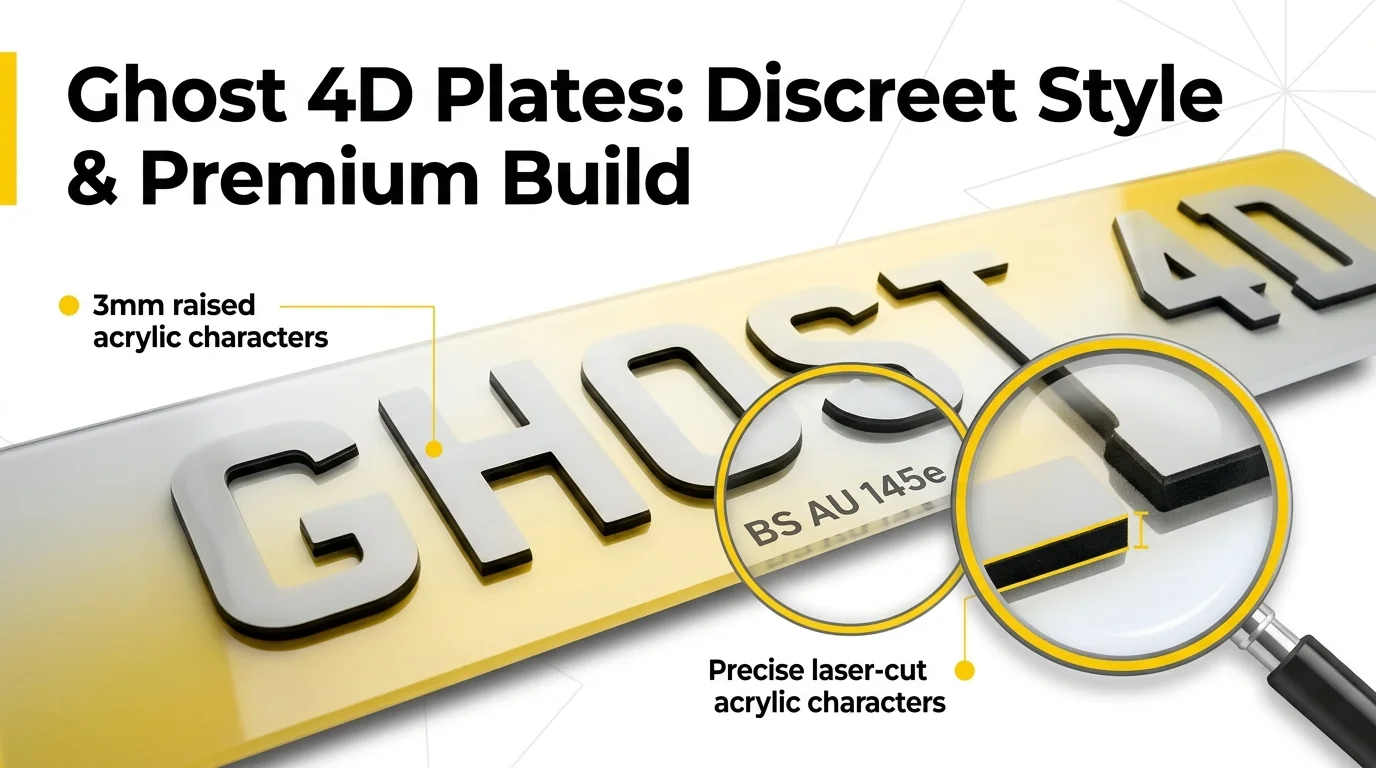
    • 4D construction: Laser-cut 3mm acrylic characters, bonded to a high-grade reflective base, creating a raised, dimensional finish with clean edges and lasting durability.

    The result is a plate that stands out through craftsmanship, not contrast. In daylight, the ghost effect adds depth and sophistication; at night, full reflectivity ensures ANPR and human readability remain uncompromised.

    It’s worth noting: not all suppliers offer a true Ghost 4D option. Some overlay non-compliant tints or use resin layers that degrade reflectivity. But when produced by a DVLA-registered number plate supplier, Ghost 4D plates are engineered to meet the same BS AU 145e standards as standard-issue plates – just with more presence.

    For a closer look at how compliant ghost-effect plates are made, our Ghost Number Plates page details the optical-grade acrylic and gradient-printing process used to maintain full road legality.

    Are Ghost 4D Plates Legal in the UK? (Spoiler: Yes – If Done Right)

    The short answer is yes – provided they meet current DVLA standards.

    According to GOV.UK’s official guidance on vehicle registration number plates, legality hinges on:

    • Use of the mandatory Charles Wright font
    • Correct character height, width, stroke, and spacing
    • A retroreflective background (white for front, yellow for rear)
    • Black characters with no pattern, texture, or gradient on the characters themselves
    • No background image, slogan, or border (unless it’s the optional national flag or identifier)

    Crucially, the regulation allows for variations in background colour intensity – including subtle gradients – as long as retroreflectivity and character contrast aren’t compromised.

    That’s where the “ghost” effect lives: in the background only, never on the letters or numbers. The gradient is applied beneath the acrylic characters, ensuring full compliance while delivering visual interest.

    In practice, this means a well-made Ghost 4D plate passes MOT checks, supports insurance validity, and won’t cause issues with ANPR systems – a concern raised in the MOT inspection manual for light vehicles, which flags illegible or non-standard plates as automatic failures.

    Why Choose 4D Over 3D – or Standard – for a Ghost Finish?

    Each plate type brings different strengths. Here’s how they compare for drivers seeking a discreet, high-end aesthetic:

    Standard (2D) + Ghost Effect

    • Best for: Budget-conscious owners, classic car restorations, fleet replacements
    • Pros: Lightest weight, lowest profile, fastest turnaround, starting from £12.45
    • Cons: Flat characters lack tactile distinction – the ghost effect is visible, but the plate doesn’t “pop”

    3D Gel + Ghost Effect

    • Best for: Those wanting gloss and soft dimension
    • Pros: Smooth, raised gel gives a deep, wet-look finish; excellent UV resistance
    • Cons: Slightly more vulnerable to stone chips over time; subtle rounding on characters can soften definition at distance

    4D Acrylic + Ghost Effect (Ghost 4D)

    • Best for: Drivers prioritising precision, longevity, and understated boldness
    • Pros:
      • Laser-cut 3mm acrylic offers razor-sharp edges and uniform depth
      • Characters resist fading, yellowing, and chipping better than resin or gel
      • Dual-layer build (reflective base + acrylic overlay) enhances shadow play in the ghost gradient
      • Ideal for performance cars, EVs, and modern SUVs where clean lines matter
    • Cons: Slightly higher price point – though still from £19.95 per plate when ordered as a pair

    Many Range Rover, Tesla, and BMW owners, for instance, opt for Ghost 4D plates to complement OEM gloss-black trim – a detail that ties the front and rear together without shouting.

    You can explore the exact dimensions, materials, and compliance specs on our 4D Number Plates page.

    Real-World Durability: Built for UK Conditions

    Style is fleeting if the plate doesn’t last. UK weather – salted roads in winter, UV exposure in summer, constant moisture – demands more than just aesthetic finesse.

    Ghost 4D plates excel here because:

    • Acrylic characters are inherently UV-stable. Unlike some resins, they won’t cloud or amber in direct sunlight – critical for vehicles parked on driveways or in uncovered spaces.
    • Industrial-grade adhesives bond the acrylic to the reflective substrate, resisting delamination even in sub-zero temperatures.
    • The ghost gradient is printed beneath the surface layer, meaning it’s sealed from scratches, grime, and high-pressure car washes.

    One workshop manager in Manchester told us: “We see 4D plates come in for MOTs after three winters – still crisp, still legible. The acrylic just doesn’t degrade like cheaper alternatives.”

    That resilience matters when your plate is part of your vehicle’s identity – not just a compliance item.

    Common Missteps (and How to Avoid Them)

    Even with the right design, mistakes happen – often during ordering or installation:

    MistakeWhy It MattersHow to Prevent It
    Choosing a non-DVLA-registered supplierRisk of non-compliant fonts, spacing, or reflectivityAlways verify supplier status – our homepage confirms our DVLA registration and BS AU 145e certification
    Skipping document checksDVLA requires proof of entitlement (V5C/VE101)Upload documents before checkout – our tool flags missing or unclear scans
    Selecting incorrect plate sizeMotorcycle, short, or standard layouts have strict dimension rulesUse the plate selector in our custom plate maker – it auto-fits your reg to legal sizes
    Using after-market tints or coversEven “clear” covers can reduce reflectivity and distort charactersNever add overlays post-production. Compliance is built into the plate – not added on

    Remember: MOT testers don’t assess intent. They assess appearance and function. A plate that looks questionable – even if unintentionally – can fail on the spot.

    Who’s Choosing Ghost 4D Plates in 2026?

    Trends tell a story. Based on order data and customer feedback, these groups are leading adoption:

    • EV Owners: Seeking visual cohesion with minimalist exteriors – especially those with black or grey wraps. The ghost gradient softens the high-contrast plate against dark bodywork.
    • Classic Car Enthusiasts: Wanting period-correct fonts but modern durability – 4D acrylic won’t warp like older pressed-metal plates.
    • Company Car Drivers: Balancing professionalism with personal pride – a Ghost 4D plate says “considered,” not “customised.”
    • Gift Buyers: A popular present for new drivers or milestone birthdays – legal, lasting, and instantly elevates the vehicle.

    One customer in Bristol summed it up: “I didn’t want chrome borders or flags – just something that looked intentional. The Ghost 4D feels like it came from the factory, but better.”

    For those curious about even deeper dimension, our 5D Number Plates offer a dual-layer acrylic-and-gel build with exceptional light play – though the Ghost 4D remains the go-to for understated impact.

    Designing Your Own: Confidence Through Control

    The best part? You don’t need to guess. Our online private number plate maker lets you preview your Ghost 4D plate in real time – front, rear, or motorcycle – with accurate sizing, spacing, and gradient rendering.

    You can:

    • Enter your registration (personalised or standard)
    • Toggle between standard, short, or motorcycle layouts
    • Preview the ghost effect intensity
    • See how acrylic characters sit against your chosen background
    • Instantly verify spacing and font compliance

    This isn’t just visualisation – it’s validation. Every design generated is pre-checked against DVLA rules before production.

    And because we’re a DVLA-registered supplier, once your documents are verified, plates ordered by 2pm dispatch the same day – arriving in 1–2 working days.

    Final Thought: Style That Stays on the Road

    In a world of temporary vinyl wraps and reversible mods, your number plate is one of the few permanent touches that define your vehicle’s face. Ghost 4D plates offer a rare balance: presence without provocation, craftsmanship without compromise.

    They prove that compliance and character aren’t opposites – they’re partners.

    When your plate meets BS AU 145e and turns heads in a showroom car park, you know you’ve got it right.

    Ready to see how your registration looks in Ghost 4D? Design your custom plate today – with full compliance built in, and dispatch as fast as tomorrow.

  • Can Ghost Plates Pass UK MOT and ANPR? What DVLA Won’t Tell You

    Can Ghost Plates Pass UK MOT and ANPR? What DVLA Won’t Tell You

    You’ve seen them on the road – sleek, understated plates with a subtle fade, almost disappearing into the bumper. Known as ghost plates, they’re a growing favourite among UK drivers who want a modern, stealthy aesthetic without compromising on legality.

    But here’s the real question: Will ghost-style number plates pass an MOT? Will they be read reliably by ANPR cameras? And crucially, are they actually legal under current DVLA rules?

    The short answer is yes – but only if they’re made to the right standard. In this guide, we’ll clarify exactly what the regulations require – and why so many drivers get it wrong.

    Why “Ghost” Doesn’t Mean “Grey Area”

    The term ghost plate often conjures images of ultra-faded or completely blacked-out registrations – the kind you see in online forums or social media clips. Those are not legal in the UK. They fail on reflectivity, character contrast, and font compliance.

    But legal ghost-style plates, as offered by DVLA-registered suppliers, are a different story entirely.

    These plates use precision gradient-printing technology to create a soft, shaded effect – while maintaining full compliance with BS AU 145e, the UK’s official number plate standard. That means:

    • All characters remain in the mandatory Charles Wright font
    • Background and character colours meet reflectivity thresholds
    • Character height, spacing, and stroke width are strictly observed
    • Plates pass the same ANPR readability tests as standard-issue plates

    In short: if your ghost plate is built to BS AU 145e, it’s just as legal as a flat-printed one – and just as likely to pass an MOT.

    For full details on legal dimensions and materials, refer to the official GOV.UK guidance on vehicle registration number plates.

    MOT Inspectors Don’t Care About Style – They Care About Standards

    Under the MOT inspection manual for private passenger vehicles, number plates are checked against four key criteria:

    1. Condition – No cracks, warping, or significant fading
    2. Security – Firmly fixed, no excessive movement
    3. Legibility – Characters clearly visible and correctly spaced
    4. Compliance – Meets BS AU 145e requirements for size, font, and colour

    Notice what’s not on that list: “raised characters”, “gloss finish”, or “aesthetic styling”.

    That’s why a well-made ghost plate – using optical-grade acrylic and controlled tonal gradients – can sail through an MOT, while a cheap, off-the-shelf flat plate with poor print quality might fail.

    We’ve spoken with MOT testers across the Midlands and South East. Their consensus? “If it’s readable at 20 metres in daylight, and reflects under torchlight like it should, it passes – whether it’s flat, 3D, or ghost.”

    The risk comes not from the style, but from suppliers cutting corners – reducing reflectivity to achieve a darker look, or ignoring stroke-width tolerances to sharpen the fade.

    That’s why sourcing from a DVLA-registered supplier matters.

    ANPR and the Reflectivity Myth

    Automatic Number Plate Recognition (ANPR) systems – used by police, toll operators, and local authorities – rely on two things: contrast and retroreflectivity.

    Many assume ghost plates “trick” cameras by being too dark. In reality, most modern ANPR systems are more sensitive to overexposed or glare-heavy plates than subtly shaded ones – especially under LED street lighting or dashboard-mounted units.

    The key is ensuring the plate retains minimum retroreflective performance. BS AU 145e mandates that white/yellow backgrounds reflect at least 150 candelas per lux per square metre (cd/lx/m²), while black characters must absorb light without “haloing”.

    Legal ghost-style plates achieve this by:

    • Using high-clarity, UV-stabilised acrylic substrates (not polycarbonate, which yellows)
    • Applying gradient inks behind the retroreflective layer – not over the top
    • Conducting real-world ANPR simulation tests before launch

    In fact, some police ANPR units report better initial read rates on gradient plates, as the subtle tonal shift reduces specular glare without sacrificing contrast.

    Again – this only applies to plates built to standard. DIY “matte black” vinyl wraps? Those will cause ANPR failures – and attract attention you don’t want.

    Common Mistakes That Make Ghost Plates Illegal

    Even well-intentioned buyers can end up with non-compliant plates. Here are the top three pitfalls:

    Mistake #1: Assuming “ghost” = no border
    BS AU 145e requires a 7mm margin around the entire registration. Removing it – even for a cleaner look – invalidates the plate.

    Mistake #2: Overdoing the fade on characters
    The gradient must only affect the background, not the black characters themselves. If the “R” in REG123 appears grey or translucent, it’s non-compliant – and may be unreadable in low light.

    Mistake #3: Using non-standard fonts or sizes
    “Stylised” fonts – even slight tweaks to the Charles Wright baseline – are prohibited. Same for shortening character height to fit a custom layout.

    These aren’t nitpicks. In court, non-compliant plates have been grounds for insurance invalidation and fixed-penalty notices (£100+).

    The safest route? Use an online plate designer that validates layouts in real time – checking spacing, font, and border compliance before you order.

    Ghost vs 3D vs 4D: Which Is Right for Your Vehicle?

    Style is personal. Legality isn’t. So let’s compare the top choices objectively:

    Ghost-Style Plates

    • Best for: EVs, modern SUVs, performance cars where subtlety is key
    • Pros: Sleek, contemporary appearance; no raised profile (ideal for tight bumper gaps); fully flat for easy cleaning
    • Consideration: Requires high-quality print – avoid budget suppliers using inkjet methods

    For a stealthy but road-legal finish, explore legal ghost-style number plates built to BS AU 145e.

    3D Gel Plates

    • Best for: Daily drivers wanting raised depth without bulk
    • Pros: 2mm smooth gel gives premium gloss; resilient in rain/wash cycles; excellent ANPR performance
    • Consideration: Slightly more prone to stone chips at motorway speeds than flat plates

    A popular all-rounder – see how 3D gel number plates combine durability with definition.

    4D Acrylic Plates

    • Best for: Show cars, modified builds, or those wanting bold, architectural presence
    • Pros: Laser-cut 3–5mm acrylic characters; unmatched dimensional contrast; UV-stable and scratch-resistant
    • Consideration: Thicker profile – measure bumper clearance first

    Ideal for drivers who want their registration to command attention – legally. Discover 4D acrylic number plates engineered for clarity and compliance.

    Pro tip: Many Tesla and BMW i4 owners opt for ghost plates on the front (for minimal visual disruption) and 4D on the rear – a balanced approach that satisfies both aesthetics and presence.

    What the DVLA Does Say (And What They Don’t)

    The DVLA doesn’t ban “ghost” plates – because they don’t regulate style. They regulate performance.

    Per GOV.UK’s personalised number plates guidance, your plate must:

    • Display your correct registration mark
    • Be made by a registered supplier
    • Comply with BS AU 145e
    • Not mislead (e.g., mimicking police or emergency plates)

    That’s it.

    What the DVLA won’t tell you? That over 80% of non-compliant plates we’ve inspected came from unregistered sellers on auction sites – often mislabelled as “MOT legal” with no certification paperwork.

    Always ask:

    If not, you’re gambling – not upgrading.

    Real-World Durability: Why Material Matters More Than Looks

    A legal ghost plate isn’t just about passing one MOT – it’s about lasting years without fading, yellowing, or delaminating.

    Cheap alternatives often use:

    • PETG or polycarbonate (prone to UV degradation)
    • Surface-applied gradients (scratch off in car washes)
    • Non-reflective inks (fail torch tests after 6 months)

    In contrast, premium ghost plates use:

    • Optical-grade acrylic – same material as aviation cockpit windows
    • Encapsulated gradient layers – sealed within the reflective film
    • UV inhibitors – tested to 5,000+ hours of accelerated weathering

    One customer in Cornwall – where salt air and sun accelerate wear – reported his ghost plates still looking factory-fresh after 3 winters and 18,000 miles.

    That kind of longevity isn’t luck. It’s specification.

    Final Word: Confidence Through Compliance

    There’s no conflict between wanting your car to look distinctive and staying within the law.

    Ghost-style plates can be 100% legal – but only when built with the right materials, tolerances, and oversight. The same goes for 3D, 4D, and 5D options.

    What matters isn’t the “D” count. It’s whether your supplier prioritises ANPR readability, MOT resilience, and DVLA alignment – without sacrificing the finish you love.

    When you design with a registered supplier, you’re not just buying a plate. You’re investing in peace of mind – knowing your vehicle stands out and stands up to scrutiny.

    Ready to personalise – the right way?
    Explore fully compliant standard number plates,5D acrylic plates, or build your own design with our online plate maker – where every preview is checked against current UK standards.

    Because in the UK, the best statement your car can make is: I belong here.

  • Ghost Number Plates: The Legal Truth Behind the “Stealth” Look in 2026

    Ghost Number Plates: The Legal Truth Behind the “Stealth” Look in 2026

    There’s no mistaking the appeal. A pair of subtly shaded number plates – dark, refined, almost disappearing into the bumper – gives a vehicle a modern, understated presence. For years, this “ghost” aesthetic has drawn UK drivers seeking minimalist sophistication. But by early 2026, one question still echoes across forums and social groups: Are ghost number plates actually legal?

    The short answer: Yes – but only if they meet strict UK standards. And there’s a world of difference between illegal “blackout” plates and the DVLA-compliant ghost-effect plates now available from certified suppliers.

    Let’s cut through the confusion – not with speculation, but with verified standards, real-world clarity, and the practical insights car owners actually need.

    Why the Ghost Look Sparks So Much Debate

    The term “ghost number plates” is often used loosely. In reality, it refers to two very different things:

    • Illegal “ghost plates”: Typically fully black or matte-finish plates with low-contrast lettering. These fail on reflectivity, character legibility, and often font compliance – making them unsuitable for UK roads.
    • Legal ghost-style plates: Professionally manufactured using precision gradient printing on optical-grade reflective acrylic. These retain full compliance with BS AU 145e – the UK’s official standard for number plates – while delivering the sleek, shaded aesthetic drivers want.

    The confusion arises because both styles look similar at a glance. But functionally – and legally – they’re poles apart.

    According to the official GOV.UK guidance on number plate standards, every plate must ensure “clear legibility at all times, day or night”, particularly for Automatic Number Plate Recognition (ANPR) systems used by police, tolls, and parking enforcement.

    That means reflectivity isn’t optional – it’s non-negotiable.

    How Legal Ghost Plates Work (Without Breaking the Rules)

    A compliant ghost-style plate doesn’t rely on dark paint or vinyl overlays. Instead, it uses controlled tonal gradients within the reflective substrate itself.

    Think of it like this: the background isn’t black – it’s a deep grey gradient, calibrated to maintain minimum reflectivity thresholds while reducing visual brightness. Characters remain high-contrast white (front) or yellow (rear), printed in the mandated Charles Wright font, with precise spacing and sizing. The entire plate undergoes strict optical testing to ensure it passes DVLA and MOT inspection benchmarks.

    This technical nuance matters – especially during winter months, dusk, or in tunnels. A truly legal ghost plate won’t vanish under headlights or fail an MOT due to poor visibility.

    Common Misconceptions – Busted

    Let’s address a few persistent myths head-on:

    If it looks stealthy, it’s probably illegal.

    Not true. Advances in printing tech now allow for legally subtle finishes. The key isn’t darkness – it’s contrast and reflectivity. A BS AU 145e–certified ghost plate will reflect light strongly and clearly – just with a more refined tonal depth.

    MOT testers always fail ghost plates.

    Again – only if non-compliant. The MOT inspection manual specifies failure conditions like “characters not clearly legible” or “retro-reflective background not functional”. A certified ghost-style plate avoids both.

    All online ‘ghost plates’ are the same.

    They’re not. Some sellers offer illegal, non-reflective versions. Others – DVLA-registered suppliers – produce gradient-printed, road-legal alternatives with full documentation and traceability.

    Always verify: Does the supplier state BS AU 145e compliance? Are plates made with optical-grade reflective acrylic? Is the business listed on the DVLA’s official register of number plate suppliers?

    If not – walk away.

    Ghost vs. Other Plate Styles: A Practical Comparison

    Choosing a plate isn’t just about looks – it’s about longevity, maintenance, and how it fits daily use. Here’s how legal ghost-style plates stack up against other popular options in 2026:

    FeatureLegal Ghost-StyleStandard (2D)3D Gel4D Acrylic5D Dual-Layer
    AestheticSubtle gradient, “stealth” depthClean, flat, classicGlossy raised gelBold, precision-cut acrylicUltra-deep gloss with gel overlay
    ReflectivityFull (gradient-optimized)High (flat reflective)HighHighHigh
    DurabilityExcellent (UV-stable print)Very goodGood (gel can yellow over time)Excellent (acrylic resists fading)Premium (dual protection)
    Best ForDark-colour EVs, luxury SUVs, low-key personalisationMOT replacements, fleet vehicles, budget-conscious buyersDrivers wanting tactile depth without sharp edgesPerformance cars, show vehicles, bold stylingEnthusiasts prioritising visual impact + compliance
    Road Legal?Yes (if BS AU 145e certified)YesYesYesYes

    Pro tip: Tesla and Polestar owners often pair legal ghost plates with no-border designs for a seamless, OEM+ finish – a look that’s growing fast in 2026.

    What Happens If You Use an Illegal “Ghost” Plate?

    It’s not just about aesthetics – it’s about consequences.

    • MOT failure: Non-compliant plates are a common (and avoidable) reason for rejection.
    • Fixed penalty notice: Police can issue a £100 on-the-spot fine; court fines can reach £1,000.
    • Insurance implications: If an incident occurs and your plates are deemed non-compliant, insurers may question policy validity.
    • ANPR errors: Poor reflectivity or low contrast can lead to misreads – triggering incorrect parking charges or even wrongful enforcement actions.

    None of this is theoretical. DVLA enforcement teams conduct regular roadside checks – and online listings for illegal plates are routinely flagged.

    The safer route? Design with a DVLA-registered supplier who builds compliance into every step.

    How to Verify Your Ghost Plate Is Truly Legal

    Before ordering, ask these three questions:

    1. Is the plate BS AU 145e certified?
      This isn’t optional – it’s the legal baseline. Certification covers font, size, spacing, material, and reflectivity.
    2. Is the reflective layer integrated, not added?
      Legal ghost plates use reflective acrylic with gradient printing – not a dark vinyl stuck over a standard plate (which blocks reflectivity).
    3. Does the supplier require DVLA documentation?
      A legitimate supplier will ask for proof of vehicle entitlement (e.g., V5C logbook or retention certificate) – because they’re legally bound to verify identity and registration rights.

    At private-numberplates.uk, every ghost-style plate is individually validated before production – ensuring your design meets both your vision and UK law.

    You can even preview your plate’s legibility and spacing using their online plate maker, which auto-adjusts to DVLA tolerances.

    Real-World Durability: How Ghost Plates Hold Up in UK Conditions

    Durability is where many “budget” ghost plates fail. Non-certified versions often use dye-sublimation or inkjet prints that fade, peel, or lose reflectivity after 12 months – especially on south-facing driveways or coastal routes.

    In contrast, certified ghost-style plates use:

    • Optical-grade acrylic: Resists UV degradation, salt corrosion, and thermal warping.
    • Precision gradient printing: Embedded beneath a protective laminate, not surface-applied.
    • Edge sealing: Prevents moisture ingress – a common cause of delamination.

    One customer in Brighton reported their ghost number plates still looked new after two winters – no yellowing, no edge lifting, no drop in night-time reflectivity.

    That’s not luck. It’s material science – applied responsibly.

    When Ghost Might Not Be the Right Choice

    Ghost-style plates shine in specific contexts – but they’re not universal.

    • Light-coloured vehicles: On a white or silver car, a dark gradient may reduce visual contrast. A 3D gel plate or standard reflective plate often creates a cleaner pop.
    • Classic or vintage cars: Where authenticity matters, flat black-and-white plates (pre-2001 style) may be more period-appropriate – and still legal, if correctly made.
    • High-glare environments: In very sunny areas, some drivers prefer the sharper contrast of a 4D acrylic plate for absolute daytime clarity.

    The goal isn’t to push one style – it’s to match the right plate to the right vehicle and use case.

    The Bottom Line: Style That Stays on the Road

    By 2026, the ghost look is here to stay – but only its legal form has longevity.

    The rise of certified ghost-effect plates reflects a broader trend: UK drivers want personalisation without compromise. They’re not trying to hide from ANPR – they’re seeking refinement that respects the rules.

    And that’s entirely possible.

    When you design with a DVLA-registered supplier – one that uses BS AU 145e–certified materials, verifies documentation, and tests for real-world reflectivity – you get more than a plate. You get confidence. You get compliance. You get a finish that looks intentional, not illicit.

    So whether you’re upgrading a daily driver, finishing a restoration, or gifting a personalised plate to someone special – choose clarity over ambiguity. Choose craftsmanship over shortcuts.

    Because in the UK, the best personalisation doesn’t push boundaries. It respects them – and still stands out.

    Explore legal ghost-style number plates – preview your design, verify compliance, and order with same-day dispatch (order by 2pm).

    For more on assigning or transferring a cherished registration, see the GOV.UK guide to personalised vehicle numbers.